Wednesday, February 26, 2020

Best Business Insurance for 2020

Hopefully, you’ll never have to use your business insurance. But just like car insurance or health insurance, protecting your business from unexpected situations is crucial.

However, 44% of small business owners don’t have insurance.

This statistic is shocking. If you’re uninsured or underinsured, your company could potentially go bankrupt if something goes wrong, and you’re forced to pay out of pocket.

Any business with employees needs to carry workers’ compensation insurance and unemployment insurance, at a minimum. But depending on your business type and industry, you’ll also want to consider getting general liability insurance, commercial property insurance, and professional liability insurance.

But finding the best business insurance goes beyond getting the right policy. Getting insured through the right company makes a huge difference.

From filing a claim to getting assistance with your agent or adjuster, service definitely varies from company to company. Some business insurance companies specialize in specific industries, such as retail, restaurants, or tech. Other companies concentrate on certain types of coverage, like commercial auto or workers’ compensation.

Top 10 Best Business Insurance Companies For 2020

The best business insurance policies offer a wide range of basic coverage. Ideally, you’d like to get a policy covering all of your needs under one roof.

After reviewing and researching dozens of business insurance companies, we narrowed down the top ten for you to consider.

  • The Hartford
  • Travelers
  • State Farm
  • Chubb
  • Progressive
  • Liberty Mutual
  • AmTrust Financial
  • Founder Shield
  • Farmers Insurance
  • Allstate

Our list is based on factors like coverage offered, premium pricing, and customer service. Use this guide to find the best business insurance company for you.

The Best Business Insurance Reviews

The Hartford

The Hartford is the best overall business insurance company on the market today. Covering businesses of all different shapes and sizes, The Hartford has everything you could possibly need.

For over 200 years, this company has been providing insurance solutions to businesses across the country. They’ve also made the list of the World’s Most Ethical Companies 11 different times.

The Hartford offers a wide range of business insurance policies, including:

  • General liability insurance
  • Commercial property insurance
  • Business income insurance
  • Professional liability insurance
  • Data breach insurance
  • Commercial umbrella insurance
  • Commercial auto insurance

From a bodily injury on one of your properties to stolen inventory, fires, or floods, The Hartford has you covered.

It’s easy for you to bundle different types of insurance with add-ons to a single policy. You can apply online to get a quote in minutes.

The Hartford is known for providing exceptional service to its business customers during the claims process. You can’t go wrong by getting a quote from an industry leader in business insurance.

Travelers

Travelers is another giant in the world of business insurance. The company covers a wide range of industries, including construction, finance, manufacturing, retail, technology, and more.

With more than 30,000 employees and roughly 13,500 independent agents and brokers, Travelers insures businesses across the United States, Canada, Ireland, and the UK.

This insurance company has been around for more than 160 years.

In addition to industry-specific policies, Travelers provides lots of different coverage types. Some of the most popular Travelers business insurance solutions cover:

  • General liability
  • Workers’ compensation
  • Management and professional liability
  • Cyber liability
  • Commercial auto and trucking
  • Surety bonds
  • Environmental liability
  • Boiler and machinery
  • Excess casualty and umbrella

With that said, the workers’ compensation insurance policies from Travelers really stand out the most. More than 500,000 businesses trust Travelers for workers’ comp insurance.

Whether you’re a small local business or national organization with employees across multiple states, Travelers is a top choice to consider for workers’ compensation and general liability.

State Farm

State Farm is typically associated with home insurance and car insurance. They are best known for providing excellent customer service at affordable rates to their customers.

This service and reliability definitely applies to their business insurance plans as well.

State Farm has policies designed specifically for small business owners:

  • Business owners policy
  • Professional liability
  • Commercial liability umbrella
  • Workers’ compensation
  • Individual health
  • Business and commercial auto
  • Small business life

With State Farm, it’s easy for you to adjust your coverage as your company grows. Your agent will work with you to understand the needs of your scaling small business. This will ensure that your coverage limits are appropriate for the business size.

From the startup stage all the way until a company sale or change of ownership, State Farm has everything a small business owner needs to protect themself from the unexpected.

Chubb

Chubb is second to none when it comes to taking care of their insureds. This insurance company has a reputation for providing “white glove” service and paying out claims quickly, without any hassle.

Chubb has business insurance coverages that aren’t offered by other companies on the market today. In addition to general liability and workers’ compensation, Chubb has business insurance packages in the following categories:

  • Accident and health
  • Cyber
  • Environmental
  • Excess and surplus
  • Global casualty
  • International solutions for mid-sized companies
  • Management liability
  • Marine
  • Medical liability
  • Product recall
  • Professional liability
  • Railroad liability
  • Surety
  • Trade credit and political risk

As you can see, the list includes some rare and unique coverage options that we haven’t really seen from other providers in this guide.

Between Chubb’s excellent customer service and wide range of coverage options, you can expect to pay a little bit more on your business insurance premiums.

Chubb is best for businesses in need of international coverage. So if you’re traveling for work or making transactions outside of the US, consider Chubb for your insurance needs.

Progressive

Like most insurance companies, Progressive has several different business insurance policies and coverage types. They provide general liability insurance, professional liability, cyber insurance, workers’ compensation, and business owner’s policy.

With that said, Progressive’s specialty is commercial auto insurance.

  • Truck insurance
  • Pickup truck insurance
  • Van insurance
  • Box truck insurance
  • Tow truck insurance
  • Cars and SUVs
  • Commercial trailers

More than one million commercial vehicles in the United States are insured by Progressive. Basically, any vehicle used for business purposes can get insurance protection from Progressive.

As the country’s most popular business auto insurance company, the rates are actually pretty affordable. Progressive’s average commercial customer pays $165 per month for business auto. You’ll even get 15% off if you pay your premiums in advance.

In addition to the coverage provided by Progressive, the company will be there when you need them. Adding a driver, vehicle, or changing a policy is quick and easy. Progressive has 24/7 commercial auto service.

Progressive’s claim experts will help get your vehicles back on the road as soon as possible to limit business interruptions in the event of an accident.

If your company has vans, trucks, drivers, or any vehicles on the road for business purposes, Progressive will be a top choice for business auto insurance.

Liberty Mutual

Liberty Mutual is another well-known name in the insurance industry. The company provides small business insurance coverage as well as mid-to-large size business protection. Liberty Mutual even insures Fortune 500 corporations.

With more than 50,000 employees and 800+ offices throughout the world, Liberty mutual is a top provider of preferred property and casualty business insurance.

Some of the top coverage options include:

  • Equipment breakdown insurance
  • Excess liability insurance
  • General liability insurance
  • Inland marine
  • Ocean marine
  • Property
  • Mergers and acquisitions
  • Umbrella
  • Third-party administration
  • Workers’ compensation

Liberty Mutual works with a wide range of industries as well. But overall, it’s one of the best insurance providers for companies in manufacturing and agriculture.

From product recalls to errors and omissions coverages, Liberty Mutual can customize your policy to protect your employees, customers, and business from unforeseen circumstances.

AmTrust Financial

AmTrust Financial isn’t as well-known as some of the other insurance companies on our list. It’s definitely not a household name State Farm or Liberty Mutual. The company isn’t nearly as old as The Hartford or Travelers either.

In fact, AmTrust Financial was born less than 25 years ago, in 1998.

With that said, the company has grown quickly. They currently have 7,000+ employees serving over 70 countries.

AmTrust Financial isn’t trying to compete with the biggest insurance providers on the planet. Instead, they are focusing on niche solutions in the following industries:

  • Financial institutions
  • Nonprofit organizations
  • Restaurants
  • Transportation

Overall, the best coverage offered is for restaurant business insurance.

AmTrust understands the unique risks associated with owning a restaurant. They’ll help you get a policy to protect your workers as well as your customers.

Some of the popular restaurant enhancement coverages include:

  • Spoilage
  • Foodborne contamination
  • Stock sales price (including liquor and fine wine)
  • Peak season
  • Umbrella limits
  • Liquor liability

AmTrust Financial covers family-style and fine dining restaurants meeting certain eligibility requirements. They also work with delis, cafes, and pizzerias.

With that said, not every restaurant will qualify for coverage. For example, new restaurants with a large bar area operating in a 25-year-old building would need to look elsewhere.

Founder Shield

Founder Shield is another new and lesser-known company. They have only been providing insurance coverages for less than ten years.

But similar to AmTrust, Founder Shield is carving out a niche in the world of business insurance.

Founder Shield specializes in providing coverage to tech startups. Popular coverage categories include:

  • Crime insurance
  • Cyber insurance
  • Intellectual property insurance
  • Directors and officers insurance
  • Fiduciary liability insurance
  • Representations and warranties insurance
  • Key person insurance
  • Product liability
  • Pollution insurance

You’ll also find that Founder Shield offers more traditional business insurance coverage for general liability, workers’ compensation, and umbrella insurance.

Founder Shield is a more modern way to get insurance. The purchasing process is 100% digital. This means there is less paperwork, and it’s easy to manage everything online.

If your company is a high-growth startup in the technology industry, consider getting a quote from Founder Shield.

Farmers Insurance

Farmers is an industry leader for home, auto, and life insurance. But it’s also a top choice to consider for business owners.

The company has been around for nearly 100 years. So you know that you’ll be getting quality service from a well-established name. They have a network of 48,000 agents and 21,000 employees across all 50 states.

Farmers Insurance provides business coverage in the following categories:

  • Property
  • Liability
  • Crime
  • Auto
  • Workers’ compensation
  • Umbrella
  • Life
  • Loss control

While Farmers covers a wide range of industries, I’d recommend it to business owners in retail. You’ll be able to get an affordable policy to protect you from things like theft, injuries, and loss of income.

This is an ideal solution for boutique shop owners, dry cleaners, florists, and salons.

Allstate

Allstate is best known for offering car insurance to individuals. While business insurance isn’t necessarily Allstate’s specialty or primary focus, there are certain industries and business types that should consider this carrier.

The company provides a high level of customer service with friendly agents and fully customizable plans.

Allstate has coverage solutions across nearly every industry, including professional firms, healthcare, service businesses, retail goods, and food service.

Top insurance coverages from Allstate include:

  • Business property
  • Business liability

Since all of the policies are customized, you can add specific types of coverage to your plan when you get a quote. Needs will vary based on business and industry.

Some unique standouts from Allstate include their real estate coverage and business insurance for rental services.

Allstate has been providing insurance since 1931. So you know that you’re getting coverage from a trusted and well-established name in the insurance world.

How to Find the Best Business Insurance Company For You

With so many companies providing business insurance, you’ll need to learn how narrow your options down. There are certain factors that must be taken into consideration when you’re evaluating an insurance provider.

This is the methodology that we use and recommend. You can use these same factors when searching for the best business insurance.

Coverage Types

Determine what type of coverage you need and find a company that can meet those policy requirements. Most insurance companies will offer the same basic types of coverage.

  • General liability insurance
  • Workers’ compensation insurance
  • Commercial property insurance
  • Professional liability insurance

But some companies specialize in certain coverages. For example, Progressive is the best for commercial auto insurance. Other companies offer unique coverage for things like cyber liability, intellectual property insurance, or international services.

So if your company needs rare or specialized coverage, make sure you discuss those needs with an agent. The last thing you want is to be underinsured.

Company Reputation

I tend to lean towards companies that have been in business for a long time. The Hartford and Travelers have been around for 200+ and 160+ years, respectively.

Lots of other insurance providers on our list have been around for roughly 100 years as well.

These companies have seen it all. They understand everything there is to know about the insurance industry, and your claim won’t surprise them. Plus, a well-established company has stood the test of time. You know that natural disasters won’t bankrupt them, so your policy is safe.

There are some newer insurance companies, like AmTrust and Founder Shield, that provide unique solutions for niche industries.

Getting a policy through one of those providers definitely has some risk. But it can still be a viable option if you’re looking for rare or specialized coverages.

Claims Process

Having business insurance is like having a good lawyer. You hope you never have to use it. But when something comes up, you want to make sure that everything goes smoothly.

The best business insurance companies have an easy claims process. Depending on your preferences, you can file a claim online or over the phone in minutes.

An adjuster will be highly responsive and settle the claim as fast as possible.

If one of your company vehicles is involved in an accident or a piece of equipment breaks during a flood, you don’t want operations to be stalled because of the insurance company dragging their feet.

Costs

Price is obviously a top consideration when evaluating business insurance.

Weigh the cost of your monthly and annual premiums against the amount of coverage you’re getting in a policy.

Always shop around for business insurance. Get quotes from a handful of providers to get a better sense of the market. You can potentially use one quote as leverage to lower another one. These companies want your business, so there could be some room for negotiation.

Just know that some insurance providers, like Chubb, will usually have higher prices for their policies.

Customer Service

Customer service goes a long way in the insurance industry. Aside from renewing or updating your policy, it’s generally not good news if you need to contact your insurance provider.

During these difficult and stressful times, it’s important that you receive excellent customer service. You want someone to answer the phone as opposed to going through ten minutes of speaking to a robot, followed by another 45 minutes on hold.

The best business insurance companies understand your needs at every level. From the sales agent to the adjuster and claims department, great service will make your life much easier.

Conclusion

If you’re shopping for a business insurance quote, look no further than these ten companies:

  • The Hartford — Best overall business insurance company.
  • Travelers — Best insurance company for workers’ compensation.
  • State Farm — Best for small business insurance.
  • Chubb — Best business insurance for international coverage.
  • Progressive — Best for commercial auto insurance.
  • Liberty Mutual — Best business insurance for manufacturing and agriculture.
  • AmTrust Financial — Best business insurance for restaurants.
  • Founder Shield — Best business insurance for tech startups.
  • Farmers Insurance — Best small business retail insurance.
  • Allstate — Best for rental services and real estate agents.

No matter what type of business you have or what industry you’re in, you can find what you’re looking for on this list. From startups to small businesses and national chains, these insurance providers can handle all of your coverage needs.


from Quick Sprout https://ift.tt/2vm4GKn
via IFTTT

Monday, February 24, 2020

3 Options for Domain Registration in 2020

I’ve registered hundreds of domain names over the years.

During that time, I bought a domain from virtually every platform in existence. Some experiences were great, others were awful, and the majority fell somewhere in the middle.

Whether you’re buying a domain for the first time or looking for an alternative solution from your last registration, you need to understand that you have options.

Where can you register a domain name? The choices can be segmented into three categories:

  1. Domain Registrars
  2. Hosting Providers
  3. Website Builders

I’ll show you the difference between these options and point out the top platforms within each category. Use this guide to learn the best way to buy a domain name.

1. Domain Registrar

As the name implies, a domain registrar’s primary function is domain name registration. There are some registrars that provide additional services as well, such as hosting plans or website builders. But the best domain registrars specialize as platforms to buy a domain name.

Let’s review four of the top domain registrar services on the market today.

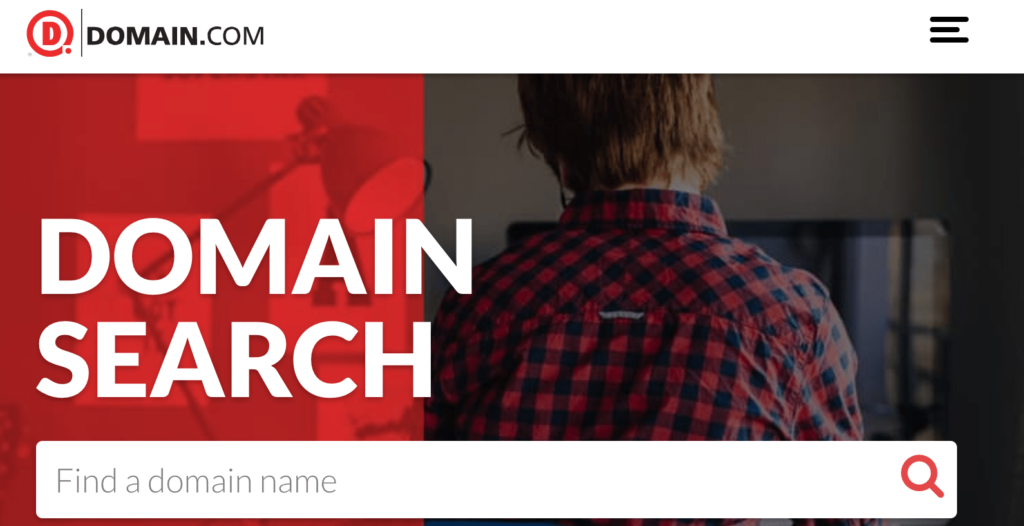
Domain.com

Domain.com

Domain.com is the best domain registrar for first-time and experienced buyers alike. The process is simple, straightforward, and the registrar provides exceptional service.

You can register a .com domain for just $9.99 per year with Domain.com.

During the checkout process, this registrar gives you the ability to buy your domain for up to five years. I love this feature because you won’t have to worry about renewing every year.

When you register a domain, your name and address become available to the public. Domain.com offers privacy and protection for $8.99 per year per domain. If you’re registering a domain under a company name (that’s what I do), you can skip this. Otherwise, you’ll definitely want to add the privacy and protection.

Some domain registrars offer this for free, but it’s worth paying a little extra for the personal privacy.

Domain.com hits with you additional upsells throughout the checkout process. This is pretty standard practice in the domain registrar industry. I’d skip the add-ons. Things like an SSL certificate and SiteLock should come standard from your web hosting provider.

Registering a domain from Domain.com takes less than a minute. It’s the perfect registrar for those of you who plan to buy multiple domain names.

Domain.com also has exceptional 24/7 customer support, making it a top choice for domain transfers as well.

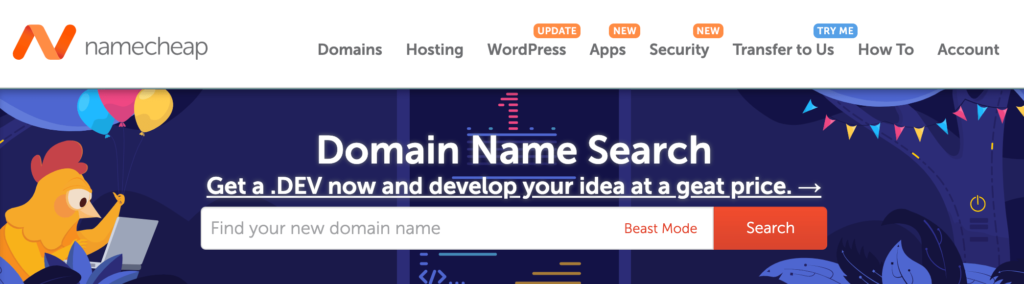
Namecheap

Namecheap

Namecheap is another top choice to consider for domain registration. More than 10 million domains have been registered through this platform.

The process is easy for someone who has never bought a domain before.

Namecheap has .com domains available for $8.88 per year. They also offer free privacy and protection, which is a nice bonus since it’s something you’ll likely need to have.

Like most domain registrars, Namecheap offers a wide range of upsells during the checkout process. Since you’re getting privacy and protection for free, you can skip everything else.

Namecheap has an excellent knowledge base of resources if you need some assistance. Live chat is available 24/7, and their support team provides ticket response times under two hours.

With a simple process, free privacy protection, and outstanding support, Namecheap delivers everything you want and need in a domain registrar.

NameSilo

NameSilo

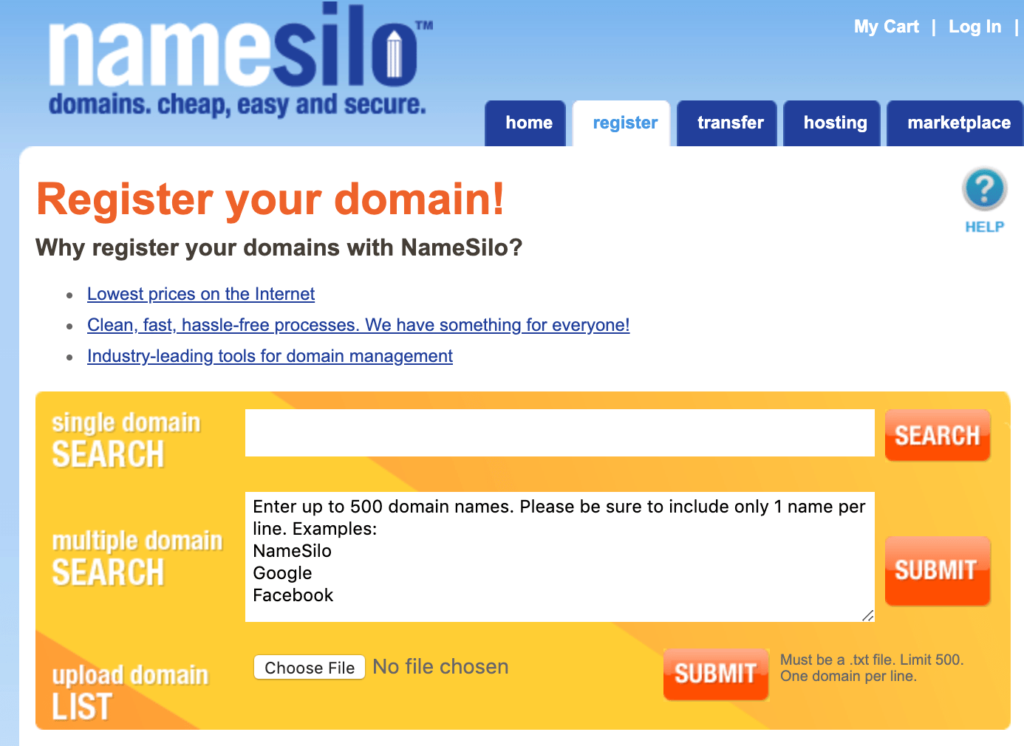
If you’re looking for a no-frills domain registrar, NameSilo has you covered. As you can see from the screenshot above, their website is very outdated. But this hasn’t stopped them from becoming one of the most popular domain registrars in the world.

Buying a .com domain from NameSilo starts at $8.99 per year. You’ll benefit from bundle discounts if you’re registering more than 50 domains in a single order.

NameSilo lets you search for up to 500 domains simultaneously. You can even upload a list of domains from your computer to save you time.

If the outdated interface doesn’t bother you, NameSilo will be a top choice for those of you who want to buy multiple domains at the same time.

There are barely any upsells during the checkout process. WHOIS privacy and protection is free, and ICANN fees are included in the total. You can be out the door for $8.99 per year per domain.

NameSilo allows you to enable auto renew as well, so you won’t have to worry about the name lapsing if you forget to do so manually.

2. Web Hosting Provider

Every website needs to be hosted. So once you register a domain name, the next step is finding a web hosting provider. With that said, some hosting providers let you register a domain directly from through their platform.

If you’re planning to register multiple domains over time, use a domain registrar. But if you just need one domain, you can save some money by bundling your hosting and registration together.

Bluehost is the best web hosting provider for domain registration bundles. It’s what I recommend the most.

But if you’re set on using another hosting provider, there are a few other platforms that deliver decent deals and service for hosting and domain registration.

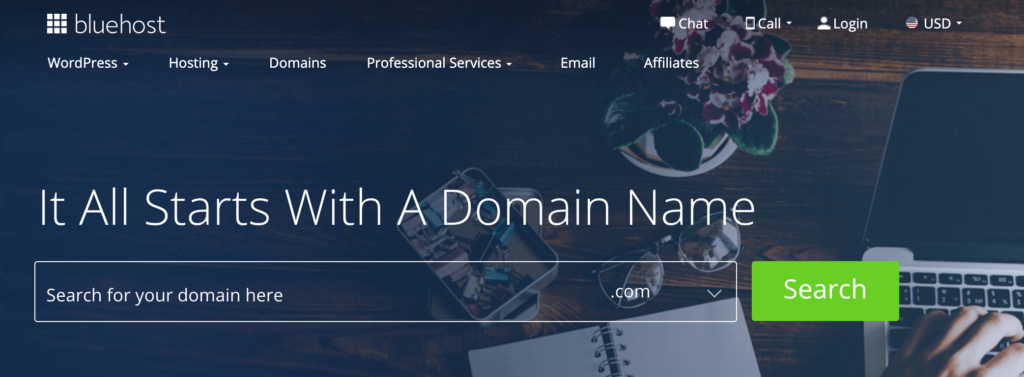
Bluehost

Bluehost

Even though Bluehost is a web hosting provider, you can still purchase a domain directly from them without using their hosting services. However, I don’t recommend this.

A .com domain from Bluehost is $11.99 per year. Privacy and protection is $11.88 per year. For the same price, I can register two domains from a domain registrar and still have change to spare.

However, you can get a free domain name from Bluehost if you bundle your domain registration with their hosting services.

The process is extremely simple. Just choose your web hosting plan, and Bluehost will prompt you to register a new domain. If you follow these steps, your domain will be free for the first year.

You’ll still have to pay $11.88 per year for privacy and protection. Bluehost provides a free SSL certificate, one-click WordPress installs, and 24/7 support.

Bluehost is the best web hosting provider on the market today, and it’s the only web host I actually recommend for domain registration.

Dreamhost

dreamhost

Dreamhost is another top consideration for web hosting. While it’s not as popular as their web hosting products, Dreamhost does offer domain registration services.

You can get a .com domain with Dreamhost for $7.99 per year. This includes free privacy and protection. Furthermore, Dreamhost has more than 400 TLDs, with .xyz extensions as low as $0.89 per year.

While $7.99 for a .com domain is definitely a great deal, there is a catch. Your domain will renew at $15.99 per year.

I really can’t justify this price, especially from a platform that specializes in web hosting, not domain registration.

HostGator

HostGator

HostGator is another well-known web hosting provider. In fact, they rank high on my list of the best cloud hosting services.

In addition to web hosting, HostGator offers a wide range of other services, including a site builder and domain registration.

You can register a .com domain with HostGator for $12.95 per year. While it’s a bit high compared to the domain registrars we reviewed, it’s just the introductory offer. The price actually jumps up to $17.99 per year upon renewal.

Privacy and protection is an additional $14.95 per year. So your initial registration comes to $27.90 and will renew at $32.94 per year.

I could get three domains from Domain.com, Namecheap, and NameSilo, for the same price.

So can you get a domain name from HostGator? Yes, the option is available. But I really don’t see any reason why you would.

SiteGround

SiteGround

SiteGround is one of the most popular and well-known web hosting providers on the market today. The platform also has domain registration services, although I can’t say I recommend it.

You can register a .com domain from SiteGround for $15.95 per year.

That’s nearly double the price of Namecheap’s registration, and there’s still a catch. You’re only able to use SiteGround for domain registration if you have a SiteGround web hosting plan.

So if you wanted to buy a domain from SiteGround and host your site elsewhere, that’s not an option.

For those of you looking to bundle domain registration with web hosting, you’re much better off using Bluehost. With Bluehost, you’ll get a free domain for the first year, which is not available with SiteGround.

3. Website Builder

Most people don’t associate website builders with domain registration.

Similar to web hosting, I normally wouldn’t recommend buying a domain from anywhere other than a registrar. But with that said, there are a handful of site builders offering domain registration services.

These are some of the best website builders to consider for buying a domain name.

Wix

Wix

Wix is best known for its simple drag-and-drop website builder. If you don’t know how to code and you’re creating a website from scratch, Wix is a top choice to consider.

You can’t exclusively buy a domain using Wix. You’ll need to bundle your domain registration with their website builder.

With that said, there are two ways to get a free domain with this platform.

Every Wix site comes with a free Wix subdomain. Without spending anything, you can have a domain in the following format:

wixusername.wixsite.com/yourdomain

I don’t recommend this to anyone unless you’re just experimenting with the Wix platform. Once you’re ready to take things to the next level, you’ll need to register your own domain.

Wix also offers a free domain for one year with all paid site builder plans. Privacy and protection is included free as well. You could even bundle your web hosting through them, although I can’t endorse that option.

Squarespace

Squarespace

Squarespace is another one of my favorite website builders. It’s great for beginners and people with an eye for great design.

But like Wix, getting a domain from Squarespace means you’ll have to bundle it with a site-building plan.

All Squarespace annual plans come with a free custom domain name for the first year. WHOIS privacy and protection is included. Additional domains can be purchased between $20 and $70 per year, depending on the extension.

Those prices are outrageous if you compare them to the domain registrars that we reviewed earlier. If you need to buy more than one domain, this is not the platform to do so.

I would only consider registering a domain with Squarespace if you need one domain, you’re using the site builder, and you think it’s easier to purchase everything from one provider. Just know that you could run into problems if you need to transfer your domain and website to another platform in the future.

WordPress

WordPress

WordPress is the world’s largest CMS platform. We use WordPress here at Quick Sprout to power our website.

This website builder is best for those of who are comfortable with coding and want to get the most out of your site’s content. Although WordPress does have plugins that allow drag-and-drop building capabilities.

You can also use WordPress to buy a domain. The domain will automatically be connected to your website, and renewals get handled through your WordPress account.

While it may be tempting to get a domain directly from WordPress, it’s not the most convenient procedure. You’ll have to go through a six-step process, which includes creating your WordPress account.

Plus, the domain registration is a bit pricey. A .com domain from WordPress costs $18 per year, which is more than double the price of the cheapest domain registrars.

Weebly

Weebly

Weebly is a website builder geared toward ecommerce sites. Compared to some of the other website builders out there, registering a domain name with Weebly isn’t the worst idea.

Two of Weebly’s premium plans (Professional and Performance) come with a free domain for one year with an annual contract. Those plans start at $12 and $26 per month, respectively.

You can use Weebly to register a domain without a site builder plan. The nice part about using Weebly for domain registration is that you’ll save money by registering for longer periods of time.

  • 1 year — $19.95 per year
  • 2 years — $16.95 per year
  • 5 years — $14.96 per year
  • 10 years — $12.57 per year

But even though you can save up to 37% off with an extended registration, the ten-year price is still more expensive than NameCheap, NameSilo, and Domain.com.

How to Find the Best Place to Buy a Domain

With so many options to choose from, finding the best place to buy a domain can be challenging. There are certain features and elements that must be taken into consideration when you’re evaluating a prospective platform to buy a domain.

This is the methodology that we used to narrow the search.

Price and Contract Terms

The price should always be the first thing you look at. If all of these platforms are basically offering the same thing, it makes sense to go with one that’s cost-effective.

Don’t just look at the cheapest extensions. Always compare the prices for .com domains, since that’s what you should be registering.

Look at the length of your contract. Some providers will require a minimum registration period, such as one or two years. Others will offer discounts for long-term registration.

Keep an eye out for additional fees. Most add-ons you’ll be able to ignore. But you’ll definitely want to get WHOIS privacy and protection. This comes free with your registration on some platforms, but others upcharge for it.

Make sure that your contract makes it easy for you to renew your domain. Look for automatic renewals or contracts giving you a grace period after the domain expires, in case you forget to renew manually.

Domain Transfers

If you’re unhappy with your domain registrar, for any reason, you might want to transfer your domain in the future.

You cannot transfer a domain within the first 60 days of registration. However, you’re free to do what you want with your domain after that.

Just make sure that your registrar makes transferring easy for you. Platforms like GoDaddy, have a reputation for throttling down outgoing transfers. So always check customer reviews about the transfer process before you settle.

The best domain registrars make transfers easy and don’t impose any extra fees.

Additional Services

As you’ve seen from this guide, you can get a domain name from a wide range of platforms. Some of those platforms specialize in additional services, like web hosting or website builders.

The ability to bundle multiple services shouldn’t sway you toward one provider over another.

Most providers are better at one service compared to the other. Just because a platform is one of the best website builders, it doesn’t mean they have a flawless domain registration process.

In many cases, domain registration is more expensive from website builders and hosting providers. Some of these platforms let you to buy a domain independently from their primary services, while others force you to bundle everything.

Sometimes it’s worth it to go with a service bundle. For example, Bluehost gives you a free domain for one year when you sign up for a web hosting plan.

Support and User Experience

Registering a domain name shouldn’t be complicated. If a platform is making you jump through hoops, it’s probably best to look elsewhere.

Most of the time, you should be able to register a domain in a minute or two, at most.

If you’re interested in buying dozens or even hundreds of domains simultaneously, look for platforms that support those needs.

In some cases, you may want to request some assistance. Although this usually won’t be required unless you’re transferring a domain. In any event, you’ll want to make sure that the platform provides excellent customer service to assist you with transfers or whatever else you need help with.

Conclusion

There are three main options for buying a domain; domain registrars, web hosting providers, and website builders.

Within each category, you’ll have tons of different providers to choose from.

Buying a domain from a domain registrar will almost always be your best option. These providers specialize in domain registration, so you’ll get the best price, quality, and customer service here. Plus, domain registrars won’t force you to bundle your registration with another service.

Using Bluehost to bundle your domain registration with web hosting is the only time that I’d consider bundling services. That’s because Bluehost gives you a free domain for one year when you sign up for a hosting plan.

Other providers have similar offers, but overall, they fall short in one category or the other.


from Quick Sprout https://ift.tt/2HUBmNu
via IFTTT

Best Business Checking Accounts for 2020

Every business needs a checking account.

Whether you’re running a startup, small business, single-member sole proprietorship, or side hustle, you’ll need to separate your business transactions from your personal finances.

For the most part, a business checking account functions very similarly to a personal checking account. However, business checking accounts typically have extra fees, minimum balance requirements, and monthly transaction limits.

So before you open a new account, it’s important that you find a bank that meets the needs of your business.

Top 10 Best Business Checking Accounts For 2020

There are hundreds, if not thousands, of business checking accounts on the market today. From small local banks to large national chains and online-only banking, there are really only ten accounts that I would consider.

  • Chase Total Business Checking
  • Citizens Bank Clearly Better Business Checking
  • Novo
  • TD Business Convenience Checking
  • US Bank Silver Business Checking 
  • Huntington Unlimited Business Checking
  • Navy Federal Business Checking
  • Axos Basic Business Checking 
  • BBVA Business Connect Checking
  • Azlo Business Checking

The majority of these are free business checking accounts. Some do have a monthly fee, but it’s fairly easy to get those waived by meeting reasonable requirements.

I’ll give you an in-depth review of the top business checking accounts below. We’ll cover the top features, benefits, prices, and any potential drawbacks that should be taken into consideration.

The Best Business Checking Account Reviews

Chase Total Business Checking

Chase Total Business Checking is perfect for entrepreneurs and small business owners. You’ll have access to 4,900 branches and 16,000 ATMs throughout the country.

There is a $15 service fee associated with the account. But the fee waived if you maintain a $1,500 minimum daily balance or link a personal Chase checking account.

Top benefits and highlights of Chase Total Business Checking include:

  • Unlimited electronic deposits
  • 100 free monthly transactions
  • Access up to seven years of statements online
  • Account alerts
  • Online and mobile banking

You can earn $200 by opening a Chase business checking account. Simply deposit $1,000 within the first 20 days, and make five qualifying transactions while maintaining that balance for 60 days.

Overall, this account stands out for its outstanding 24/7 customer support to business owners.

Chase has all of the tools you need to manage your growing business, including some of the best business credit cards on the market today.

Citizens Bank Clearly Better Business Checking

For those of you seeking a free business checking account, look no further than Citizens Clearly Better Business Checking.

You won’t have to worry about meeting any minimum balance requirements because there are no maintenance fees. This makes Clearly Better Business Checking a top choice for business owners who maintain a lower bank balance.

Other top features include:

  • 200 free monthly transactions
  • Overdraft coverage
  • Dedicated business customer support
  • Online and mobile banking
  • Grant read-only controlled access to your account (for bookkeepers and accountants)

One potential drawback of Citizens Bank is its size. While the company has more than 1,000 branches and 3,100+ ATMs nationwide, most of them are located on the east coast. So if you’ll need to visit a branch, for anything, verify that there is a Citizens Bank near your business before opening an account.

Unlike other business checking accounts, Citizens does not offer a sign-up incentive for Clearly Better Business Checking.

Novo

Novo is an alternative to traditional banking. It’s an online-exclusive business checking account intended for freelancers and entrepreneurs.

I’d recommend Novo to any business owner seeking a straightforward solution with transparent pricing and no hidden fees. You can apply for a Novo account in less than ten minutes online.

These are some of the notable highlights for Novo business checking:

  • No minimum balance requirements
  • No monthly maintenance fees
  • Free ACH transfers
  • Free incoming wires
  • Free mailed checks

Novo lets you open a new business checking account with just $50.

This is a modern banking solution. You can integrate your account with Zapier, Xero, Slack, and other tools that your small business is currently using.

Like any online-only bank, you can’t walk into a physical branch. So if your business has in-person banking needs, then Novo isn’t for you. However, Novo will reimburse you for ATM fees imposed by other banks. So you’ll still be able to access cash from anywhere without paying an extra fee.

TD Business Convenience Checking Plus

You can open a TD Business Convenience Checking Plus account with just $100. However, you’ll need to maintain a $1,500 daily balance to waive the $25 monthly maintenance fee.

If you link a personal checking account to your Business Checking Plus account, TD Bank counts your combined balance between the two accounts toward the daily minimum. So this is a great choice for business owners who already have an account at TD Bank.

Let’s review some of the account benefits:

  • 500 free transactions per month
  • Up to $5,000 in cash deposits per cycle
  • Overdraft protection
  • Online statements and mobile deposit
  • Up to four signers

While TD Business Convenience Checking Plus does have a high maintenance fee, you’ll benefit from more free monthly transactions. For comparison purposes, Chase Total Business Checking has a $15 fee for just 100 free transactions each month.

Plus, it’s easy to waive TD’s $25 fee by maintaining a low combined balance between two accounts.

Even though you’re limited to $5,000 free cash deposits each month, you’re only charged $0.25 per $100 thereafter. So an additional $5,000 cash deposited in a cycle ($10,000 total) would cost you $12.50. That’s just 0.13% of your deposits, which is next to nothing.

TD Bank gives you access to other services, like merchant solutions, business loans, and business lines of credit.

US Bank Silver Business Checking

US Bank Silver Business Checking is 100% free. They do impose a $5 monthly fee for paper statements, but you can waive that charge by going paperless.

Here’s an overview of the account benefits:

  • 125 free transactions per month
  • Remote deposits
  • Overdraft protection
  • Mobile and online account access
  • 50% off first order of checks
  • Digital bill pay

One thing that needs to be taken into consideration is the strange wording US Bank uses to limit cash deposits. The account allows 25 “units” of free cash deposits each billing cycle.

After reading the fine print, you’ll learn that a unit is calculated by dividing each deposit by 100 and rounding the value to the closest whole number.

Here’s an example. Let’s say you deposit $920.

920 100 =9.2

Round 9.2 down to 9, and you just used 9 of your 25 credits for the month.

This credit system is a complex way of saying you’ll get up to $2,500 in free cash deposits each billing cycle. So if you’re making cash deposits on a regular basis, this account might not be the best option for you.

Huntington Unlimited Business Checking

Huntington Unlimited Business Checking is a top option for larger organizations. If you have a higher monthly transaction volume, some of the other accounts on our list won’t fit your needs.

The top features and benefits of Unlimited Business Checking from Huntington include:

  • Unlimited transactions
  • Overdraft protection
  • Online and mobile banking
  • Free text and email alerts
  • Up to $10,000 free cash deposits each month

Huntington does charge a $20 monthly maintenance fee for this account. But it’s waived with a $10,000 combined balance between all of your eligible Huntington Bank accounts.

With an Unlimited Business Checking account, Huntington Bank allows you to choose one of the following bonus services as well:

  • Fraud tool
  • Huntington deposit scan (up to 50 per month)
  • 10% off payroll services
  • Two free incoming domestic wires per month
  • Returned deposited items (up to 25 per month)

This bank also has a tool called “The Hub” for business checking accounts. It comes with several digital tools for things like cash positioning and cash flow forecasting. The Hub is a great resource for managing your revenue and expenses.

Navy Federal Business Checking

Navy Federal Business Checking is a top choice to consider if you or someone in your family is a member of the armed forces, National Guard, or DoD.

It’s a straightforward and basic account, best for startups with a low transaction volume.

The best part about this account is that it’s 100% free. You’ll never be charged a monthly maintenance or service fee.

Your first 30 non-electronic transactions are free. After that, it’s $0.25 for any in-branch deposits, withdrawals, or transfers. But you can deposit up to 12 checks at the same time, and it will count as a single transaction.

Another reason why I like Navy Federal Business Checking is because they have other banking solutions to meet your needs as the business grows. Once your banking activity increases, consider upgrading to:

  • Navy Federal Business Plus Checking
  • Navy Federal Business Premium Checking

Those accounts cost $8 and $20 per month, respectively. The Premium Checking maintenance fee is waived if you maintain a $5,000 daily balance.

Axos Basic Business Checking

Axos is another online-only bank. So if you don’t have any in-person banking needs, you should definitely consider Axos Basic Business Checking.

Here’s an overview of the account:

  • $1,000 minimum opening deposit
  • No monthly fees
  • Up to 200 free transactions per cycle ($0.30 per transaction after)
  • Surcharge-free ATM network
  • Compatible with Quickbooks

The online and mobile banking solutions from Axos are exceptional, as you would expect from an online-exclusive bank. You can deposit a check from anywhere using your mobile device.

Overall, Axos Basic Business Checking is suitable for small business owners with modest banking needs.

BBVA Business Connect Checking

BBVA has free banking solutions for small businesses. Sole proprietors can apply online for a BBVA Business Connect Checking account. Other business types need must apply at a branch.

Here’s an overview of the account advantages and highlights:

  • No monthly service charge
  • No minimum balance requirements
  • Free digital bill pay
  • Free online and mobile banking
  • $100 minimum opening deposit
  • $5,000 cash deposits per month at no charge

BBVA gives you free unlimited transactions every month, sort of. You’ll get two in-branch deposits, and five in-branch withdrawals or processed checks free each month. All other transactions are unlimited at no charge.

You’ll only find BBVA branches in the following states:

  • Alabama
  • Arizona
  • California
  • Colorado
  • Florida
  • New Mexico
  • Texas

However, you’ll have access to a network of 55,000+ ATMs nationwide. That’s because BBVA is an Allpoint partner. There are no ATM fees at Allpoint ATMs and participating 7-Eleven locations.

Azlo Business Checking

Azlo Business Checking is a bit unique compared to the other options on our list. This online-only banking solution is made for freelancers and entrepreneurs.

The company is very straightforward in saying that they are not right for all businesses. Azlo doesn’t accept cash deposits or offer checkbooks. So it’s only suitable for businesses that send and receive digital payments.

With that said, the account definitely has its advantages:

  • No monthly fees
  • No minimum deposit
  • Unlimited transactions
  • Create and manage custom digital invoices
  • Pay vendors, freelancers, and yourself
  • Exceptional mobile banking app
  • Apply online in minutes

Azlo integrates with platforms like Stripe, PayPal, Square, QuickBooks, and Xero.

Overall, Azlo is a modern way for freelancers to access their banking needs online. But it’s definitely not suitable for everyone.

How to Find the Best Business Checking Account For You

All business checking accounts are not created equally. The best choice for one business might not be ideal for yours.

This is the methodology that you should use when you’re evaluating business checking accounts. I’ll explain each feature in greater detail below.

Fees

Service fees and monthly maintenance fees are common for business checking accounts. In most cases, these fees fall somewhere in the $10 to $50 range.

But there are still plenty of free business banking solutions. In fact, six of the ten accounts on our list don’t have monthly fees. While the remaining four contain fees, you can easily waive them by maintaining a minimum account balance.

There’s no reason to pay these fees if you can avoid them.

Balance Requirements

Some banks require a minimum opening deposit. So choose a bank with a reasonable opening deposit minimum based on your situation.

If you’re launching a startup and don’t have a ton of cash on hand, you can open some accounts with as little as $50 or $100. Some banks don’t require a minimum opening deposit at all.

In addition to the opening deposit requirement, some accounts will charge for you falling below a certain minimum daily balance. Make sure that your cash flow is enough to maintain your minimum requirements without getting penalized.

Transaction Limits

Personal checking accounts will rarely if ever, cap the number of transactions you can make in a billing cycle. But that’s not the case for most business checking accounts.

Depending on the bank, activities like deposits, withdrawals, and transfers count toward a monthly limit. Some banks will restrict the number of in-person transactions you can make while offering free unlimited electronic transactions.

For the most part, free monthly transaction limits start at 100. TD Business Convenience Checking allows for 500 free transactions per month. Other banks give you unlimited transactions, with a few contingencies.

You’ll pay a small fee for each transaction over your monthly limit. This is usually somewhere in the $0.25 to $0.50 range.

Mobile Banking and Online Accessibility

Every bank offers some way to access your account online or through a mobile app. But with that said, some of these digital solutions are definitely better than others.

Choose a business checking account that lets you deposit checks remotely, set up account alerts, and pay invoices automatically.

I do nearly all of my business banking from a mobile app, and I’m sure you’ll want that convenience as well.

Branch Locations

Some banks are region-specific, while others are large national chains. It’s important to choose a bank near your business location if you need to access a branch for anything.

However, there are several business checking accounts that are online-exclusive. These banks don’t have any physical locations. But those solutions aren’t for everyone. For example, if your business accepts cash, you’ll definitely need access to a physical branch for in-person deposits.

Online-only banking is very popular for freelancers and entrepreneurs working remotely and accepting digital payments.

Additional Banking Services

This may not be important to you immediately, but it’s nice to have a bank that will provide you with additional services as your business grows.

Whether it’s merchant services for credit card processing, additional accounts, or a business loan or line of credit, it’s easier to get these from a bank where you have an existing relationship.

Always look at what else a bank has to offer beyond your immediate checking account needs today.

Conclusion

Every business owner needs a business checking account. But everyone has different banking needs, which is why finding the best business checking solution can be difficult.

These are the top ten best business checking accounts on the market today:

  • Chase Total Business Checking — Best checking account for small businesses.
  • Citizens Bank Clearly Better Business Checking — Free business checking account with no minimum balance requirements.
  • Novo — Best online-only business banking for freelancers and entrepreneurs.
  • TD Business Convenience Checking — Up to 500 free transactions each month.
  • US Bank Silver Business Checking — Free checking account ideal for businesses with a low monthly transaction volume and cash deposits under $2,500 per month.
  • Huntington Unlimited Business Checking — Unlimited transactions best for larger businesses with high cash flow.
  • Navy Federal Business Checking — Best for startups and small business owners with ties to the armed forces.
  • Axos Basic Business Checking — Online-exclusive bank with no monthly fees.
  • BBVA Business Connect Checking — Best business banking for sole proprietors.
  • Azlo Business Checking — Best online bank for freelancers accepting and receiving digital payments (no cash deposits).

There’s an account for every type of business on this list. From freelancers and startups to small businesses and larger organizations with high transaction volumes, I’m confident that you can find a checking account from one of the options above.


from Quick Sprout https://ift.tt/2SRE8cK
via IFTTT

Friday, February 21, 2020

GotoMeeting Review

GoToMeeting ranks high on our list of the best conference call services.

The platform has virtually all of the tools you’ll need to run a successful business meeting. GoToMeeting stands out for its exceptional call quality, robust features, and excellent customer service.

Whether you’re a small, medium, or enterprise-sized business, GoToMeeting has conference call solutions to fit your needs.

Millions of people have used GoToMeeting, including some well-known names like Make-A-Wish and Marketo.

If you’re in the market for new conference call software, GoToMeeting should definitely be taken into consideration. Use this guide to learn more about its benefits, plans, and pricing, as well as any potential drawbacks.

GoToMeeting Features and Benefits

GoToMeeting has a wide range of features for different use cases. I’ll highlight some of the top advantages of GoToMeeting’s software and service. If you want to just jump right in then I suggest signing up for the GoToMeeting free trial.

Conference Calls

Whether you need to communicate with coworkers, customers, or prospects, GoToMeeting’s audio conference calling has you covered.

Any device with Internet access can be used to host or join a GoToMeeting conference call. So whether you’re using a Mac, PC, or mobile device, you can participate from anywhere.

GoToMeeting has taken the complexity out of business conference calling. From the initial setup to the call quality and meeting management features, it’s easy for anyone to use.

All plans come with unlimited web audio conference calls. So you’ll never have to worry about exceeding a limit.

GoToMeeting provides optional toll-free numbers for more than 50 countries. If you add-on this feature, you’ll only pay for what you use. This is an alternative solution to traditional VoIP phone services.

You’ll also get custom email invitations, reservationless connections, integrated scheduling, and one-click meetings with the conference calling feature.

Video Conferences

Video Conference

In addition to audio calls, GoToMeeting provides HD quality video conferencing. This gives you the opportunity to host face-to-face meetings online.

Up to 25 users can use their webcam at the same time with GoToMeeting.

Other video conferencing platforms have confusing controls, syncing errors, and unexpected outages. But you won’t have to worry about any of these problems with GoToMeeting.

The platform enables cloud collaboration for both desktop and mobile.

Bandwidth is automatically adjusted for each user based on their resources and hardware, making it a seamless experience for everyone involved.

Using the video conferencing feature is simple. GoToMeeting allows people using the desktop app to edit their webcam preferences. So you can change the display format before going live.

Want to jump off of your camera without leaving or interrupting the meeting? No problem. GoToMeeting makes that easy to accomplish.

Screen Sharing

Online screen sharing with GoToMeeting will elevate the quality of your audio and video conference calls. You’ll be able to present your computer screen in real-time to meeting attendees.

This is the perfect way to enhance your communication when visuals are required.

Use screen sharing for things brainstorming ideas as well as team member training. You can also show conceptual designs or prototypes to your clients.

With screen sharing capabilities, you can turn any conference call into a full-blown presentation in seconds.

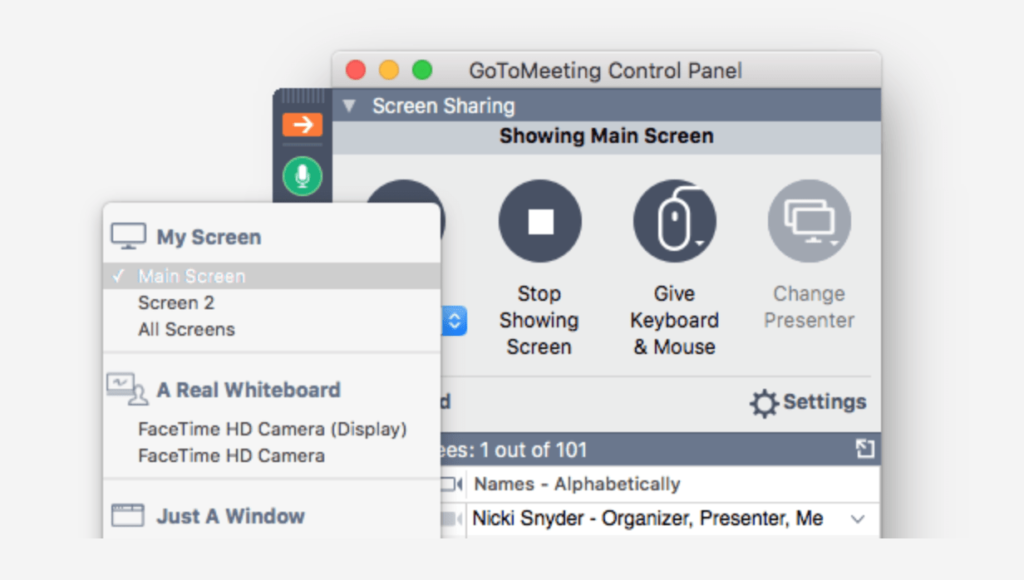
Another advantage of this feature is its flexibility. You can choose exactly what screen you want to share. Whether it’s your entire monitor or just a single app, GoToMeeting has settings to support your needs.

Screen Sharing

Meeting attendees do not need to download any desktop or mobile software to access screen sharing capabilities. GoToMeeting offers screen sharing from all Chrome web browsers.

This is perfect for people who are in a software-restricted environment or using an operating system where installing the app isn’t possible. These are both common scenarios for certain corporate firewall permissions.

You can share your screen from an iPhone or iPad as well. You’ll even be able to switch between iOS devices seamlessly. If a meeting is running late and you need to step away from your computer, just continue on your mobile device without leaving the meeting.

Transcriptions and Recordings

A common problem with virtual meetings is the ability to retain information. This is especially true for longer sessions featuring multiple presenters and participants.

Hand-written notes aren’t always practical. Plus, it defeats the purpose of using technology to your advantage.

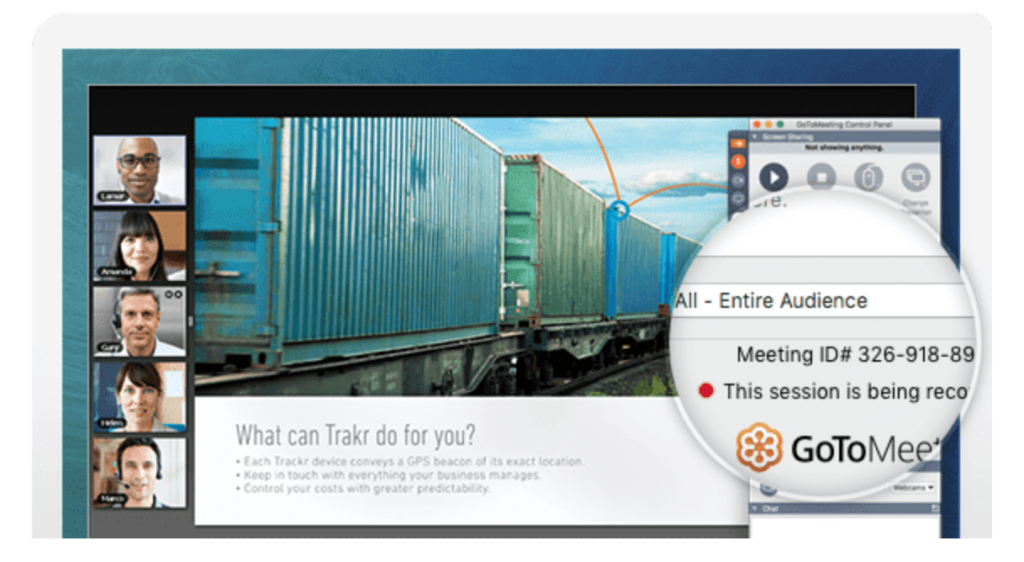
GoToMeeting solves this problem with transcriptions and recordings. Simply click the record button. The presenter’s screen, along with everyone’s audio, will be captured. You can store these recordings locally or in the cloud.

The Smart Meeting Assistant will also transcribe the conversation automatically. So you’ll always be able to refer back to those transcripts.

Recording

There’s no reason to assign a designated transcriber to your meetings anymore. Instead of scrambling to write things down, you can actually pay attention to what’s going on.

The transcriptions and recordings are also highly beneficial to coworkers or clients who were unable to attend. They can re-watch the meeting on their own time as if they were there.

Hardware Bundles

In addition to providing software, GoToMeeting also has all of the hardware you need for hosting high-quality meetings. They have hardware bundles available for huddle spaces, as well as larger conference rooms.

With Poly and Dolby Voice, GoToMeeting provides top of the line technology. The audio and video quality with these bundles is second to none.

These out-of-the-box conference room solutions are incredibly user-friendly. Installation is easy as well. You can get the entire system set up in less than 15 minutes.

There’s no reason to get your conference room hardware from a third-party provider. Bundling your solution with GoToMeeting is a cost-effective way to get top of the line equipment.

Mobile Conferencing

The modern workforce is always on the go. Remote employees aren’t always tied to a desk with a computer at their disposal.

GoToMeeting solves this problem by providing native mobile apps for iOS, Android, and Windows. Now you can schedule, join, or host a meeting directly from any mobile device.

The mobile app still gives you all of the features and benefits that we previously discussed. You’ll be able to share your screen and record meetings as well. It works for both audio and video conference calls.

Again, GoToMeeting will automatically adjust your bandwidth to ensure high quality, no matter where you are.

Other Considerations of GoToMeeting

GoToMeeting isn’t perfect. There are potential drawbacks that you should take into consideration before you sign up.

Stable Connection Required

If your Internet service provider is frequently pinging your modem, GoToMeeting might give you some problems. The connection must be error-free for the software to work properly.

Even brief interruptions can force a session to crash. Restarting a new meeting can be a pain, especially when there are lots of attendees. If your company experiences lots of Internet connection problems, you should switch providers before signing up for GoToMeeting.

Equipment Quality

The quality of the equipment being used for hosting and attending meetings matters. GoToMeeting prioritizes the most up to date solutions but doesn’t keep up with outdated technology.

If you’re using hardware that’s more than five years old, you’ll probably need an upgrade to get the full benefits of GoToMeeting. Fortunately, you can get a hardware bundle directly from this provider.

Added Costs For Premium Features

All features are not available for every plan. We’ll discuss the plans in pricing in greater detail shortly, and you’ll see what I mean.

But the entry-level plan is not all-inclusive. You’ll have to upgrade to get the most out of GoToMeeting.

Limited Chat Capabilities

Until recently, GoToMeeting’s chat was limited to meetings. Meaning you weren’t able to create chat rooms for on-demand instant messaging.

Now they launched Business Chat, which includes this feature. However, I don’t think it’s at the point where you can use it to replace Slack or similar real-time messaging tools.

Maybe this will change in the future. But for now, GoToMeeting is better for its conference calling capabilities, not chat functions.

No Free Plan

There are lots of free conference call services on the market today. However, GoToMeeting isn’t one of them.

They offer a 14-day free trial and provide discounts for annual contracts, but you can’t use the software for free indefinitely.

Compare GoToMeeting Plans and Prices

Pricing

GoToMeeting has three different plans to accommodate businesses of all different shapes and sizes. I’ll give you an in-depth look at what each plan has to offer, including the price points.

GoToMeeting Professional

GoToMeeting Professional starts at $12 per month per user with an annual contract. The month-to-month rate is $14 per month for each user.

This package allows you to host meetings and conference calls with up to 150 participants, which is more than enough for a small business.

In addition to the HD video, audio, screen sharing, and other benefits that we discussed earlier, GoToMeeting Professional comes with the following features:

  • Siri voice command compatible
  • Slack integration (launch a meeting directly from Slack)
  • Office 365 plugin
  • Google Calendar plugin
  • Salesforce Integration
  • SSL encryption
  • AES-256 bit encryption
  • SOC2 certified data centers
  • HIPAA compliant
  • Single sign-on

You’ll also benefit from GoToMeeting’s 24/7 customer care team.

The admin center is a robust and intuitive dashboard for managing calls, users, and your account. You’ll also have access to diagnostic reports for all of your meetings. This allows you to track the performance on an individual user level for advanced troubleshooting.

Every update or change made within your account is tracked. You can view these logs with downloadable admin reports.

Even with the entry-level plan, GoToMeeting gives you unlimited meetings with no time limits for audio and video calls. It’s tough to find a better entry conference call plan on the market with so many advanced features.

Transcription and recording functions are not available with GoToMeeting Professional. So you’ll need to upgrade if you want those advanced features.

GoToMeeting Business

GoToMeeting Business starts at $16 per month per user with an annual contract. If you don’t want the long-term commitment, you can $19 per user on a monthly basis.

This plan allows you to host calls with up to 250 participants, making it an appealing choice for medium to large-sized organizations.

GoToMeeting Business has all of the features in the Professional plan, with extras like:

  • Unlimited cloud recording
  • Meeting transcriptions
  • Drawing tools
  • Keyboard and mouse sharing
  • Meeting lock

The meeting lock feature adds an extra layer of security to your calls. Once a meeting begins, late users need to wait until the host lets them in.

GoToMeeting Business comes with Smart Assistant. This tool uses machine learning technology to detect highlights and action items in a meeting automatically.

You’ll also benefit from the ability to take notes directly on the platform during a call or conference.

GoToMeeting recently launched a new feature that’s available on the Business plan called “Slide to PDF.” During a presentation, you can automatically capture slides and create a sharable PDF with everything in chronological order. This is just another way to stay organized after a meeting is complete.

GoToMeeting Enterprise

As the name implies, this is an enterprise-grade solution intended for larger organizations with needs exceeding the limits of the other plans.

With GoToMeeting Enterprise, you can host meetings and calls with up to 3,000 participants. This is an ideal solution for organizations with dozens of locations positioned across the country or globe.

The Enterprise plan allows you to connect using your existing conference room system with InRoom Link (H.323, SIP). This provides an additional layer of security for your protection.

Aside from the 24/7 customer support you’re already getting, GoToMeeting will provide you with a dedicated customer success manager. You’ll also benefit from custom onboarding, training, and quarterly reviews.

GoToMeeting Enterprise pricing is customized for each organization. They provide volume discounts for extra users.

You’ll need to contact the GoToMeeting sales team to get your quote.

Conclusion

Overall, GoToMeeting is an exceptional conference call service provider.

They have solutions for small, medium, and large organizations. The plans are affordable and come with features that go beyond just basic audio or video calling.

Even the entry-level plan comes with unlimited calling with no limits for up to 150 participants. Other conference calling solutions won’t give you as much out of the box.

I like GoToMeeting because its technology is second to none. They are always using the most up-to-date equipment, and offer exceptional hardware bundles for businesses as well.

Whether you’re hosting meetings from the office conference room, or on the go with your mobile device, GoToMeeting has you covered.

While the platform does have a handful of drawbacks, I’d say the pros definitely outweigh the cons.

Try GoToMeeting for 14 days with a free trial. You won’t even have to provide your credit card information, so there’s no commitment.


from Quick Sprout https://ift.tt/32dHJVE
via IFTTT

Thursday, February 20, 2020

Best Business Loans

Business owners need loans for a wide range of reasons. A loan can cover operating costs, purchase new equipment, buy inventory, or help with expansion.

From startups to companies that have been around for decades, it’s not uncommon for businesses to seek funding at one point or another.

If you need a loan and you’ve done any preliminary research, you’ll quickly learn that the market is flooded with choices. Banks, credit unions, and alternative lenders all have loan options for small businesses.

While you might be tempted to visit your local bank for a loan, take this into consideration. Big banks approve just 27% of small business loan applications.

This means you have just above one in four chances of getting approved. I don’t like those odds.

That’s why the best business loans for 2020 come from online lenders and alternative financing options. I’ll show you the top small business loans in this guide, and explain how to find the best loan for your business.

Top 11 Best Business Loans for 2020

There are hundreds, if not thousands, of business loans to choose from. But there are 11 business loans that stand out from the crowd.

  • BlueVine — Best for established businesses seeking lines of credit up to $250,000.
  • Lendio — Best small business loan marketplace with 75+ lenders.
  • OnDeck — Term loans and lines of credit for business owners with a 600+ FICO score.
  • Fundbox — Best for new businesses in need of inventory or supplies from vendors.
  • Funding Circle — Best small business lender for loan terms up to five years.
  • Kabbage — Best for businesses with low monthly or annual revenue.
  • Lending Club — Best P2P lending marketplace for business loans.
  • Kiva — Microloans up to $10,000 at 0% interest for entrepreneurs.
  • SmartBiz — Best for SBA loans up to $5 million with 25 year terms.
  • Credibility Capital — Bank-backed loans for business owners with great credit.
  • CAN Capital — Best merchant cash advance for small business.

I’ll review each business loan below. You can use this information to decide which loan best fits the needs of your small business.

The Best Business Loan Reviews

BlueVine

BlueVine is one of the first places a business owner should look for a loan. You can get approved for a loan in just five minutes, and they have interest rates as low as 4.8%.

Applying online will not affect your credit score. Hard credit checks are only performed after you’ve reviewed and accepted an offer.

With BlueVine, you can get a loan of up to $5 million or as little as $5,000.

Unlike other lenders on the market, BlueVine has three different types of financing solutions for business owners:

Line of Credit

  • Revolving line of credit to $250,000
  • Only pay interest for the amount used
  • No prepayment penalties

Term Loan

  • Lump sum of cash up to $250,000
  • Fixed weekly rates
  • No origination fees

Invoice Factoring

  • Up to $5 million in credit
  • Choose which unpaid invoices you want to fund
  • No long-term commitment

More than 20,000 business owners have used BlueVine for a loan. The company has provided more than $2 billion in loans to a wide range of business types across all industries.

There are some eligibility restrictions to consider. For example, to get a line of credit, you need to be in business for at least six months, earn at least $10,000 in monthly revenue, and have a 600+ FICO score.

This makes BlueVine a better choice for an established business as opposed to a startup company.

Lendio

Lendio is unique compared to some of the other lenders on our list. That’s because you won’t be borrowing money directly from them.

Instead, Lendio operates as a small business loan marketplace. They have a national network of more than 75 different lenders. PayPal, American Express, and Bank of America are just a few of the many companies that you’re familiar with. You’ll even recognize some names from our list of the best business credit cards.

Simply fill out an application, and you’ll be matched with the top lenders and loan terms to meet your needs. This is the best way to compare business loans from a single platform.

It takes just 15 minutes to apply, and there’s no fee or obligation. Once approved, you can have access to your funds in as little as 24 hours.

Lendio works with lenders providing:

  • Business lines of credit
  • Equipment financing
  • Startup loans
  • Commercial mortgages
  • Term loans
  • Credit cards

Over $1.4 billion has been funded from 73,000+ loans in the Lendio marketplace. No matter what you need the capital for, Lendio is sure to have an option for you.

In some cases, Lendio will request additional information or documentation after you apply, which can sometimes be a pain. But if you’re not in a major rush to get a loan, this extra step is a non-issue.

OnDeck

OnDeck is a global leader in business financing. The company has loaned more than $13 billion to businesses across 700+ industries.

With OnDeck, you can access a term loan or a business line of credit. Here’s a quick overview of each option:

OnDeck Term Loan

  • $5,000 to $500,000
  • Term lengths from three to 36 months
  • Same day funding
  • Daily or weekly payments

OnDeck Line of Credit

  • Revolving line of $6,000 up to $100,000
  • 12-month term lengths
  • No prepayment penalties
  • Weekly payments

To qualify for a loan with OnDeck, regardless of the loan type, you must meet the following minimum requirements:

  • At least one year in business
  • Personal FICO score 600+
  • Annual revenue $100,000+
  • Established business bank account

With that said, the typical OnDeck customer has been in business for more than three years, has a personal FICO score above 650, and does $300,000+ in annual revenue.

There’s some conflicting information online about OnDeck. Some websites claim this is a good place for business owners with bad credit. But you’ll still need to meet the minimum FICO requirements.

OnDeck does not offer funding to businesses based in certain industries. For example, adult entertainment materials, firearms, drug dispensaries, gambling services, and vehicle dealers will need to seek a loan elsewhere. You can view the full list of OnDeck restricted industries here.

Fundbox

More than 100,000 businesses have trusted Fundbox to finance their small business loans.

Fundbox is known for its simplicity and transparent pricing. It’s a great option for small business owners who don’t meet strict qualification terms from other lenders.

To get approved for a Fundbox loan, you need to meet the following qualifications:

  • 500 minimum personal credit score
  • Have a business checking account
  • Provide three months of business banking activity
  • Be registered in the US

Fundbox specializes in trade credit, which is also known as vendor credit or net terms. In these cases, your company can continue to purchase inventory and supplies directly from vendors. But the vender will be paid by the lender, and your business repays the lender based on your term agreement.

You can get interest rates as low as 4.66% with Fundbox. They offer 12 and 24-week term options for repayment.

Funding Circle

Funding Circle is a well-known and trusted name in the small business financing world. More than $10.9 billion has been lent to 77,000+ businesses throughout the globe on this platform.

It takes just six minutes to apply online for a loan from Funding Circle.

Access interest rates as low as 4.99% per year. You can borrow between $25,000 and $500,000 and pay it back between six months and five years.

This type of flexibility is one of the many reasons why Funding Circle is such a popular choice for small business owners.

Try the Funding Circle loan calculation tool on their website. It’s a great way to calculate your monthly payments based on the amount you want to borrow and the loan term.

One potential downside of using Funding Circle is that you’ll have to pay an origination fee. This fee ranges from 3.49% to 5.99%, depending on your term.

Funding Circle has loans specifically for minority business owners, businesses owned by women, business debt consolidation loans, and business acquisition loans.

Another reason why I like Funding Circle is because they provide excellent customer service. You’ll hear back from a personal loan specialist within an hour of applying. Once your offer has been approved and accepted, you can usually access funds the following business day.

Kabbage

Kabbage offers small business funding in the form of revolving credit. You can get a credit line of up to $250,000 from this online lender.

With Kabbage, the application process is simple. You’ll get a decision within minutes of applying online. With that said, you must connect your bank account so the system can review your business performance.

You have to meet the following minimum requirements to get a loan from Kabbage:

  • Business has been operating for at least one year
  • Revenue is $50,000 per year or $4,200 per month

This is a great alternative for business owners who don’t qualify for stricter revenue requirements that we’ve seen from other lenders.

Kabbage offers 6, 12, and 18-month loan terms with no prepayment penalties. However, you will pay a fixed monthly fee in addition to the financing rate. The monthly fee ranges from 1.5% to 10% of the principal loan amount. The good news is that there are no prepayment penalties if you want to pay your balance off early.

More than 200,000 businesses have used Kabbage to secure financing.

Lending Club

Lending Club offers a wide range of loan options. In addition to business loans, they provide auto refinancing, personal loans, and patient solutions for healthcare bills. Altogether, over three million customers have borrowed $50+ billion from Lending Club.

$28+ billion has been loaned to businesses.

Lending Club is another loan marketplace, similar to Lendio, which we reviewed earlier. However, Lending Club stands out because it’s a P2P lending network.

The money you borrow can come from individual investors.

In general, P2P lending has a reputation for high-interest rates since it involves more risk for the investor. But Lending Club has rates as low as 4.99% for qualifying borrowers.

Lending Club has business loans for:

  • Inventory
  • Debt consolidation
  • Marketing
  • Equipment
  • Remodels
  • Emergency repairs
  • Acquisitions

Another reason to consider Lending Club is the loan terms. You can get all of your capital in a lump sum upfront and repay it with fixed terms for up to five years. There are no prepayment penalties.

Loan amounts range from $5,000 up to $500,000. You can get funded in just a few days if you qualify.

To get a business loan from Lending Club, you must be in business for more than one year and have at least $50,000 in annual sales. You must own at least 20% of the business and be free of any recent bankruptcy or tax liens.

Loans over $100,000 require collateral.

Kiva

Kiva is a nonprofit organization. This allows them to offer business loans at 0% interest. Yes, you heard that right; 0%.

More than 2.5 million people have used Kiva to raise $1+ billion.

This platform is designed to create opportunities for entrepreneurs in the United States.

Benefiting from 0% interest does come at a cost. Kiva can only be used for microloans of up to $10,000. There is also a lengthy process to apply and get funded.

First, you’ll have to fill out an application that takes up to 30 minutes. Then you’ll spend 15 days getting your friends and family to lend you money “to prove your creditworthiness.” Next, you can go public on the Kiva marketplace, where your loan will be visible to more than 1.6 billion lenders across the globe.

Basically, Kiva is a mix between crowdfunding and P2P lending. You’ll have up to 36 months to repay the loan.

If you need fast access to large sums of cash, Kiva is not for you. But for small business owners who aren’t in a hurry to get a microloan, Kiva is the best way to avoid interest fees.

SmartBiz

In most instances, you’ll need to visit a bank to get an SBA loan. These are government-backed loans that give businesses access to cash at favorable rates.

Fortunately, you can get an SBA loan directly from banks in the SmartBiz marketplace.

SmartBiz has SBA loans for up to $5 million, with interest rates between 6.25% and 8.50%. Loan terms range between 10-25 years.

These favorable rates do come with stricter qualification terms. For example, get an SBA loan between $30,000 and $350,000 for working capital or debt refinancing, you must:

  • Be in business for 2+ years
  • Have a personal credit score above 650
  • Be a US citizen at least 21 years old
  • Own and operate the business in the US
  • No outstanding tax liens
  • No foreclosures in the past three years
  • No bankruptcies in the past three years
  • Be up to date on all other current government loan payments

SBA commercial real estate loans between $500,000 and $5 million have even stricter qualification terms:

  • Be in business for 3+ years
  • Personal credit score above 675
  • Real estate must be majority occupied (at least 51% of square footage) by your business
  • Sufficient cash flow to support debt
  • Provide three years of tax returns and financial information
  • No defaults or delinquencies on other government loans

While it’s harder to qualify, you’ll benefit from favorable lending terms. SmartBiz has other loans that aren’t SBA-backed. But I’d only consider using this platform if you’re seeking an SBA loan.

Credibility Capital

Credibility Capital specializes in small business loans. All of their loans are bank-backed, which gives them the ability to provide lower rates than other financing options on our list.

Loans range from $25,000 to $350,000.

Each loan is paid back monthly over one, two, or three-year terms. Interest rates start at 8%. There is no application fee. However, Credibility Capital charges origination fees starting at 3%. Fortunately, there are no prepayment penalties if you want to pay the loan off early.

Here are the eligibility requirements for Credibility Capital loans:

  • 2+ years in business
  • Business is currently generating revenue
  • Business owner is a US citizen
  • Strong personal credit
  • No bankruptcies in the last five years
  • Businesses located in Vermont, North Dakota, South Dakota, or Nevada are NOT eligible

The information on their website is fairly limited. You’ll need to start an application to see more details about your financing options.

CAN Capital

CAN Capital has been served 81,000+ businesses for more than 20 years. During that time, they’ve loaned more than $7 billion to small business owners.

With CAN Capital, you can get access to funding quickly with minimal paperwork. Most decisions are made within a few hours of applying, and funds can be released as soon as the next business day.

They offer loans from $2,500 to $250,000.

In addition to short-term business loans, CAN Capital also provides merchant cash advance programs. A merchant cash advance is more flexible. The repayment schedule is based on a percentage of future credit card receivables.

This is an excellent option for business owners who don’t want to be locked into fixed daily payments, which is required for CAN Capital’s short-term loans.

Repayment terms range from 6-18 months, regardless of your loan type.

There’s an origination fee of up to 3% on short-term loans. All merchant cash advance loans have a $595 administrative fee.

How to Find the Best Business Loan For You

With so many business loan options to choose from, finding the best loan for your small business can be challenging. Getting a business loan is a big deal, so don’t rush through this process.

There are certain factors that must be taken into consideration when you’re evaluating a prospective loan or lender. This is the methodology that we used to narrow down the choices on our list. You can use the same criteria during your search.

Loan Type

All loans are not created equally. Some lenders offer a wide range of loan types, while others provide just one or two. Common types of small business loans include:

  • Installment Loans — Lump sum of cash paid back in fixed installments over the term length.
  • Business Line of Credit — Revolving line of funds that can be drawn at any time. Interest is only paid on the amount borrowed, as opposed to the full amount of the credit line.
  • SBA Loans — Loans with lower interest rates backed by the Federal government.
  • Short-Term Loan — Lump sum of cash that must be paid back in fixed installments over a shorter period than an installment loan. Some short term loans typically range from 12 weeks to 18 months.
  • Equipment Loans — Must be used to purchase business equipment. In many cases, the equipment is used as collateral to secure the loan.
  • Merchant Cash Advance — Money borrowed against future revenue, typically repaid as a percentage of daily or weekly credit card sales.

It’s important that you apply for the right type of loan. For example, certain loans can only be used for real estate. So you wouldn’t be able to use those funds to purchase inventory.

Lender Type

Decide what type of lender you want to borrow money from. Certain lenders offer more flexible terms or types of loans. Lenders typically fall into one of the following categories:

  • Big national banks
  • Small local banks
  • Credit unions
  • Alternative lenders
  • Loan marketplaces
  • Nonprofit lenders
  • Crowdfunding services
  • P2P lending

Qualification terms and interest rates vary based on the lender. For example, a P2P lending platform might offer loans to business owners with poor credit, but the interest rates will be much higher than an SBA loan from a bank.

Funding Needed

How much money do you need?

This will have a significant impact on choosing a loan and lender. Some lenders on our list only provide microloans of up to $10,000. Others offer loans in the $500,000 to $5 million range.

Make sure you choose a lending option that can provide you with adequate funding.

Interest Rates and Loan Terms

Before you accept a business loan agreement, review all of the terms. Some platforms have great tools to calculate the amount you’ll pay, including interest and other fees, over the term of your loan.

Shop around for the best interest rates for your loan type. If you have excellent credit, you’ll be able to get more favorable terms.

Always try to get the longest loan term for the lowest interest rate. I only recommend loans with no prepayment penalties. So you can pay it off early to avoid added interest charges.

Some loans come with other charges, like a fixed monthly fee or an origination fee. While a 3% origination fee might not sound like much, it gets quite expensive as you start looking at six-figure loans.

Qualification Requirements

Unless you have an outstanding credit score, you probably won’t qualify for every loan. Review the qualification terms before you apply to anything. Otherwise, you’re just wasting your time.

Common loan qualification terms include:

  • Minimum credit score
  • Location of business
  • Age of the business owner
  • Years the business has been operating
  • Minimum monthly or annual revenue

These requirements are usually easy to find on every lending website.

Funding Time

How fast do you need money?

In some cases, you can fill out an application online in just a few minutes and get a decision within the hour. Other times, the application process is a bit slower.

Some business loans provide same-day or next-day funding once you’ve been approved. You’ll have to wait days, weeks, or even months (rarely) in other cases to get your hands on cash from some lenders.

Unless it’s an emergency, getting next-day funding shouldn’t be the deciding factor. I’d rather get a loan with lower interest rates and favorable terms, even if it takes a bit longer to get funded.

Conclusion

If you’re looking for a business loan, these are the top 11 options to consider:

  • BlueVine — Best for established businesses seeking lines of credit up to $250,000.
  • Lendio — Best small business loan marketplace with 75+ lenders.
  • OnDeck — Term loans and lines of credit for business owners with a 600+ FICO score.
  • Fundbox — Best for new businesses in need of inventory or supplies from vendors.
  • Funding Circle — Best small business lender for loan terms up to five years.
  • Kabbage — Best for businesses with low monthly or annual revenue.
  • Lending Club — Best P2P lending marketplace for business loans.
  • Kiva — Microloans up to $10,000 at 0% interest for entrepreneurs.
  • SmartBiz — Best for SBA loans up to $5 million with 25 year terms.
  • Credibility Capital — Bank-backed loans for business owners with great credit.
  • CAN Capital — Best merchant cash advance for small business.

I’ve included something for all types of businesses here. From startups to large organizations seeking financing for virtually any business purpose, there’s a loan for you on this list.

Whether you need $5,000 or $500,000, you can find a lender to meet your needs using this guide.


from Quick Sprout https://ift.tt/2SYYKPm
via IFTTT