Monday, August 3, 2020

The Best Blogging Platforms and Blog Sites for 2020

Want to jump straight to the answer? The best blogging platform for most people is definitely Wix.

When it comes to creating your own blog, you have two options:

The first is to build a website and host your blog there. Building your own website and blogging on it is the old-school way to build a blog. To do this, you’ll need to use software like Wix or do everything yourself through WordPress.

This requires more work upfront but you’ll own and control your site completely.

The other option is to use a blogging platform like Medium, LinkedIn, Facebook, or Instagram. Even if some of these platforms aren’t technically blog platforms, you can get more success from them by treating them as blogs. It’s a lot easier to get in front of millions of people and takes less than 15 minutes to set up. The downside is that you’ll be beholden to their rules and algorithms.

In this guide, I’ll break down both ways to set up your blog and help you pick which blog site, software, or blogging platform is best for you. Let’s get to it.

How to Choose the Best Blogging Platform for You

To figure out the right platform to you, we need to take a look at two very important questions: Do you want to make money and what’s your blogging niche?

1. Do you plan to make money blogging?

If so, go with Wix.

Wix has all the features you’ll need to make money with your blog. It’s also easier to use than other platforms.

• 14-day free trial
• Drag and drop site builder
• Integrated payment processing
• 500+ ecommerce templates
Try Wix for Free

If you’re not trying to make money blogging, use one of the best blog sites I list below instead.

These blog sites are great if you aren’t trying to create an income because:

  1. They have built-in audiences
  2. They’re free to use

My recommendation for which one to choose is based on the outcome that you’re trying to achieve. Which leads me to my next question:

2. What’s your blog about? Who will read it? What is your blog niche?

My recommendations:

  • If you’re in business, blog on LinkedIn.
  • If you’re creative, start your “blog” on Instagram.
  • The best classic blogging site is Medium, which can also serve as a syndication platform.
  • The biggest audience, of course, still lives on Facebook.

If you hadn’t thought about creating your blog on anything other than a website builder, it might be kind of hard to wrap your mind around these blog sites. I’m not saying they’re best for every blog, but they’re a great way to go if your audience already spends time on those platforms.

No matter what, research your audience first. See whether a social platform might be a better fit for them than a traditional “blog.” I often recommend that designers, photographers, and artists skip blogging entirely and go straight to Instagram, where their audience would expect to see their work.

Reviews of the Top 6 Best Blogging Platforms and Blog Sites for 2020

Here are our in-depth reviews of the most popular blog platforms.

Wix – Best Website Builder for Blogging

Wix is the best website builder for blogging. No question.

If you want to go the easy route for owning your own blog, this is it. It’s an easy runner up to WordPress for the best blog platform.

That’s because it’s incredibly simple and easy to use.
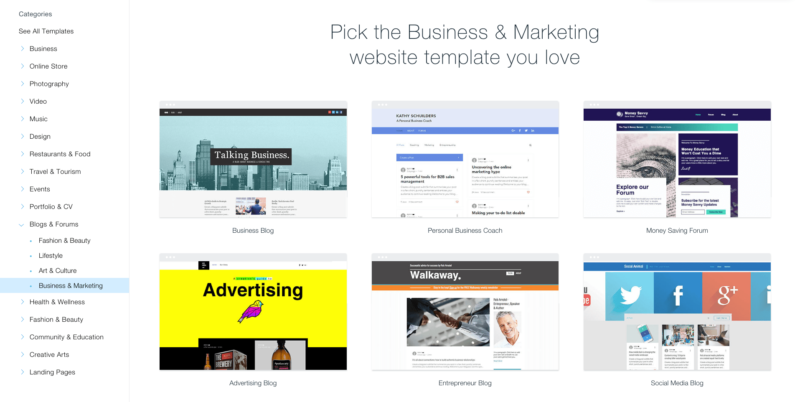
Wix Blog Templates

It comes with beautiful templates for any type of blog. They’re also easily customizable with their drag-and-drop editor. The blog manager is simple and intuitive, and you’ll get analytics and SEO built right in. It’s simple to add the basic features you might want on your blog: social tools, likes, comments, hashtags, categories, and subscriber forms.
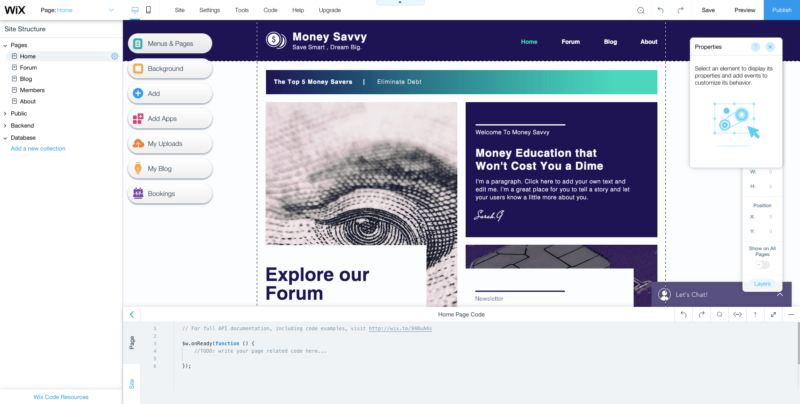
Editing a Wix Blog

All of the SEO features you need are easy to access too: alt tags for your images, internal links, SEO titles and descriptions (that are different from you post title), and nofollow tags for external links. Wix blogs have an automatic email subscription feature and a social media bar beneath each article for sharing on Facebook, Twitter, and more.

To build a blog on Wix, you’ll sign into your account and pick a template. There’s a Blog template category, which is a great place to start. Once you have your template selected, I suggest updating the font, colors, and logo to personalize your template and help it stand out from the rest.
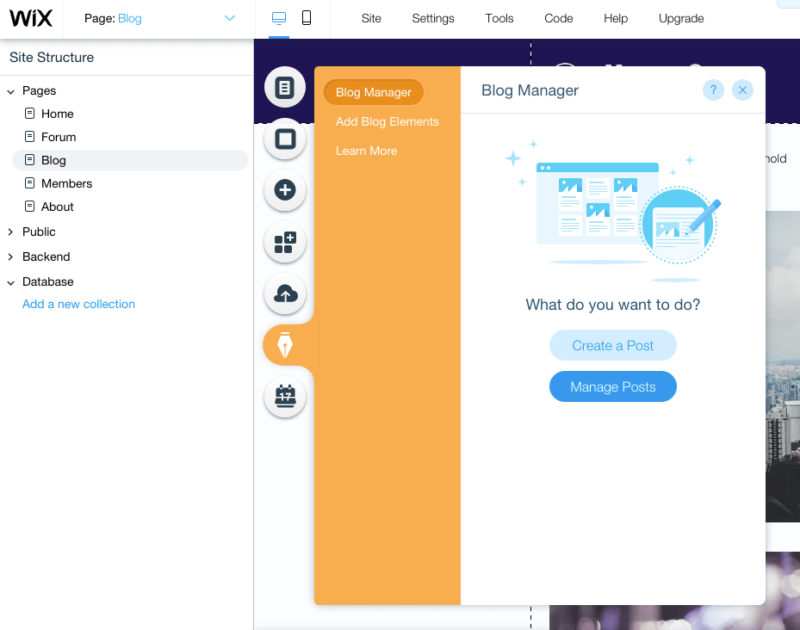
Create a blog post with Wix

Writing a post is as simple as clicking Create a Post, writing, and adding images. You can save drafts, or even give other contributors writing privileges for your site. This is all just as easy from a mobile device as from a desktop — no app required.

Make sure that you update your SEO settings for every post: this is what’s presented in the search results page and is critical for ranking in organic search.

The resulting post will have an automatic read-time count, like a Medium post right next to the author’s name, which I also like a lot. I also like the ability to live-chat with your readers in the Wix app. If you build a real community in your blog or are open to answering reader questions in real time — say about an online course you’re offering or a webinar that’s coming up — then it’s a cool feature.

Pros and Cons of Creating a Wix Blog

Wix is a fantastic option if you want a simple, but powerful blogging platform. With its drag-and-drop website builder, it’s an easy option if you’re looking to have your blog on your own site, rather than on a blog platform or service like Medium or another form of social media.

The downside is you’ll be paying a subscription fee and you’ll be locked into Wix’s themes and tools. So, you’ll trade some convenience for some flexibility. For most users, we think this trade-off is worth it.

• 14-day free trial
• Drag and drop site builder
• Integrated payment processing
• 500+ ecommerce templates
Try Wix for Free

WordPress – Best Blogging Software for Flexibility

WordPress by far the most flexible option. No matter what you want from your blog, it can be done with WordPress.

They’re also one of the most popular website builders in the world. So you’ll be in good company if you use it.

To build your own site, you’ll need to buy a domain name, get web hosting, and set up your WordPress account. There’s more information on our post The Best Web Hosting and on The Best Web Hosting for WordPress, which is about selecting a managed host that’s designed for WordPress.
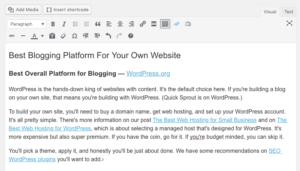
Backend of WordPress blog post

You will need to spend time configuring your site, that includes picking a theme, configuring it, setting up your WordPress settings, adding SEO WordPress plugins, getting all your content uploaded. For first-time bloggers, it can be overwhelming.

That’s the trade-off with WordPress. It’ll do anything you want but it takes more time to learn than an easier platform like Wix.

Pros and Cons of Blogging with WordPress

The main reason to use WordPress is for its complete flexibility. No matter what you want to build or how big you get, WordPress can handle it. This is the biggest benefit of using WordPress.

There are millions of plugins that give you all sorts of extra features. And if you really want, you can start changing the code yourself. WordPress is open-source which means you can do whatever you want with it. If you know PHP or are willing to hire a developer, you can change WordPress however you like.

But with such flexibility comes a lot of learning. You have to learn WordPress, the plugins, your theme, and how to write posts well. It’s a lot to take in when building your first site. If you just want to launch your site so you can start blogging right away, WordPress won’t be the easiest option.

Medium – Best Traditional Blogging Site

It’s hard to pin down how many users Medium has — they focus on sharing how much time is spent on the platform reading instead. I dig it. The platform, was founded by Twitter co-founder and former CEO Evan Williams as a response to the hyper-short limits of Twitter, hence the name Medium. Medium category page
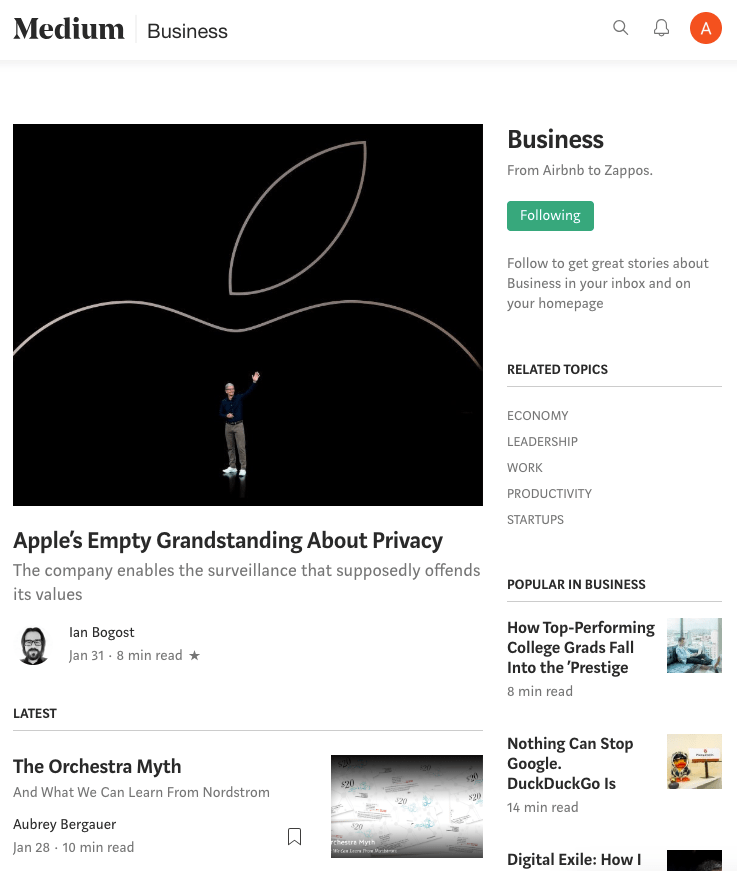
At one point, there was some distinction between even longer blog platforms, but that’s dissipated by now.

In 2017, Medium had 60 million unique visitors. From personal experience, I know that when I read on Medium, I read with curiosity and intent. I’m ready to put in some time reading, and the read times on each article get me to commit to sticking it out for the whole thing.

Posting with Medium is super simple. There’s a clean, very white WYSIWYG (what you see is what you get) editor. Basically, as you type, you see what the post will look like when it’s published. You’ll find that tips and tricks to format your post are a little hidden in the simplicity of the interface.

Don’t stop at this point though. Instead of just a profile, I recommend creating a Medium Publication. This gives you the option to add other writers and editors to your blog. More importantly, it gives you a lot more options for controlling what is essentially your blog homepage.

Take a look below at the difference between Patagonia’s basic Medium profile (top image below) and REI’s Medium publication (bottom image below).

Medium blog profile page

Above, a consecutive stream of your posts. This is all you’ll get with a Medium profile.
Below, the more magazine-style layout you’ll get with a Medium publication. 
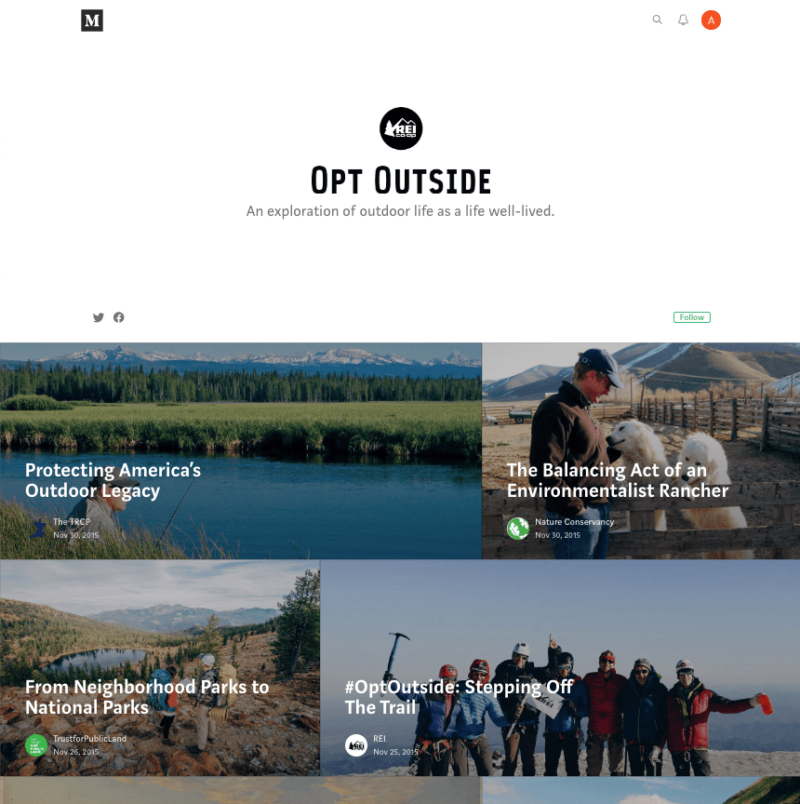
Medium blog publication page

One is a simple chronological feed and the other is a designed page with useful menu options. When you create a publication like REI’s, you also unlock the ability to send a newsletter to all of your followers.

Pro Tips for Blogging on Medium

  • If you are syndicating your actual blog, use the Import feature. This is essential for SEO.
  • To start a bulleted list, simply type an asterisk or a dash.
  • There are two types of quotes. Use a block quote by clicking the quote icon once. Click it again for a pull quote.
  • Drop caps add a little editorial weight. To make the first letter of your paragraph larger, and give it that designed look, highlight the letter. The option will appear.
  • Use TK to leave yourself notes. This is an old journalism trick — there are no words with TK in them in the English language. If you’re writing something that needs a placeholder, use TK and Medium will alert you if you try to publish with one still in place.

Pros and Cons of a Medium Blog

Medium is the best all-around traditional blogging platform. It’s where the majority of readers who’re looking to read classic blog-style posts are right now.

The downside is built into the choice of picking to create your own blog or build one on a platform — you won’t own the traffic and you won’t be able to do things like sell ad placements, for example.

Deciding to blog on WordPress vs Medium isn’t an either-or choice. You can also publish your site and re-publish some posts on Medium to take advantage of its benefits, just like you would any syndication deal. You can thoughtfully approach this, but there are some technical how-tos we’ll get into below. You’ll need to import your posts to Medium properly and set the canonical tag, so you’re not penalized by Google (at worst) or simply out-ranked by the Medium version of the post (at best). Overall, though, I prefer to see each channel as a separate channel and create and publish unique content for that channel.

LinkedIn – Best Blog Site for Business

There are 590 million LinkedIn users, 154 million of them in the US. And a lot of them are active: 44% are monthly active users. LinkedIn used to be basically a resume hosting platform. In a lot of ways, it was like a job-hunting dating app: you’d go on if you were looking to hire or looking to get hired but not much else. In the last few years that has changed dramatically.
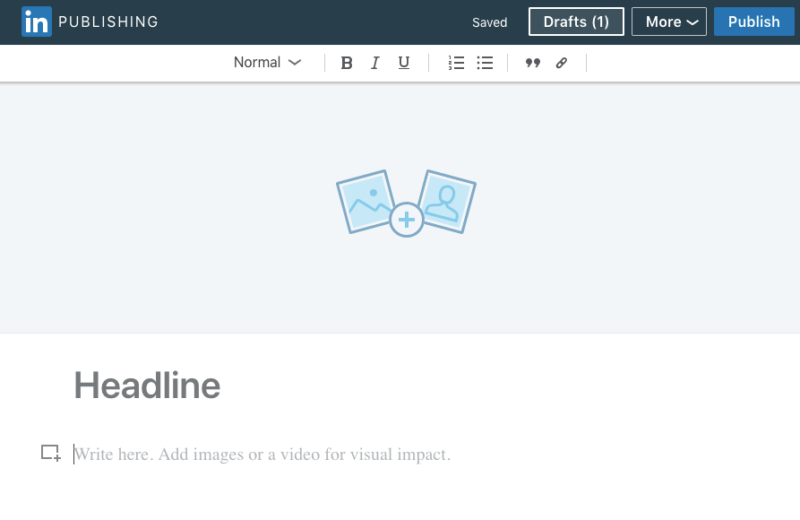
Publishing blog on LinkedIn

If you’re building a business blog, the audience on LinkedIn is premium: 45% of LinkedIn article readers are in upper-level positions (managers, VPs, Directors, C-level).

In an article for Forbes, “Is LinkedIn Poised To Be The Next Big Social Network … For Brands?”, Ryan Holmes nailed what’s great about the platform, “Hardcore LinkedIn users know that there’s a certain warm professionalism that underlies many exchanges on the platform. In short, LinkedIn offers a kind of stability, civility, and real value that’s sorely needed on some social platforms.” I completely concur. The platform has a ready-made culture and set of expectations that a business blogger would dream of creating on their own site. Why build it when it already exists?

LinkedIn is a social network. Your influence grows in proportion to the size of your network. The more posts you publish, the more connection requests and followers you’ll attract. Writing consistently not only expands your network, but it also reinforces the message about the depth and breadth of your knowledge of the subjects that you write about. — Glenn Leibowitz, “10 Tips for Writing LinkedIn Blog Posts That Expand Your Influence” for Inc.

Publishing doesn’t make you a LinkedIn Influencer, unfortunately. That’s a hand-selected group of people that rotates throughout the year “to include only the most engaged, prolific, and thoughtful contributors and to ensure that their expertise matches our members’ interests,” according to LinkedIn.

An article isn’t a post and vice versa. A post is a smaller update you’d share with your feed and connections. Think quick anecdote or pro tip. They’re limited to 1,300 characters, which is about 5 lines. Articles are longer and more in-depth. They’re something that the broader LinkedIn audience would be interested in reading. A person who reads your article can also follow you from there, so they’ll be alerted when you publish your next article. Any articles you publish will appear in the Articles section of your LinkedIn profile.

Pro Tips for Blogging on LinkedIn

  • Be clear about who you are and what you’ll be talking about it. Stick to that topic and don’t stray. And post regularly. Even posting once or twice a month — consistently over time — will add up. Twice a month is 48 times a year. In five years, you’ll have nearly 250 posts. That’s huge.
  • You can share a draft with a colleague or friend for feedback.
  • Use the stats related to your posts as a tool: create more of what’s working, less of what’s not.

Want to improve? Check out LinkedIn’s own course on getting better at blogging on the platform, Writing to be Heard on LinkedIn. Because when they own the platform, what’s good for them is successful content that people want to read and engage with.

Pros and Cons of Blogging on LinkedIn

If you’re blogging about business, or something related, like management, then I’d say to build your blog on LinkedIn. There’s a pre-existing community of people there talking about those topics and ready to read your posts too. You’ll be able to build business followers, which is different than a “connection.”

The audience on LinkedIn is premium: 45% of LinkedIn article readers are in upper-level positions: managers, VPs, Directors, and C-level. If you’re building thought leadership, brand value, or community, rather than trying to make money, I recommend going to where your audience is rather than trying to woo them over to where you are. Build content for them where they already are and they’ll love you for it.

You’ll be able to build your network and your business opportunities, but like all blog platforms, the cons here are that you’re beholden to the algorithm and don’t own the site or the traffic.

Instagram – Best Blog Site for Creatives

Instagram is primarily visual — the feed is all the images or videos, and very little of the captions. You can use the caption field for your text, and users like a long caption. You’ll be capped at 2,200 characters or about 300 words.

Instagram is perfect if what you’re sharing is visual: a lifestyle, art, dance. Or if there’s some way to share it visually like in a how-to mini-video.

In fact, in a lot of ways, Instagram has killed the entire genre of lifestyle blogging.

It’s become a lot harder for upstart “bloggers” in the crowded yet lucrative fashion, beauty, wellness, and lifestyle spaces to build a following centered around their own blog. At the same time, social media platforms have given influencers more and more tools—including e-commerce, groups, and direct messaging—to keep them (and their followers) from going elsewhere online.

— Rosie Spinks, “Instagram Has Killed the Art of Lifestyle Blogging” on Quartzy

Instagram is so good now that it’s hard to want to go anywhere else. The downside is definitely that you’re beholden to the algorithm and the feed, and the changes the platform makes. On the flip side, you also don’t have to be the product manager, hire a developer, or build an audience from scratch. You’ll have to weigh the pros and cons yourself.

You can also host vlogs on Instagram Live — simply tap the camera icon (top left of the screen, or by swiping right from the Feed) and tap Live at the bottom. When you’re ready to actually go live, it’s as simple as tapping Go Live. You’ll be able to see the number of viewers you have at the top of the screen and comments will pop in at the bottom. When you’re done, tap End. From here, I recommend tapping “Save” to save it to your camera roll and tapping “Share” to add it to your story. It’ll live there for 24 hours to be replayed by anyone who wasn’t around when it was actually live.

Pro Tips for Instagram Blogs

  • Pick a good name that’s catchy and easy to type — your name should make it clear what your whole feed is about.
  • Stick to a niche.
  • Have a visual point of view.
  • Don’t stray. If you’re an artist, don’t post pictures of your salad for lunch. If you’re a food blogger, think twice before you post photos of your doodles.
  • Post regularly! And engage.

You can only have one link in your profile, but with something like Linktree, you can add more links. I don’t think it’s a great idea to build a blog somewhere hoping to get your readers or followers to move from there to somewhere else on the regular. It’s feasible to get your Instagram followers to also subscribe to your newsletter, but it’s not really logical to hope they’ll leave Instagram after ever post and go read your blog. They’re scrolling through Instagram, not trying to read your website.

Think about your own behavior here — how much momentum does it take to get you to follow a link that leads away from the platform you’re in? For me, it takes a lot of work. There has to be something I really want to buy, or really, really want to read.

It’s more likely that I’ll follow someone on Instagram for a while and then one day I’ll buy something from that person, or follow them somewhere else. Instagram, and all blogging really, is about creating a relationship with the people who’re reading your posts. Once that relationship is strong enough, then people will be interested in going wherever you’re taking them. Until then, you’ll need to deliver on that relationship within the platform itself.

Pros and Cons of an Instagram “Blog”

If you’re a creative — especially in a visual field, then your blog should really be an Instagram account. You can post images of your work and use the caption field for your written post. If you’re not used to this idea, it might seem kind of zany: That’s not a real blog. But it is. People read Instagram captions of the accounts they follow like they’d read a blog — and your visual work will be well highlighted in your feed and the general feed. The cons are self-explanatory: you’ll have to follow the Instagram format, and are subject to the feed’s algorithm. It’s not impossible to monetize your Instagram feed, but you’ll be limited to those that you can feature in an image or caption. All of the monetization opportunities will need to be natively integrated.

Facebook – Biggest Blog Audience

1.49 billion daily active users is a number worth noting. How many of those active users will make it to your page or your post, now that’s another question.

Organic reach on Facebook was once not such a wild aspiration, but in 2016 there was a huge decrease in organic reach. SocialFlow found that brands saw a 42% decline in organic reach over Q1 and Q2 2016.

The easiest way to build a blog on Facebook is to create a group or a page for your business or brand. From there, your posts will literally be Facebook posts.

To make it easier to post and handle all your interactions in one spot, I recommend using the Facebook Creator Studio. It’s an all-in-one dashboard for publishing and analyzing your content. If you’re new to Facebook and are really using it as a classic blog platform, you’ll want to create Notes. These are the closest things to blogs: a header image, a title, and text down the middle.

From here you can also go live, post videos, gifs, polls, recommendations — any type of Facebook post you’ve seen you can create from this dashboard. You can even save, schedule, and backdate posts.

Pros and Cons of Blogging on Facebook

Of course, Facebook is the juggernaut in the room. It has the largest audience of any of these platforms. Creating a Facebook page might be all you need to build a blog — post on Facebook like you would on your blog and build your audience right there on your page. The comments and interactions on Facebook are even better than a traditional blog. You can really focus on building true fans on Facebook.

The cons of Facebook have really been blasted through the media lately. There are privacy concerns, there’s the issue of an ever-changing and pretty secretive algorithm, and all of that. You probably already have an opinion of Facebook — let that inform your decision here.

If you build your blog on a single platform that you do not own, well, then you’ve built your blog on a single platform you do not own. That means you’re beholden to another person’s business and their algorithm for your business. What’s good for their business and algorithm may not be what’s good for yours. That’s why I say if you’re here to make money, you should own your site. You’ll have more control.

Recap of the 6 Best Blog Sites and Blog Platforms for 2020

Best Website Builder for Blogging — Wix

If you want control over your own site and keep things easy, go with Wix. It’s a drag-and-drop editor that’ll get you up and running quickly, and you’ll still be building your blog on your own website, not on someone else’s platform.

• 14-day free trial
• Drag and drop site builder
• Integrated payment processing
• 500+ ecommerce templates
Try Wix for Free

Best Blog Software for Flexibility — WordPress

I’d recommend going this route to anyone serious about customizing your site and need complete control

Best Traditional Blogging Platform — Medium

If you’re not creating your own site and your blog is a classic blog — long-form posts about a topic that’s meaningful to you — I like Medium. It has a built-in audience that’s interested in reading and an interface that’s seamless.

Best Blog Site for Business — LinkedIn

Blogging about business or hoping to be a thought-leader in a certain industry? You could go with Medium, but a more rabid and useful audience might be waiting for you on LinkedIn. I know, it might not seem like a blogging platform, but LinkedIn users are really engaged and content-hungry.

Best Blogging Site for Creatives — Instagram

If you’re doing anything with images, art, creativity, or lifestyle, you’ll probably find your audience on Instagram. There are already so many people there and it’s easy for new followers to discover you through hashtags, comments, and the other people you and they are following.

Largest Audience — Facebook

Lastly, the biggest audience is on Facebook. There are millions of people there, and though organic reach on the platform isn’t what it once was, it’s still a massive platform. It’s also a great spot for building a community page element to your blog.


from Quick Sprout https://ift.tt/2AgqjKQ
via IFTTT

Friday, July 31, 2020

Best Office Chairs

If you’re spending 40+ hours per week seated at a desk, having a great office chair is crucial for both comfort and functionality. The right office chair can even boost your productivity.

On the flip side, the wrong office chair can cause pain in your neck, back, hips, legs, and more. Your chair could even make you susceptible to long-term health complications.

With remote work becoming the new normal, so many people are trying to upgrade their home offices. Getting a new office chair is the first step.

Whether you’re buying office chairs in-bulk for your conference room or just need a single chair for your home office, this guide contains the top nine office chairs on the market today.

The Top 9 Best Office Chairs

Each review below contains the features, benefits, pricing, and use cases for the office chairs on our list. Use this information to find the best office chair for you.

#1 – Steelcase Gesture — Best Overall Office Chair

• Starts at $1,698
• 12 colors
• Supports different postures
• Fully customizable
Shop Now

The Steelcase Gesture is the best office chair available on the market today. For home offices and at-work use alike, it has everything you could possibly need or want in a chair.

Steelcase conducted a posture study on 2,000 people while designing this chair. This ensures that it can accommodate a wide range of seating needs and preferences while delivering comfort and support.

It comes in 12 different colors to match any space or work environment. The chair comes in a wide range of pre-configured options—wrapped back, headrest, stool, shell back, stool with shell back, and stool with wrapped back.

If you don’t like one of those pre-configured chairs, you’ll have the freedom and flexibility to customize your own.

Optional features include:

  • Polished aluminum base
  • Glides
  • Adjustable lumbar
  • Coat hanger
  • Fixed arm
  • Armless

The Steelcase Gesture starts at $1,698, which is a little steep for some people. But if you’re spending 40+ hours a week sitting in a chair, the price is justifiable.

#2 – Herman Miller Mirra 2 — Best For Home Offices

• Starts at $745
• 12 year warranty
• Free shipping
• 30 day free returns
Shop Now

The Herman Miller Mirra 2 makes an excellent addition to any home office. It has the perfect balance between comfort and sleek design.

Choose one of five modern colors—alpine, graphite, cappuccino, dark turquoise, or slate grey. You’ll also have the option to select a butterfly suspension back or a triflex polymer back.

Herman Miller gives you the option to customize your chair based on preferences for comfort and functionality, including:

  • Adjustable lumbar support
  • Standard tilt
  • Tilt limiter
  • Tilt limiter and seat angle
  • Adjustable arms
  • Fixed arms
  • Fixed seat depth
  • Front adjustable seat depth
  • Carpet vs. hard floor casters

The chair is made at a 100% green-energy facility in Michigan. It comes with a 12-year warranty, free shipping, and 30-day free returns.

The Herman Miller Mirra 2 starts at $745.

#3 – Humanscale Liberty Task — Best Mesh Back Office Chair

• Starts at $1,069
• Weight-sensitive recline
• Form-sensing mesh
• Lumbar support
Shop Now

Humanscale has a wide range of different office chairs for you to choose from. But their Liberty Task chair is a top choice for anyone who prefers a mesh back.

The chair is designed to encourage movement while accommodating users of different sizes and weights. It features a weight-sensitive recline, so there’s no need to make any manual adjustments.

The ability to accommodate any user makes the Liberty Task chair a popular choice for conference rooms and shared office spaces.

It provides excellent comfort and lumbar support while still offering a minimalist aesthetic and modern design.

You can customize your own Liberty Task chair or choose from a wide range of pre-configured models. Features available for customization include

  • Armrests
  • Frame color
  • Back mesh
  • Mesh color
  • Seat textile
  • Seat type
  • Cylinder height
  • Fireproofing
  • Base upgrades

The one potential drawback is the shipping time. Custom models typically don’t ship for 2-4 weeks, which isn’t ideal if you need an office chair ASAP.

The Humanscale Liberty Task chair starts at $1,069.

#4 – Autonomous ErgoChair 2 — Best Ergonomic Office Chair

• Starts at $349
• Free shipping
• 2 year warranty
• Fully adjustable components
30 Day Free Trial

As the name implies, the Autonomous ErgoChair 2 is built with ergonomic design. This chair is perfect for anyone who prioritizes maximum efficiency related to comfort.

It’s great for preventing back pain, improving posture, and providing extra lumbar support.

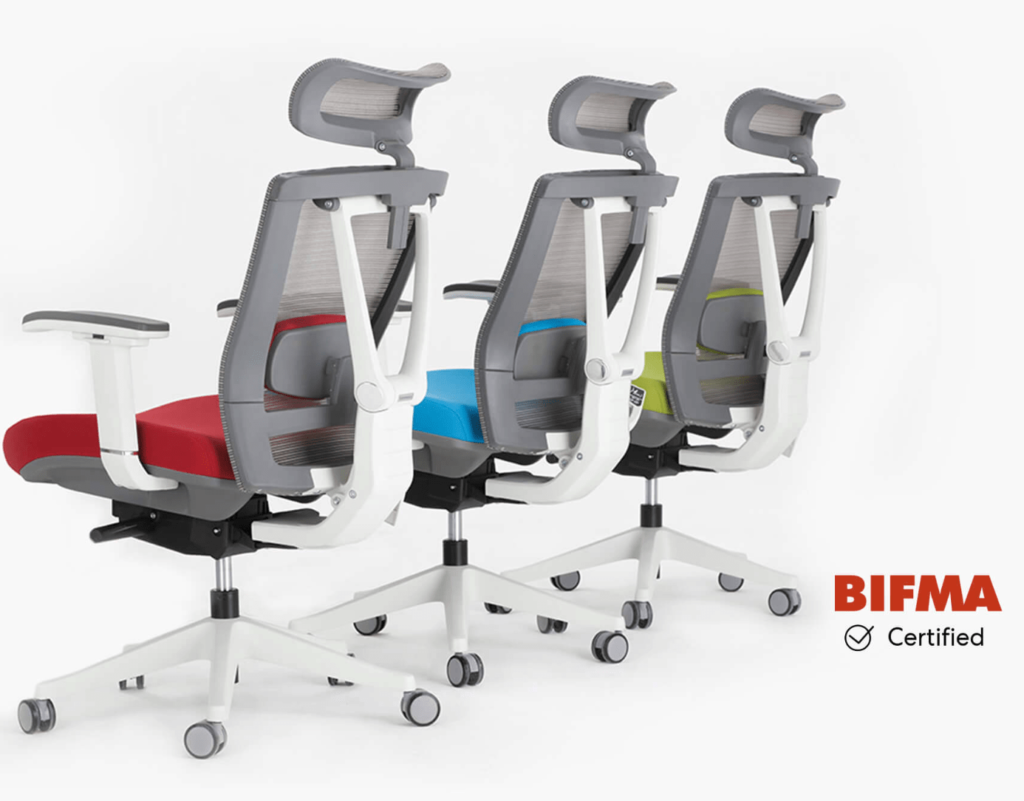
The Autonomous ErgoChair 2 carries a BIMFA (Business and Institutional Furniture Manufacturer’s Association) certification for its safety, performance, and ergonomics.

Essentially every feature of the chair can be adjusted for comfort:

  • Headrest height
  • Headrest tilt
  • Back tilt
  • Back tilt tension
  • Seat tilt
  • Lumbar support tension
  • Handrail height
  • Handrail direction
  • Chair height

For such a comfortable and functional chair, the Autonomous ErgoChair 2 is surprisingly affordable. It can be yours for just $349.

The chair comes with a two-year warranty and free shipping. Try it free for 30 days.

#5 – BTExpert Mid Back Task Chair — Best Armless Office Chair

• $105
• Compact Design
• 360 degree swivel
• Rolling caster wheels
Shop Now

If you’re not sitting at a desk all day and just need a small chair for writing quick notes or sending out the occasional email, you don’t need to spend a fortune on an office chair.

The Mid Back Task Chair from BTExpert is perfect for small desks or even low built-in counter spaces where you open the mail, write checks, or don’t spend a ton of time sitting.

The compact design makes it easy to tuck beneath a desk or table when it’s not being used, without taking up a ton of space in the room.

It’s simple, modern, and elegant, while still proving sturdy support and functionality.

You’ll benefit from features like a 360-degree swivel, fast assembly, non-scratch leg tip, five-point stainless steel finish, and rolling caster wheels.

Unlike other office chairs on the market, you can’t really customize the Mid Back Task Chair. What you see is what you get. But it’s one of the best cheap office chairs on the market. Buy it now for the low price of just $105.

#6 – Global Arturo — Best Leather Office Chair

• Starts at $1,007
• Premium leather
• Memory foam
• Customizable
Shop Now

The Global Arturo is a premium leather chair that comes with plush cushions and detailed stitching.

It’s available in three different models—high back, extended high back, and low back.

The chair is perfect for anyone who wants an office chair that blends comfort with luxury. It comes standard with upholstered arms for added comfort and a padded headrest to provide extra head and neck support.

All three models can be fully customized. You can choose your preferences for features like:

  • Base finish
  • Cylinder
  • Gaster glides
  • Frame
  • Backing
  • Memory foam
  • Commercial vs. performance textiles

The Global Arturo office chair starts at $1,007.

#7 – Via Oslo — Best Custom Office Chair

• Starts at $1,283
• Low and high back models
• 400 lbs. capacity
• Fully customizable
Build Your Own

For those of you who want a unique office chair, the Via Oslo is fully customizable. In fact, there aren’t any pre-configured models for you to choose from.

The only way to get this chair is by building your own.

Start by choosing from a high-back or mid-back chair. Then personalize virtually every aspect of the chair, including:

  • Arms
  • Base
  • Casters
  • Upholstery
  • Upholstery layout
  • Colors
  • Textiles

The Via Oslo delivers a timeless design. You’ll also benefit from saddle stitch lines, tilt adjustment, depth adjustment, and more. It has an impressive 400-pound maximum weight capacity, so you know that the chair is sturdy and strong.

All models are backed by a 12-year warranty. The low-back model starts at $1,283, and the high-back model starts at $2,448.

#8 – Branch Task Chair — Best Budget Office Chair

• $199
• Free shipping
• Easy to assemble
• 5 adjustable options
Shop Now

Some office chairs can be pretty pricey. So if you don’t want to spend $500+ or upwards of $1,000 on a chair, you can still get an excellent quality product from Branch.

The Branch Task Chair is the best office chair under $200. It’s proof that you can get a budget office chair without sacrificing comfort and functionality.

This is a great option for anyone who wants a sleek design with premium ergonomics at an affordable price point. You’ll benefit from features like adjustable lumbar support, breathable mesh, and five points of adjustment:

  • Tilt adjust
  • Tilt tension adjust
  • Height adjust
  • Armrest adjust
  • Lumbar adjust

Aesthetically, the Branch Task Chair blends in well with any home office design. It’s easy to assemble and ships for free in 1-3 days.

Buy it now for $199.

#9 – Vari Active Seat — Best Office Chair For Standing Desks

• $250
• No assembly required
• Free shipping
• 30 day money back guarantee
Shop Now

Standing desks have been growing in popularity. But even with an adjustable-height desk, you probably won’t spend the whole day standing.

So if you want to sit from time to time while working at your standing desk, the Vari Active Seat is perfect for you.

The Vari active seat comes fully assembled right out of the box so you can start using right away.

It features a wide cushioned seat and a bent plywood base to deliver maximum comfort and sustainable durability. You’ll benefit from a dynamic range of motion with the chair’s articulating pedestal—it’s designed for movement.

The Vari Active Seat lifts up to 32.75 inches, making it easy to use at your standing desk.

It’s comfortable but still lets you work with great posture. Vari also has a wide range of standing desks, so you can get more than just an office chair with your order.

The Vari Active Chair costs $250. It’s backed by a 30-day guarantee and ships for free.

How to Find the Best Office Chairs For You

How hard can it be to pick an office chair? Surprisingly enough, not all chairs are the same.

This is the methodology that we used to narrow down our top picks in this guide. Keep these factors in mind as you’re evaluating prospective options.

Comfort

First and foremost, your chair needs to be comfortable. Some of you might be sitting in this chair for 40-60+ hours per week.

The best way to evaluate comfort without actually sitting in the chair itself is by checking out customer reviews. Some companies will even offer a money-back guarantee or trial period.

Assembly

If you’re buying an office chair online, it typically won’t come fully assembled. This means you’ll have to put it together on your own.

In most cases, this shouldn’t be too complicated. Depending on the chair, this could take anywhere from five to ten minutes at most. Consider looking at the instructions before you buy to see if it’s something you feel like tackling on your own.

Warranty

The best office chairs come with extended coverage. What if something happens to the chair and it breaks next month? What about next year?

If you’re paying hundreds or even $1,000+ on a product, you want to make sure that the manufacturer stands behind its quality.

Adjustability

Make sure you can adjust the chair. This will accommodate different desk heights and users, which is crucial if the chair is being shared by multiple people.

The best chairs allow you to adjust the seat height, seat angle, and seat depth. In some cases, you’ll also be able to adjust the armrests, back height, back angle, and more.

Lumbar Support

It’s possible for chairs to be comfortable, but terrible for your back. The best office chairs provide excellent lumbar support, which will help prevent back pain and long-term damage to your spine.

Aesthetics

I’m typically more of a “function over form” type of person. But depending on the circumstances, some office chairs might not fit the environment.

You don’t want your office chair to be an eye-sore in the room. The best chairs allow you to customize the colors and other features to match your office. However, this may not be important to everyone.

Conclusion

What’s the best office chair on the market today? We recommend the Steelcase Gesture. But there are plenty of other excellent options to choose from depending on your needs.

If you’re on a tight budget, check out the Branch Task Chair or the BTExpert Mid Back Task Chair. For those of you with a standing desk, the Vari Active Seat will be the best option for you.

Want a premium leather office chair? Get the Global Arturo. Anyone that prioritizes ergonomics will love the Autonomous ErgoChair 2. The Herman Miller Mirra 2 is our favorite home office chair. The Via Oslo is fully customizable.

Make sure you refer to our buying guide methodology as you’re shopping around. No matter what type of chair your office needs, you can find it on our list.


from Quick Sprout https://ift.tt/33fdm3U
via IFTTT

Best Customer Service Software

Want to jump straight to the answer? The best customer service software is Zoho Desk, Hubspot, and LiveAgent

Customer service software makes sure your customers are happy and satisfied with your business.

After all, your customers make or break your success.

Happy customers keep coming back and spending more money, while unsatisfied customers will cause significant damage to your reputation.

That’s why customer service must be a priority for every business.

Fortunately, the right customer service software can make this possible. Customer service solutions help ensure fast response times, positive interactions, and happy customers.

The 8 Best Customer Service Software of 2020

It’s tough to find a good customer service software. There’s many options available on the market. But some of these tools are significantly better than others.

After researching and testing dozens of customer service solutions, I’ve narrowed down the top eight for you to consider.

  • Zoho Desk — Best customer service software for ticketing.
  • HubSpot — Best free customer service software and product bundles.
  • LiveAgent — Best customer service software for live chat support.
  • Freshdesk — Best customer service software if you’re switching from another platform.
  • Zendesk — Best customer service software with support suite options available.
  • Salesforce Service Cloud — Best customer service software for field service agents.
  • Groove — Best customer service software for small teams and growth startups.
  • Help Scout — Best customer service software for nonprofits.

As we continue you through this guide, I’ll give you an in-depth review of each one below. You’ll learn about the top features, benefits, use cases, pricing, and more.

Best Customer Service Software Reviews

Zoho Desk (Best for ticketing)

• Free forever plan
• Upgrade starting at $12/mo
• Email ticketing & help center
• Mobile app access
Try for Free

Zoho is one of the most popular names in the world of business software and CRM. They offer tools for sales, marketing, email, collaboration, finance, accounting, human resources, and business intelligence.

But one of the best solutions that they offer is Zoho Desk—IT and help desk software.

Zoho Desk has solutions for customer service agents, managers, and customers. But above all, it’s arguably the best customer service software for managing and closing tickets.

Let’s take a closer look at the plans and price points for Zoho Desk:

Free — $0

  • Up to three agents
  • Email ticketing
  • Help center
  • Private knowledge base
  • Predefined SLAs
  • Mobile app
  • Multilingual help desk

Standard — $12 per month per agent

  • Social and community channels
  • Product-based ticket management
  • Public knowledge base
  • Escalations
  • Workflow and assignment rules
  • Supervise rules
  • Customer happiness ratings

Professional — $20 per month per agent

  • Multi-department ticketing
  • Team management
  • Telephony
  • Automated time tracking
  • Ticket templates
  • Ticket sharing
  • Mobile SDK

Enterprise — $35 per month per agent

  • Live chat
  • AI
  • Customize help center
  • Advanced process management
  • Scheduled reports
  • Validation rules
  • Role-based data sharing

No matter how big, small, or complex your business is, Zoho Desk has a plan for you.

HubSpot (Best free customer service software)

• 100% free forever plan
• Advanced features start at $40/mo
• Wide range of solutions
• Free software for customer service
Try for Free

HubSpot is one of the most well-recognized CRMs in the industry. They have a wide range of software and solution suites for managing relationships with customers.

These offerings are segmented into three main categories—sales, marketing, and service.

The HubSpot Service Hub is what we’ll be focusing on here today. It’s an exceptional solution for managing customer issues through service tickets.

I like HubSpot because they offer free CRM solutions, including free software for customer service. Free features include ticketing, live chat, chatbots, team email, and a conversations inbox. You’ll also benefit from free email templates, closed ticket reports, and time-to-close reports.

HubSpot is proof that you don’t need to spend a ton of money on improving your customer service with software. This won’t cost you a thing.

For those of you who want access to advanced features and benefits, here’s an overview o the paid plans:

Starter — $40 per month

  • Includes two paid users
  • Canned snippets
  • Meeting scheduling
  • Agent productivity reports
  • Calling

Professional — $320 per month

  • Includes five paid users
  • Ticket status, routing, automation, and pipelines
  • Knowledge base
  • 1:1 video creation
  • Custom reporting
  • Surveys for NPS, experience, and support

Enterprise — $1,200 per month

  • Includes ten paid users
  • Playbooks and goals
  • Hierarchical teams
  • User roles
  • Single sign-on
  • Integrates with Slack

All rates are based on an annual contract. You can get the HubSpot Service Hub month-to-month for 20% more.

HubSpot also offers exceptional product bundles for all CRM categories in a single solution. So if you want to get software for service, sales, and marketing from a single provider, HubSpot is the best option for you. Bundles start at $112.50 per month.

LiveAgent (Best for live chat support)

• 100% free forever plan
• Upgrades starting at $15/mo
• All-in-one solution
• Simple and flexible tools
Try for Free

LiveAgent is a customer service solution that helps you manage all customer requests from multiple channels in a single platform.

No matter where your customers are, you can merge all communication and support to one place. LiveAgent saves you time, simplifies the process, and allows you to increase the profitability of your support team.

LiveAgent has tools for:

  • Email ticketing
  • Live chat
  • Voice and video calls
  • Social media integration

Here’s a closer look at the plans and prices for customer service software form LiveAgent:

Free — $0 forever

  • 7 day ticket history
  • 1 email address for ticketing
  • 1 live chat button
  • 1 phone number for call center support

Ticket — $15 per month per agent

  • Unlimited ticket history
  • Unlimited email ticketing
  • Load data from your CRM
  • Multi-brand support

Ticket + Chat — $29 per month per agent

  • Unlimited live chat
  • Real-time visitor monitor
  • Chat invitations
  • Chat satisfaction surveys

All-inclusive — $39 per month per agent

  • Unlimited call center support
  • Video calling
  • Gamification
  • Unlimited call storage

For all of the paid plans, LiveAgent has add-on pricing for features like social media integration, time tracking, audit logs, and more.

Overall, it’s a simple and flexible tool for managing live customers with ticketing and live chat.

Freshdesk (Best for switching platforms)

• Free 21-day trial
• Plans start at $15/mo
• Extensive list of features
• Trusted by 150,000+ businesses
Try for Free

Freshdesk is another one of the most popular help desk solutions on the market today. Above all, it’s simple. That’s why it’s trusted by 150,000+ businesses, including American Express, HP, and Panasonic.

With Freshdesk, you’ll have access to an extensive list of features across a wide range of customer support categories:

  • Ticketing
  • Collaboration
  • Field Service
  • Automation
  • Customer self-service
  • Reporting
  • Multi-channel support

It’s an excellent solution to streamline all of your customer connections in a single location. Freshdesk makes team collaboration and automation a breeze.

If you’re currently using another help desk solution and you’re unhappy with it, Freshdesk makes it easy for you to switch to its software.

Here’s an overview of the plans and pricing. All rates are based on an annual plan. The prices are a bit higher if you go month-to-month.

Sprout — Free

  • Unlimited agents
  • Email ticketing
  • Team collaboration
  • Knowledge base
  • Ticket trend reports
  • Social ticketing

Blossom — $15 per month per agent

  • Automations
  • Collision detection
  • Marketplace apps
  • Helpdesk
  • SLA management
  • Business hours

Garden — $29 per month per agent

  • Time tracking
  • CSAT survey
  • Session replay
  • Performance report
  • Knowledge base with multi-lingual support

Estate — $49 per month per agent

  • Automated ticket assignment
  • Custom agent roles
  • Custom portal
  • Enterprise reporting
  • Multiple time zones and SLAs

Forest — $109 per month per agent

  • Ticket assignment based on skills
  • Create a testing environment without affecting agents or customers
  • IP Whitelisting
  • HIPAA compliant
  • Extendable API rate limit

Freshdesk has omnichannel add-ons and features for field service management for an additional fee. Try it free with a 21-day trial.

Zendesk (Best with support suite options)

• Free trial available
• Starts at $89/mo
• Flexible customized solutions
• Used by 150,000+ businesses
Try for Free

Zendesk is one of the best overall customer service software solutions on the market today. It’s used by 150,000+ businesses, including big brands like Uber, Venmo, Shopify, and Slack.

The Zendesk support suite has everything you need to manage customer service communication across multiple channels. You can provide customer support via email, live chat, voice, Facebook, Twitter, WeChat, WhatsApp, and more.

The software makes it possible to connect all of your data sources to a single location. So when a customer contacts you for support, the right information will automatically be on display.

Zendesk is flexible, so it can support the needs of any business. You can get a customized solution that fits with your existing support environment.

Here’s a quick overview of the plans, features, and pricing for the Zendesk support suite:

Professional Support Suite — $89 per agent per month

  • Omnichannel support
  • Social messaging add-on
  • Self-service knowledge base
  • Dashboards and reporting for all channels
  • Talk partner edition
  • Multiple ticket forms

Enterprise Support Suite — $149 per agent per month

  • Roles and permissions with skilled base routing
  • Multi-brand support
  • Chat widget and web SDK
  • Content cues to identify knowledge gaps
  • 24/7 live chat and phone support

The full-service support suite from Zendesk has it all. But not every business needs something this comprehensive. If you’re looking for something a little bit more basic, Zendesk offers more affordable options for smaller businesses.

  • Essential — $5 per month per agent
  • Team — $19 per month per agent
  • Professional — $49 per month per agent
  • Enterprise — $99 per month per agent
  • Elite — $199 per month per agent

You can try any Zendesk software or support suite with a free trial. If you’re looking for a customized solution, contact the Zendesk sales team.

Salesforce Service Cloud (Best for field service agents)

• Starts at $25/month
• Resolve cases quicker
• Streamline your on-site support
• Trusted by 150,000+ companies
Get Started Now

Salesforce is an industry leader in sales CRM software. But they also offer tools and solutions for customer service. It’s trusted by 150,000+ companies across the world.

The Salesforce Service Cloud makes it easy for any business to build customer relationships while saving time and improving customer satisfaction. Brands like Yeti and Adidas are just a couple of well-known names that use this software.

Your customer service representatives will be able to resolve cases quicker with the insights and tools offered by Salesforce. The platform has a shared view of every customer interaction.

Set up self-service portals so your customers can access account information, view tutorials, and view knowledge base articles.

The Salesforce Service Cloud has capabilities to streamline your on-site support. Field service works, dispatchers, and on-site technicians can use these tools to resolve problems during the first visit.

Salesforce uses AI to predict recommendations and provide support with an intuitive chatbot service.

Let’s take a look at the plans and pricing for Salesforce Service Cloud:

Essentials — $25 per user per month

  • Case management
  • Service console apps
  • Knowledge tools
  • Telephony integration (CTI)

Professional — $75 per user per month

  • All Essentials features
  • Service contracts

Enterprise — $150 per user per month

  • All Professional features
  • Web services API

Unlimited — $300 per user per month

  • All Enterprise features
  • 24/7 support and configuration

All plans come with tools for collaboration, productivity, personalization, real-time insights, cross-sell and upsell tools, app integration, and solutions to automate processes.

Salesforce offers add-ons for things like field service workers, digital engagement, and location-based intelligence.

Groove (Best for small teams and growth startups)

• Plans start at $9/month
• Team collaboration tools
• Customizable knowledge base
• Exceptional automation tools
Get Started Now

Groove isn’t as popular and well-known as some of the other options on our list. But it’s still used by more than 10,000 businesses across 140+ countries.

If your company has outgrown email for customer support and you’re getting inquiries on multiple channels, Groove will be a top choice for you to consider.

This solution stands out from the crowd with its team collaboration tools. You can add internal private notes to discussions, quickly mention teammates to bring them in the loop, and assign specific tasks to members of the team.

Groove has exceptional automations to streamline your customer support. Set rules, tagging, canned replies, and custom folders with your preferences to eliminate busywork.

Another standout feature from Groove is the ability to customize your knowledge base. This is crucial for businesses that want to offer customer self-service tools.

The knowledge base themes are fully customizable, beautifully designed, and mobile responsive. Plans and pricing for Groove customer support software are as follows:

Starter — $9 per month per user

  • One mailbox
  • Knowledge base
  • Live chat
  • Web widget
  • Assignments and mentions

Plus — $19 per month per user

  • 5 mailboxes
  • Full history of reports
  • Rules
  • API access
  • 40+ integrations

Pro — $29 per month per user

  • 25 mailboxes
  • Teams
  • WhatsApp and SMS
  • Integrations with Salesforce, HubSpot, and Jira

Company — Custom pricing

  • Unlimited mailboxes
  • Priority support
  • Dedicated customer support manager
  • SSO/SAML
  • Enterprise-level security

I’d recommend Groove for small teams and startups. In fact, they have a special startup rate for businesses with less than ten employees. Eligible businesses can get a 93% discount off of the Pro plan.

Help Scout (Best for nonprofits)

• Plans start at $20/month
• Certified B corporation
• High-quality software
• Used by 10,000+ businesses
Try for Free

Help Scout is another lesser-known solution on our list. But with that said, it’s still a high-quality software for customer service. It’s used by 10,000+ businesses worldwide.

Help Scout is unique because it’s a Certified B corporation. They strive to make a positive impact on the environment and communities. So they go the extra mile to support organizations that share the same values.

If you have a nonprofit that supports human rights, environmental sustainability, or underrepresentation in tech, Help Scout will provide a significant discount on your customer service software.

Some of you might even be eligible for discounts of up to 100%. That’s right—free.

Even if you don’t fall into one of those categories, Help Scout is still a top solution for customer service. Here’s a closer look at the plans and prices:

Standard — $20 per month per user

  • Three mail boxes
  • Beacon with live chat
  • Messages for up to 10,000 customers
  • Reports
  • Automated workflows
  • 50+ integrations

Plus — $35 per month per user

  • 10 mailboxes
  • Custom fields and teams
  • Salesforce, HubSpot, and Jira apps
  • HIPAA compliance
  • SSO/SAML authentication

Company — Custom pricing

  • Unlimited mailboxes and docs sites
  • Flexible users
  • Concierge onboarding
  • Dedicated account manager
  • Enterprise-grade security

The rates above are based on an annual contract. Month-to-month plans are available for an additional fee. You can try Help Scout for free with a 15-day trial.

How to Choose the Best Customer Service Software For Your Business

What’s the best customer service software for your business? There are certain features and considerations to keep in mind as you’re evaluating different options.

This is the methodology that we use and recommend here at Quick Sprout.

Number of Agents

How big is your customer service team? Companies with five service reps won’t need the same software as a business with 50 agents.

Larger teams need features for things like collaboration and role-based ticketing, but that won’t be necessary for a smaller business.

Customer Communication Method

How are customers currently reaching out to your service team? How do you want them to do so moving forward?

There’s a software for everything. Whether it’s email, live chat, chatbots, or support tickets, you can find a solution to meet your needs. There are even tools for social media integration so all of your messages, including DMs and comments, can be managed from a single dashboard.

Feature Bundles

Every customer service software on our list does an exceptional job of marketing its top features. But with that said, you should only focus on the features you need the most.

For example, are you looking for customer service software specifically for live chat? LiveAgent will be a top choice for you. If you want a solution for your field service agents, use Salesforce Service Cloud. There are even tools for customer service, sales, and marketing CRM built into single product bundles.

My suggestion is this. Identify the features you definitely need. Then look for the right plan that has all of those features.

Price

The price for customer service software varies on a wide range of factors. Lots of solutions charge you based on the number of customer service agents on your team.

Available features in your package will also have a significant impact on what you pay.

Customer service is definitely not something you should skimp on. It’s ok to spend money. But with that said, not all of you need to go overboard. Small businesses, startups, and nonprofits with smaller teams can use free customer service software without compromising quality.

Conclusion

Every business must prioritize customer service. These are the top eight customer service software solutions on the market today:

  • Zoho Desk — Best customer service software for ticketing.
  • HubSpot — Best free customer service software and product bundles.
  • LiveAgent — Best customer service software for live chat support.
  • Freshdesk — Best customer service software if you’re switching from another platform.
  • Zendesk — Best customer service software with support suite options available.
  • Salesforce Service Cloud — Best customer service software for field service agents.
  • Groove — Best customer service software for small teams and growth startups.
  • Help Scout — Best customer service software for nonprofits.

Use this guide to help you find the best solution for your business. I made sure to include something for everyone on my list.


from Quick Sprout https://ift.tt/2JtZyap
via IFTTT