Wednesday, December 19, 2018

How to Increase Engagement on Facebook Videos

Videos are a crucial component of your content marketing strategy. Once your videos are created, you need to distribute them on as many channels as possible.

With more than 2.2 billion monthly active users, it’s only logical for Facebook to be one of those distribution platforms.

Overall, this should be a winning strategy for your business. Here’s why.

According to research, 90% of consumers report that videos help them making purchasing decisions. And 64% of people say that watching a video increases their chances of buying something.

Further, 77% of businesses are using videos on their social media channels. Consumers are used to seeing this type of content from brands.

By using videos to improve your social media marketing strategy, your company will be able to:

  • generate leads
  • create brand awareness
  • increase website traffic
  • drive sales

But there’s a catch. You can’t assume that all your videos will be effective just because you published them on Facebook.

Your videos need to drive engagement.

If people aren’t engaging with your content, this strategy will not be effective.

Fortunately, there are plenty of ways for you to increase the engagement rates of your Facebook videos. That’s what inspired me to write this guide.

Use this as a reference to help you produce better videos moving forward and fix some of the videos you already shared. Here’s what you need to do.

Add subtitles

Usually, good audio is a key factor of a good video. Spoken words and other sounds can help you convey a message.

But if you’re relying on audio to drive engagement on Facebook videos, it’s going to be a problem.

That’s because 85% of videos on Facebook are watched without sound.

If people are speaking in your video, you need to add subtitles to the video. Even if your video doesn’t have people speaking, you can use subtitles as a way to narrate your video.

Explain what’s happening. Your video must be optimized for silent viewing.

Plus, Facebook videos automatically start playing on mute when users scroll through news feeds on both desktop and mobile devices.

If your videos require volume to get the message across, it could be why your engagement rates are so low.

Here’s an example of how Forbes Magazine used subtitles on this Facebook video:

forbes1 1

Dwayne “The Rock” Johnson is speaking throughout this entire video. But even those watching with the sound off will receive his message.

Here are the detailed instructions for how to add closed captions on Facebook.

You can also do this manually with editing software such as:

  • Adobe
  • Final Cut Pro
  • Animoto

Knowing that most people watch videos on silent on Facebook will change the way you produce content.

If you have videos that require audio, you could always add captions asking viewers to turn the sound on to experience the video in a better way.

Here’s an example from Tasty:
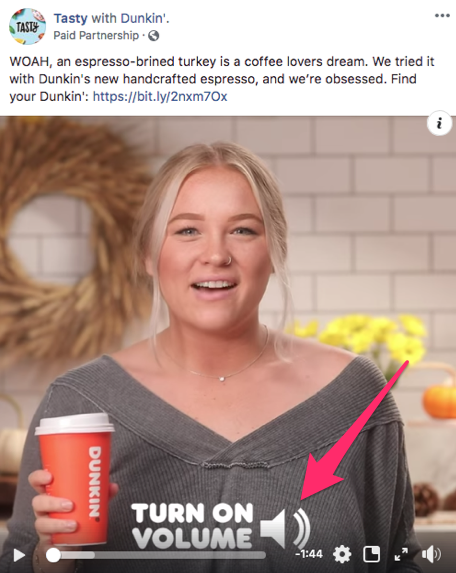
tasty

You don’t need to completely abandon audio. I’m not saying you should start creating videos without sound.

Just make sure they are optimized for silent viewing. Adding subtitles or captions is the easiest way to do that.

Publish a square format

Square videos have a 1:1 ratio. This format is much better for mobile users.

Why is this important?

Well, 92% of Facebook users access it on their mobile devices daily.

When square videos are played on these devices, they take up more real estate on the screen.

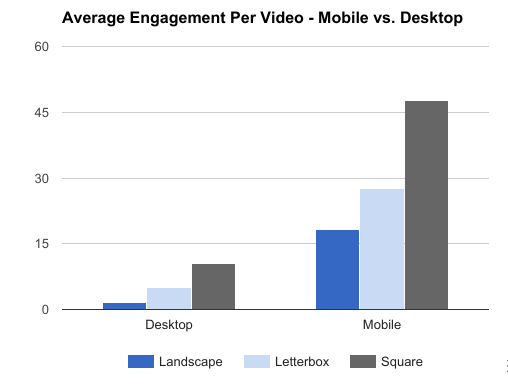
But engagement rates are higher on square videos on both mobile and desktop devices.
square

Furthermore, square videos have an average higher reach on mobile and desktop devices compared to landscape and letterbox formats.

The only time when a landscape video outperforms a square video is when it comes to the average completion rate on desktop devices.

Do you want people to watch your videos in full? Absolutely.

But remember, we’re trying to drive engagement.

Square videos still have a higher completion rate on mobile devices. If your desktop completion rate is the only metric that might suffer here, it’s still worth it to publish square videos.

It’s also worth noting that square videos get more average views per post on Facebook than landscape and letterbox videos combined.

Grab attention early

If people aren’t intrigued by your content within the first few seconds of your video, they won’t watch the whole thing and engage with it.

Avoid slow starts. Put your most interesting shots right in the beginning to pique viewers’ interest from the get go.

Here’s a great example of a video that Thrillist shared via the Matador Network:

attention early

As you can see, this video has more than 75 million views.

This perspective is amazing. It’s the type of shot that nearly makes you gasp when you see it.

Notice the progress bar. This is shown in the opening seconds of the video.

As a result, viewers will stick with the video because their attention has been grabbed early on.

This video also illustrates one of my previous points about subtitles.

If you look at the bottom right corner of the screenshot above, you can see that by default, the volume is muted. But you can still understand what’s happening from the captions on the screen.

I also like this example because it’s a shared post.

Not everything you publish needs to be your own. You can share someone else’s video on your page as Thrillist did here.

On the flip side, Matador Network benefits as well since its content is being shared.

The reason why you want people to share your content is it drives even more engagement when it’s viewed by more users. That’s what helped this video reach 75 million views.

Upload native videos

Native videos play in the feed, like in the examples you’ve seen so far. A native video will start playing automatically when a user scrolls to it on Facebook.

This is different from a video uploaded somewhere else and then shared on Facebook as a link, such as a link to a YouTube video.

If you’re not publishing native videos, it could be why you’re not satisfied with your current engagement rates.

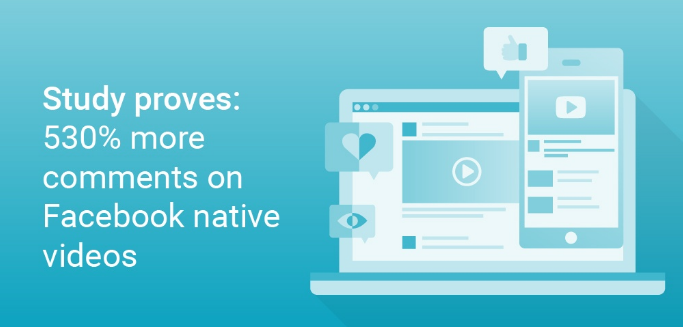
Native videos have more comments than links to videos:
native 1

On average, native Facebook videos have a 110% higher interaction rate than YouTube videos.

They are also shared at a rate that’s 478% higher than links to YouTube videos.

As I said before, Facebook will automatically play videos on a user’s feed when they scroll on both desktop and mobile devices. But this happens only if the video is native.

Otherwise, you need to rely on the user clicking on the link you shared, getting redirected to another platform, and watching the content, and hope they engage with it.

That’s too many extra steps, decreasing your video  engagement rates.

Target your preferred audience

Who is watching your videos on Facebook?

The engagement of your videos will depend on who sees them. You want to make sure your video content is relevant.

You’ll need to identify your target audience. Once you determine who they are, use that information to define the audience for your videos.

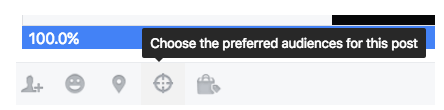
Before you publish anything, look for this option in the bottom left corner of the screen. Here’s what it looks like:
bottom left

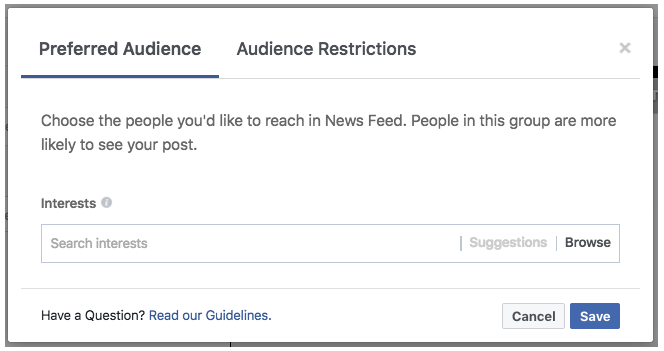
Once you click on this button, you’ll see a popup with the option to select your preferred audience and restrictions for the video.
audience

With the preferred audience, you’ll be able to reach users based on factors such as the pages they’ve liked and their interests.

For example, you could choose interests like “swimming” or “baseball” depending on what type of business or industry you’re in.

The audience restrictions tab gives you the chance to narrow down users based on demographics such as:

  • age
  • gender
  • location
  • language

Making sure the audience is relevant will increase your engagement rates.

You can take this strategy one step further by publishing Facebook video ads. 71% of people say that the video ads they see on Facebook are relevant to them.

That’s because Facebook does a good job of giving businesses ways to target the right people with ad settings.

For example, you can use lifetime value to create a Facebook audience that converts.

Craft a striking title and description

You spent much time filming and editing the video. Time to publish it on Facebook, right? Not so fast.

You need to put the same effort into your title and description.

Learn how to increase clicks by mastering your headlines. The idea is to grab the attention of viewers and get them interested right away, before they even watch anything.

Descriptive videos will also increase your chances of being seen through organic searches on the platform.

There are more than 2 billion searches on Facebook each day. You definitely want your videos to be optimized for these searches.

I assume you’ll be using your Facebook videos on other distribution channels as well, which you should be. It’s a great idea to repurpose your content across multiple marketing platforms.

But your copy for these videos needs to be Facebook-specific.

Look at this data from Sprout Social about Facebook copy:

words

Furthermore, Facebook posts with 80 characters or fewer have 88% more engagement.

Facebook gives you a limit of 63,206 characters per post. You can experiment with a longer copy if you want.

But as you can see from the statistics above, fewer words and characters drive higher engagement rates.

Include a CTA

What should viewers do when they finish watching your videos?

If you don’t know the answer to this question, they certainly won’t have a clue.

Your Facebook videos need to have a CTA. That’s what’s going to drive engagement.

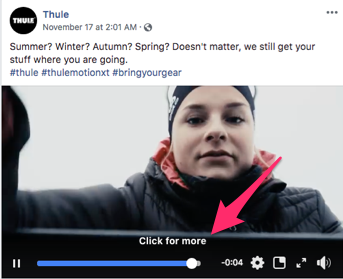
Here’s an example from Thule:
Thule

The CTA is a link to its website, trying to drive sales of the products showcased in the video.

That’s one approach.

But you can drive engagement by other means. It all depends on the goals of each campaign.

If you want to expand your reach and create brand awareness, you’ll want your videos to be shared on Facebook.

A potential CTA could be as simple as “share this video with your friends.”

Ask viewers to comment on it as well by ending the video with a question to spark a debate. All of these strategies will increase your engagement metrics.

Broadcast live

While you may not want to do it every day, live video streaming is a great way to boost engagement on Facebook.

With Facebook Live, you can have a more authentic interaction with your audience.

As you broadcast, they’ll be able to add comments and questions. This gives you the opportunity to respond to those users in real time.

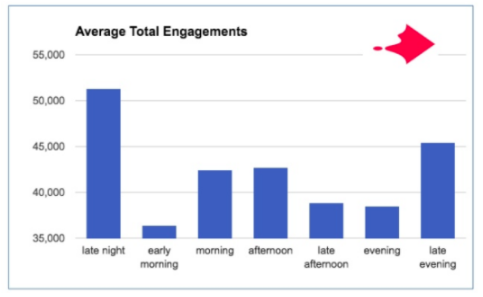
When should you go live?
live

Late at night and late in the evening are the two best times to go live if you’re trying to drive engagement.

I’d say you can use this strategy about once a week.

Try to stick to a schedule, similarly to a TV show. If your audience knows you’re going live every Wednesday night at 9:00 PM, you’ll have more viewers.

Showcase your best videos

Not all your content is the same.

As someone who produces tons of blog posts, videos, and podcasts, I know this reality firsthand.

It would be amazing if everything you produced and published was perfect, but that’s unrealistic.

Some of your videos will be better than others. You know it, and your audience knows it too.

That’s why those videos have more views, likes, shares, and comments.

Feature those videos on your Facebook page. Here’s an example from The Wall Street Journal:

WSJ

Usually, the most recent videos are displayed first.

But if a user navigates to your videos page on the left menu, you have the option to have your best videos shown ahead of your newest ones.

The idea behind this strategy is that you can hook people with your best videos.

Once they engage with that content, they’ll be more likely to watch your other videos and keep coming back for more in the future.

Conclusion

Your video content might be great, but it’s useless if nobody is engaging with it.

Since the vast majority of Facebook videos are played without sound, you need to add subtitles to optimize them for silent viewing.

Publish square videos. Your content should be native to be played automatically in everyone’s feed.

Start with your best content to grab your viewers’ attention early. Don’t slack when you’re writing a title and description.

Take advantage of the preferred audiences feature to make sure your videos are shown to relevant viewers. All of your videos should end with a CTA.

Go live. Highlight your best content as a featured video.

If you follow the advice I’ve outlined in this guide, you’ll see a major boost in engagement metrics for your Facebook videos moving forward.

What strategies is your company using to drive engagement on Facebook videos?


from Quick Sprout https://ift.tt/2UZFoJR
via IFTTT

Monday, December 17, 2018

How to Drive Sales by Implementing a Friendly Return Policy

What’s your company’s return policy?

I’m sure you’ve been asked this question before by both current and prospective customers.

But think about when this question gets asked. It’s not just when someone wants to return an item. Customers want to know what your return policy is before they buy.

This holds true for in-store and ecommerce purchases. In fact, 90% of consumers read return policies before making a purchase online.

Obviously, you don’t want to get frequent returns.

But knowing that returns are easy and hassle-free will make it more likely that customers will complete the purchase process.

Friendly return policies will improve your customer service. It shows everyone that you stand behind your products.

If everything you’re selling is a final sale, it’s an unreasonable and questionable business practice. This will make customers think twice before buying.

Some of you may not have thought of these ideas before you came up with your existing return policy. That’s why I created this guide.

Whether you’re developing a return policy from scratch or wishing to change your current policy, you’ll benefit from these tips.

The adjustments will make your product or service more desirable for consumers to buy.

Provide free returns

I realize that returns can potentially cost your company some money. But you need to weigh that expense against the price of potentially losing a customer.

Do not charge customers for returns even if they need to ship an item back to you.

That money isn’t worth losing a customer over.

Put yourself in the shoes of a consumer. There’s a reason why they are returning an item.

It was unsatisfactory in some way. Maybe it was damaged, or it looks different from what they saw online. You could have made a mistake and potentially sent the wrong item.

Regardless of the reason, they are already inconvenienced. Don’t make them pay to give it back to you.

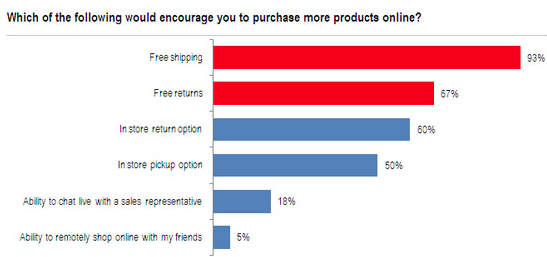
Free return policies encourage shoppers to buy products online.

free returns

As you can see from the graph, this was a top motivating factor, second only to free shipping.

Studies show that 27% of consumers say they would buy an item that costs more than $1,000 if the store offers free returns.

Just 10% of buyers would do the same without free returns.

Think about that. These customers are willing to spend $1,000 or more. You want to make sure you keep their business and encourage them to buy.

If they want to return something and it costs you a few extra bucks, so what?

The value of that customer will make up for it over time.

Offer a free trial

Usually, free trials are associated with subscription services. But you can implement this strategy even if your business sells physical products.

Here’s how it works.

Rather than having someone buy something and then return it, let them try it free and leave it up to them whether they want to keep the item or not. It’s not exactly the same as a free trial you’re used to, but the concepts are the same.

Basically, it’s a risk-free way for consumers to experience your product.

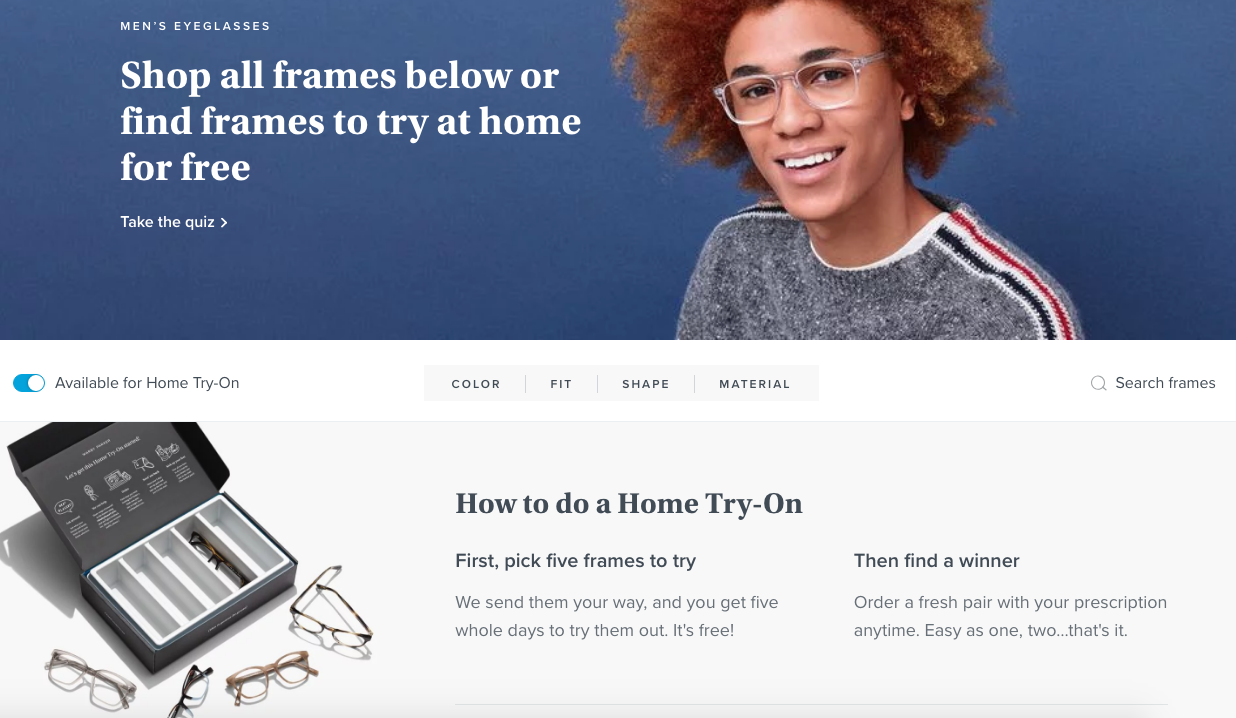
Here’s an example from Warby Parker:

warby parker

Glasses need to be tried on before a decision about them can be made.

In most instances, it’s difficult to order well-fitting glasses online without trying them on in person. But Warby Parker makes this easy for its customers.

It allows people to order five different frames, shipping them to the customers’ homes at no cost.

Customers can test them to see which ones fit and look the best. Then, they send back the ones they don’t want and get charged for whatever they keep.

It’s brilliant.

This strategy will result not only in more sales but also in increase in the average order value of each purchase.

The customer already has products in their possession. At this point, they may end up wanting two pairs instead of one.

The main benefit of shopping in stores compared to online is getting to see, touch, feel, and try on products. But if you can provide your customers with the same experience from the comfort of their homes, it will give you a huge advantage.

I definitely recommend this strategy, especially to ecommerce shops.

Make the return process as easy as possible

You should apply the same concepts to your return procedure as you do to your checkout process.

The fewer steps a customer has to go through, the higher your conversion rates will be.

Again, it’s not like you want to have lots of returns. But they are bound to happen.

In fact, 30% of products ordered from ecommerce shops get returned compared to just 9% to those from physical stores.

And 92% of consumers will buy from a store again in the future if they experience an easy return process.

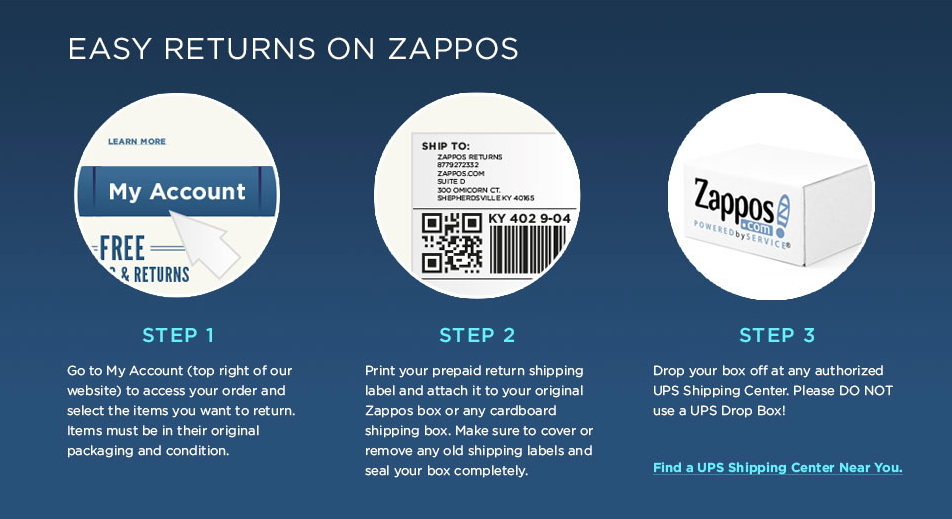
Here’s Zappos’ return policy:

zappos

The return process consists of three simple  steps.

The website includes a picture and description of each step. Zappos even has an option for people to find the nearest UPS shipping center to drop off the package they are returning.

This added value goes a long way.

Even though the customer physically has to go to a UPS center to return their order, the friction has been reduced.

Otherwise, the customer would have to open a new browsing window, search for UPS, and find a location nearby. That’s three extra steps.

If you can eliminate the hassle in your return process, people will be more likely to buy.

Don’t restrict return methods

Give your customers as many options as possible when it comes to returning items.

Let’s say you have multiple store locations. If a customer buys something at one location, they shouldn’t have to go back to that exact store to make a return.

Your system should make it possible for returns to be accepted at every location, regardless of where something was purchased.

It’s for the customer’s convenience. You don’t know the circumstances behind the sale.

Customers could be traveling away from home or be on vacation. In this case, it would be unrealistic for a customer to return to an exact store if they live hours away or potentially in another state.

In this case, they would be less likely to buy something if they knew it could only be returned at one location.

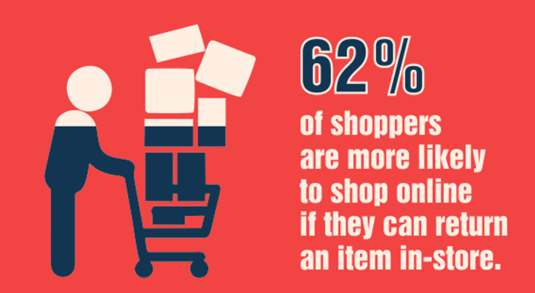
Let’s take this concept one step further. Online orders should be accepted as in-store returns as well.

in store

Maybe the customer doesn’t want to deal with shipping, even if you made the process easy as in the previous example.

But the fewer restrictions you have, the easier it will be for your customer.

People will be more likely to buy knowing they have options if they decided to return something.

Showcase your return policy

I already talked about the fact that customers will review a return policy before making a purchase online.

Don’t make them hunt for your policy on the website. If your return policy is buried somewhere, it’s going to be difficult to find.

I’m not saying you need to have the return policy displayed in its entirety on every page, but at least highlight the benefits.

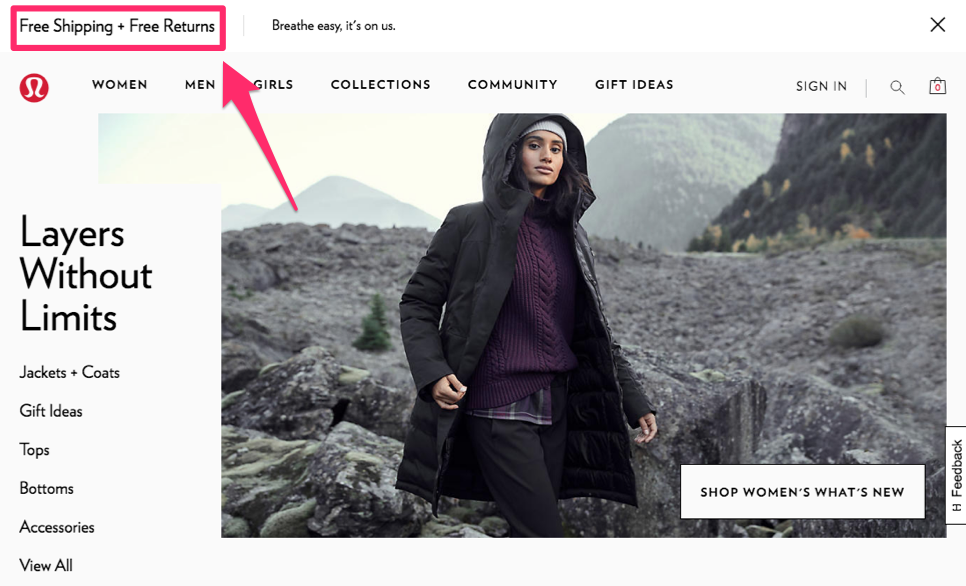
Here’s an example of how Lululemon does this on its homepage:

lululemon

Remember the graph you saw earlier about the top two factors that encourage people to buy online?

Free shipping and free returns.

As soon as a visitor navigates to this website, they know returns are free.

They can click on it to review the policy in greater detail, but at least they don’t have to go searching for it.

That’s how you design a homepage that converts.

Stand behind your product

What happens when one of your products has been opened, had the tags removed, or had been worn or used? Can the customer still return it?

If the answer is no, you might have a harder time generating sales.

Sometimes, consumers won’t know whether they are happy with an item until they had the chance to use it.

If you stand behind your product and offer returns on used items, consumers will be more likely to buy.

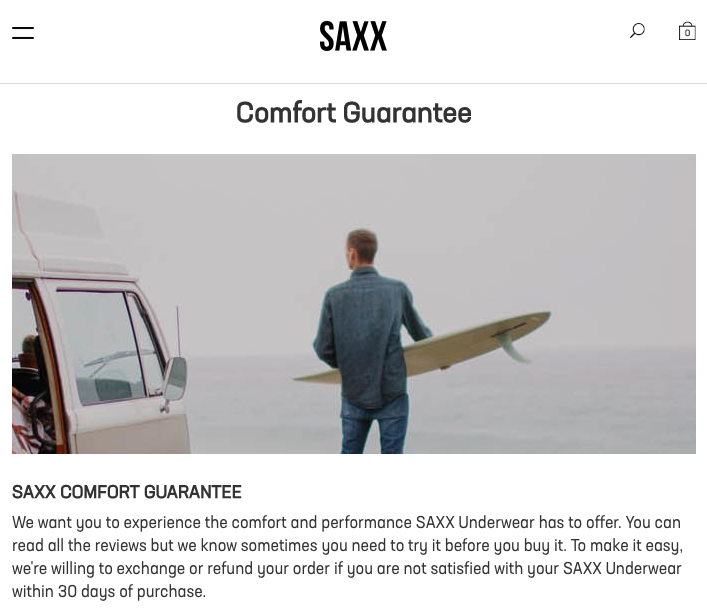
Here’s an example from SAXX:

saxx

I’m not saying you should accept an item after it’s been used for a year and is now worn out.

But the comfort guarantee from SAXX is very reasonable and something you might want to consider implementing in your business.

30 days, or your money back.

This gives its customers a chance to try the underwear, which is the only way someone can truly know whether they are happy with it or not.

If someone is unhappy, SAXX will exchange the item or refund the purchase.

Obviously, you would prefer a product exchange, but you should still offer a refund as an option. Don’t make it seem as if you’re holding their money hostage.

Provide easy access to customer support

Before someone wants to return something, they may have questions that can be answered by your customer support team.

The customer may want to learn more about the policy, find out what their options are, or just talk to someone about their dissatisfaction.

Regardless of the reason, you want to make this process as easy as possible.

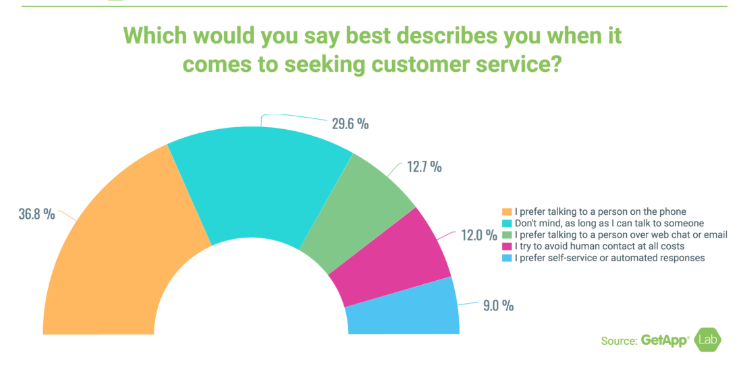
You need to understand what people want when it comes to customer support:

customer service

Customers have different preferences.

You need to be available through as many communication platforms as possible, such as:

  • phone
  • email
  • live chat
  • social media
  • in person

Further, you don’t always have to stick to your exact return policy. Exceptions can be made. Let me explain what I mean.

The fans of the TV series Seinfeld may be familiar with an episode in which Jerry wants to return a jacket he bought.

The customer service representative asks why he wants to return it, and Jerry says he’s returning it out of spite because he doesn’t care for the salesman who sold it to him.

So the store manager tells Jerry that spite doesn’t meet the conditions for a return.

Obviously, it’s a show and meant to be humorous. But let’s look at a more realistic example.

If you have a return policy similar to the earlier SAXX example, customers can return an item within 30 days of the purchase, even if it’s been worn.

Well, what happens if someone contacts customer support on day 33 asking for a return? Is the answer no?

Exceptions can be made. Hear them out.

Maybe they are just now trying it on for the first time. Instead of refunding their money, at least give them a store credit or offer an exchange.

Your staff needs to be trained accordingly to handle these circumstances.

As I said before, it’s not worth it to lose a customer over this.

They want to return something that was used and cost $50. I get it. This is not ideal for your company.

But if that customer is going to spend more than that in the future, it’s worth it to make an exception by providing customer service that’s reasonable and easily accessible.

Extend the return deadline

This is similar to my last point.

You can avoid the above circumstances from arising if you extend the return deadline to begin with.

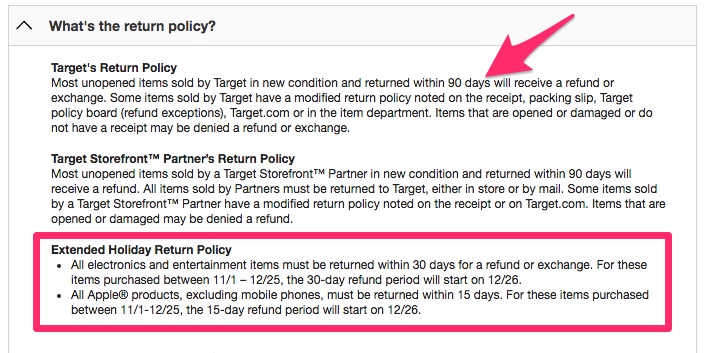
Here’s a great example from Target:

target1

Customers have 90 days to return items.

Target extends its return policy during the holiday season. It recognizes customers are buying for other people, and items might not be seen or opened by the final user right away.

The policy starts on 12/26 if an item was purchased between 11/1 and 12/25.

This is a great way to drive sales during the holiday season.

Do you remember I said you should make exceptions? Well, Target has a separate section of its return policy that addresses exceptions:

target2

One of my favorites is the first one on the list, which is shown above.

You can bring back anything within one year and get an exchange or refund if it’s a Target-owned brand item.

This type of extended policy makes it really enticing for a customer to buy from the store.

Conclusion

Your return policy is much more important than you might think. Customers take this into consideration when deciding whether they’re going to make a purchase or not.

That’s why you need to offer free returns.

Set up a trial system allowing people to try products you sell online before the sale is finalized.

Returns need to be as easy as possible. Give customers lots of options so they can choose a return method convenient to them.

Your return policy should be easy to find on your website.

Stand behind your products. Make sure it’s easy for people to reach a customer service representative.

Extending the deadline of returns from the purchase date gives customers an added incentive to buy.

You don’t want to encourage returns. But changing your return policy will help you generate sales. Use this guide as a reference to implement changes.

What return policy does your business offer, and will you make changes to it in the near future?


from Quick Sprout https://ift.tt/2GpWygC
via IFTTT

Friday, December 14, 2018

The Best Dropshipping Companies

Quick Sprout is reader-supported. That means we use affiliate links. When you click, we sometimes earn a commission. Learn more.

Dropshipping is when you sell a product that’s shipped directly from the manufacturer to your customer. It is never held by you in a warehouse or a spare bedroom, and you’re not responsible for the packaging or shipping. Your dropship partner takes care of all that.

Sounds dreamy, right? No warehouse rent to pay, no upfront investment in purchasing inventory, and no shipping work on your end. Those are the perks.

But those are also the drawbacks. You don’t have the inventory in your warehouse, so you don’t have control of a customer ordering something that’s out of stock. There’s no shipping work on your end, so you can’t control the shipping speed, or the packaging. Long ship times = canceled orders. Weird packaging = bad reviews. And, you’ll still need upfront money for advertising, building your website, and all the other steps you’ll need to take to start your business.

And, because you’re basically outsourcing those storing and shipping tasks to your dropshipper, you may not have as great of margins that you would if you took that all in house.

In this guide, we’ll round up some of the best known dropshippers and some lessons from top dropshippers, including what to consider before you get started.

Like any business partnership, before you get involved you need to do your research on who you’re working with, what it’s going to cost you, and what you’re expecting to get out of it.

What’s the best dropshipper?

Trying to find the best dropshipping company is a little bit beside the point. It’s like asking for the best eBay seller or the best store on Etsy.

There are things that make dropshippers great, and they’re a lot of the same things that make an eBay or Etsy seller great: They’re super communicative and have fast shipping. The product arrives as promised. It looks like the listing and it arrives in one piece in packaging that looks nice and not chewed up by an alligator.

Just like an eBay seller, the best dropshipper for you is the one selling what you’re interested in buying. They will reliably, communicatively, and quickly shipping the product you’re after at the price that’ll be profitable for you — that’s your best.

Dropshipping suppliers, databases, and tools

It can be hard to break into dropshipping because most dropshipping businesses don’t like to share their items or their suppliers. The thinking is: you’ll just replicate their shop and eat into their market.

Many dropshippers use a Shopify store and an automation app like Oberlo or Spocket. This is a quick way to get set up in minutes.

Shopify dropshipping apps and tools

  • Oberlo is a plugin service that works with Shopify stores. You’ll browse the Oberlo directory (which includes suppliers verified by Oberlo) to find inventory you’d like to sell in your store. You’ll be able to see how many pageviews, sales, and star-rankings each item and seller has. Once you make a sale, you’ll use Oberlo to order the item to be shipped to your customer. Oberlo has a forever-free plan, though you’ll need to pay for a Shopify subscription, too. Oberlo has 4.7 out of 5 stars from 2,258 reviews in the Shopify app store.
  • Spocket is a database app of dropship items that you can sort by country and simply upload into your Shopify store. Spocket makes it easy to find US and EU items that’ll ship within your country rather than from China, cutting down on slow ship speeds. The Basic plan (25 products with unlimited orders) is forever free, and upgrading to Pro is $39 / month for 250 products and branded invoicing. The Empire plan unlocks unlimited products for $99 / month. The app has 4.8 out of 5 stars from 1,008 reviews in the Shopify app store.
  • Dropified is a Shopify app for populating your store with items and automate your orders on AliExpress, including customer shipping address. There’s no Dropified marketplace, but rather a browser plugin that’ll let you pull from anywhere on the web. You can set up margin parameters and rules for changing the price points in your store. There’s a free 14-day trial; after that it’s $47/month for the Builder plan. The app has 4.8 out of 5 stars from 98 reviews in the Shopify app store.
  • Dropwow is like Oberlo or Spocket, but has more negative reviews. The tool claims to automate your orders and help you locate dropshippers located in the US and elsewhere. However, with only 3.8 out of 5 stars from 108 reviewers on the Shopify app store, and a monthly subscription of $29/month, we don’t recommend it.

Dropshipping databases and software solutions

  • SaleHoo – A $67 yearly membership grants you access to this database of wholesalers and dropshippers. There are currently 8,000+ suppliers on the site, and they’re all screened by Salehoo before they’re added to the directory. There’s a 60-day free trial period, and the customer service gets high marks: 9.6 out of 10 with 239 reviews on TrustPilot.
  • Doba – This 2 million product database doesn’t just bring a number of suppliers into one marketplace — you’ll also place your customer orders within Doda as well. That being said, it’s not cheap and we’ve read a number of negative reviews, many of which mention that the prices aren’t low enough to profit. Doba has a 14-day free trial, so you can log in and run the numbers to see if a membership (which ranges from $29–249/month) is right for you.
  • Wholesale2B has a variety of plans: sell its products on eBay, Amazon, on a Wholesale2B site, or your own WooCommerce / Shopify / Magento / BigCommerce site. Any one of these options costs about $20–30/monthmonth. Handle the orders yourself by becoming a registered reseller with each supplier or pay Wholesale2B a 3% fee to handle that for you.
  • Worldwide Brands – For $299, you can get a lifetime subscription to this database of wholesalers and dropshippers.
  • Wholesale Central – This free directory lists suppliers you can work with individually to order products from. There’s nothing fancy about it — it’s like a phone book — but has useful information to use as you do your research.
  • Sunrise Wholesale Merchandise – A $99 yearly fee gets you access to Sunrise’s selection of goods. It’s a bit smaller than other databases, but there the shipping times are pretty quick: typically 5–7 days. Packages arrive to your customers with a receipt from “Customer Service” that’s not branded.
  • Megagoods – A California-based warehouse and will dropship your goods under your packaging and branding, typically in less time than it’d take to ship from an overseas supplier. Check the added fees to make sure that your margins are good.
  • Inventory Source – An automation tool that allows you to either sync the suppliers products with your page (inventory automation) or to sync the entire customer purchase flow so that your orders are automatically placed with your supplier (full automation). Inventory automation is $50/month and full automation is $150/month.
  • Dropship News – This free online directory of suppliers is worth sifting through. We found some great US-based suppliers. Most of each supplier’s dropshipping information is on their profile, which saves you some clicking around.
  • National Dropshippers – This site is free for the first 7 days, but its products are hard to find and search for, and the returns and shipping policies aren’t favorable. You can give a try to see if there’s a product that’s only available here, but if you can find it elsewhere you’ll probably be better off going with the alternative.
  • DropshipDirect.com – This site makes some enticing claims: 100,000 items in its inventory, a SaaS-approach to data, and quick shipping from its Michigan warehouses. However, the sign-up form is in private mode and the company seems to be on a year-long hiatus. We’ll keep an eye on Dropship Direct and report back.

Online marketplaces

  • AliExpress is a Alibaba’s online retailer. It’s based in China, but doesn’t sell products to anyone in mainland China. The site has lots of user reviews and analytics that are super useful during the product research phase.
  • DHgate – There are over a million Chinese suppliers on DHGate. Best practice for buying off DHgate: check user ratings and feedback. Just like you would when buying something off of eBay, be wary of anything that could be a knock-off or imitation, and be prepared for slow shipping and nuances like new-with-box items arriving with their boxes unassembled.

4 Steps to start your dropshipping company

1. Find items to sell

Find your niche.

There’s lots of chatter on the internet about finding your dropshipping niche, but this is just a trendy buzzword for product-market fit: are there people who want to buy your product? From you?

If not, you won’t have a successful business.

You’ll have the most success dropshipping a product if there’s an audience that wants to buy it and doesn’t have an easy way to access it. That’s where you come in.

Some ways to find your niche: brainstorm rabid fan groups or audiences with a common need or interest (dog lovers, anime fans, parents who love to dress up their kids in matching outfits, sailors, very tall people, people who love 90s throwback tees). These are purchase-ready populations looking to love and buy things that they’re interested in.

See what’s trending on Facebook.

Doing a quick search of a phrase like “Get yours here” or “Buy now” and look at the videos featuring items for sale that are getting traction. This can give you a sense of which products are interesting people on Facebook right now. Look for a high number of views in a short period of time, then search for the item at a dropship supplier like Oberlo or AliExpress. Consider the price-point of the item in the video and the assets you can create for it. Can you replicate — or improve on — the current trending video? If so, you may have an item worth dropshipping.

Don’t sell anything dangerous or copyrighted.

If you’re a beginner, don’t start with something that goes in or on a person’s body. If you do not know the quality and source of the ingredients, and something goes wrong, do you have coverage for that liability?

Also, if there’s a celebrity or character from a movie franchise on the item, it could get you in trouble. Steer clear of mice with big round ears.

Look at seller’s reviews and order a test product.

How long has the seller been selling? What feedback have they been getting. When you order a test product, does it meet your expectations? What do you need to tell your customers so they’ll be happy when they receive the product?

Consider dropshipping only some items.

Just because you’re dropshipping some things doesn’t mean you need to dropship everything. Perhaps it makes sense to use dropshipping for large, bulky, high-priced niche items.

Say, for example, you have an online store that sells nautical gear. You may want to personally store and ship some items, but dropship the anchors. For items like this, your customers may also be more accommodating to longer shipping times since it’s a large and more considered purchase. Same goes for home goods: perhaps you keep small items in stock, but dropship the couches. You can increase your inventory breadth very simply this way.

Go directly to a supplier and build a dropshipping relationship with them.

This is a killer plan: there’s guaranteed to be less competition. You’re basically creating a new audience for an under-marketed product that’s not getting seen by a ready-to-buy audience. If you use a database, every single other subscriber is using that same database.

2. Nail the basics

Invest in a good domain name.

We buy all our domain names from Namecheap. (You can read our full review on the best domain registrars.) They come with free privacy protection. Skip all of the upsells — you don’t need them.

Set up your website.

If you go with Shopify, you’ll be up in minutes. Lots of dropshippers recommend the Shopify Brooklyn theme with a good font choice. You can also use another ecommerce option. Here’s our review on the best ecommerce platforms, if you’re interested in exploring.

Get a professional logo.

You can get one for a reasonable price (and no design expertise) with 99Designs.

Use a professional email address.

It should be a sensible start (help@, support@) with your own domain name. We recommend getting G Suite for $5 a month per user. There’s nothing to trust about emailing a customer service that’s at yahoo.com or gmail.com.

Give your customer strong trust signals.

You can do this with high quality photos and unique item copy, a real and robust About Us page, and thoughtfully using things like discounted prices and pop-ups.

Ask yourself: Would I buy from this store? Would I feel comfortable suggesting it to a friend or family member? You’ll need some trust logos and some FAQs at minimum.

Set shipping time expectations.

Most dropshipped items aren’t going to get to the customer very quickly — and in world where Amazon Prime has set the standard at two days, that means dropshipments of 30 days feel extremely slow. If you don’t prepare your customers they’ll be very unhappy. We’ve seen very straightforward copy, like: All our items ship directly from our suppliers in China. Shipments are processed the day of your order and arrive in 25–30 days.

Make sure your orders go through.

Bundle credit card orders so your bank doesn’t cancel your numerous orders. Let your bank know what types of orders and in what quantities you’ll be placing, so they’re not flagged as fraudulent. There is no pain so rich as having to reorder orders you’ve placed. (You do have a business credit card, right?)

Prepare for returns and cancellations.

How will you deal with unhappy customers? What’s your return policy and how will you chargeback customer payments? Will returned items be shipped to you, or to your distributor? How will that work? Like with anything in business, it’s important to set it all up from day one like it’ll be a huge success.

Set aside money to pay taxes.

If you’re using Shopify as your payment gateway, once you get to a certain sales threshold, Shopify will automatically report your sales to the government. You’ll want to make sure you have money available to pay applicable taxes. We also recommend getting an accountant and a lawyer (we’ve heard good things about UpCounsel and LegalZoom) and setting up Quicken.

3. Differentiate yourself

Make your store listings and ads unique.

Remember, if you can quickly and easily set up a dropshipping order for a specific product, it’s likely another store will be able to do the same. You will need to find an edge: why would someone order from you, or find your store selling the product, and not your competitor?

Take your own pictures. Write your own copy. Shoot unique social videos. Really put thought into how to best convey the product and why a person would want it: What problems does it solve? Can it make them feel joy?

Import user reviews.

If you’re using AliExpress, you can import the user reviews. No one likes being the first to buy something.

Consider offering free shipping.

Do all orders have free shipping or only when a certain order spend is hit? What threshold or minimum spend works best?

Market your store.

Make sure people know about your store. This can be through word of mouth, social media ads, viral memes, influencer programs, SEO, a newsletter. You’re going to need visitors to make sales.

4. Iterate iterate iterate

Use ads to test and gather data.

We’re assuming that you’ll be buying ads. If you do, buy and use the data to test what’s working. What gets traction? Double down on it. What doesn’t? Trash it. This may lead you to changing your products, your ad style, your audience. Following the early traction means you head toward what’s working and away from what’s not.

Analyze your sales.

What’s selling well? What’s not selling at all? Is there any common theme in the items? Replicate what you can. Stop what’s not working.

Dropshipping vocabulary

Arbitrage – The simultaneous buying and selling of an item to take advantage of a difference in price for the same asset. Say there’s a board game for sale at Walmart for $20, but the lowest price on Amazon is $45. Arbitrage is listing the game for sale on Amazon and buying the Walmart game. For every sale you make on Amazon, you take advantage of a $25 price difference. If your arbitrage is online to online, with free shipping, the math suggests you could simply sell on one site, buy and ship from the other, and pocket all the profit. This does not take into account any hiccups: returns, merchandise not accurate, merchandise no longer in stock, price changes in either market, etc.

Dropshipping (DS) – The supply chain system in which a seller does not keep items in stock, but rather transfers orders directly to a manufacturer, supplier, or wholesaler who ships the item directly to the consumer.

Minimum Advertised Price (MAP) – Some sellers set a floor to how low you can advertise or display your product for sale. This is not the same as the price you can sell it for. So, the MAP price does not take into account coupon codes or sales, or other tricks like offering a gift card with a purchase, offering rebates, or doing things like showing an even lower price in the cart.

Dropshipping examples and press

You may have seen the posts we’ve seen — the ones about people starting dropshipping businesses and raking in the sales. We’re talking five-figures in a single day, six-figures every month. What is this magic sauce, we wonder.

The magic sauce is the same sauce as any other business: it’s a math equation based on margins. How big are your margins? How big is your customer base? What’s the conversion rate? How stiff is the competition?

Welcome to a little-known corner of the e-commerce world, where small entrepreneurs use social-media ads and hip virtual storefronts to entice people into buying products listed on online marketplaces such as Alibaba Group Holding Ltd.’s AliExpress.

The process often involves online storefronts transferring customer details to an AliExpress seller, which ships the goods directly to the customer; the storefront bills the customer. Called dropshipping, it is a twist on a fulfillment technique that major online retailers also use to send goods directly from their manufacturers to the customer.

The entrepreneur profits by charging a high markup, betting shoppers are unlikely to stumble upon the less-expensive goods on a marketplace site. AliExpress is the most popular such marketplace, but some entrepreneurs order from sellers on other marketplace sites like Amazon.

—“The Mystery of the $70 Hoodie That’s All Over Facebook,” Wall Street Journal

The mystery of the $70 hoodie is also not a mystery: it’s a one-time sale that’s not going to turn into repeat business. It’s a simple equation:

high price + low product quality + poor customer experience ? repeat business

Dropshipping seemed cool because it made starting an eCommerce seem easy: I didn’t need to buy products in advance; I didn’t need to have space to hold them, and it didn’t require extra time and effort to ship the orders myself. Dropshipping does have disadvantages, but it really appealed to me, so I continued my online search.

There are numerous ready-to-use eCommerce platforms like Shopify, BigCommerce or Squarespace. Most of them start at around $20 per month, which seemed like a good deal for a first-time entrepreneur like myself.

It took me two days to set up the store the way that I wanted it to look. Shopify is totally non-programmer friendly. All you need to do is open an account, select a look for your store, and that’s it – you’re ready to sell.

When I set up my store, I had no definite idea of what I should sell. I wasn’t sure if I should pick a product I was passionate about or just a random product I was able to find in dropshipping databases like WholesaleDirect.com or the like.

“This Guy Made $12K In One Month While Working Full-Time,” Huffington Post

“This guy” is Justin Wong, and he made his business work by studying Instagram marketing, set up affiliate partnerships with influencers, and matched his product with his marketing technique. And, he’s not confused about the pros and cons of that marketing strategy: when the posts age on a influencers feed, his sales go down.

My name is Jacky Chou. With my partner, Albert Liu (albeliu on Reddit), we launched a home decor dropshipping site that went from negative 3k to 250k a month in 8 months at 30-40% margins. We’re both first generation Asian-Canadians who moved from Vancouver to Berlin to work in marketing.

We started our dropshipping store as a ‘practice what you preach’ case study, as we’re both working as digital marketing consultants (Albert as a freelance Facebook consultant and I’m a founder of an SEO agency, Indexsy).

— “We made 250k USD last month with our dropshipping side hustle. Oberlo / Shopify reached out to us to do a success story. AMA!,” Reddit

Further reading


from Quick Sprout https://ift.tt/2QSiyEN
via IFTTT

How to Avoid a Plateau by Avoiding These 8 Business Mistakes

Mistakes happen.

If you’ve been in business for a while, you know by now that mistakes are just part of the process. New businesses and startup companies are slowly learning this.

Nobody is perfect, but some mistakes happen on a larger scale than others.

But here’s the thing, lots of these mistakes can be avoided.

That was my inspiration for writing this guide. There are certain common business mistakes that I see people making all of the time.

Brands are only making these mistakes because they don’t realize it until it’s too late.

Realistically, there are hundreds of mistakes that different businesses make each day.

However, I wanted to focus the attention on specific types of mistakes.

Your business always needs to be growing. If sales start to plateau or even drop off, it’s going to be a major problem for your company.

But you can prevent a plateau by avoiding these common mistakes that I’ve identified.

Use this guide as a reference to correct any of the mistakes that you’re currently making, or you can avoid them completely in the first place.

1. Not focusing on sales

Shockingly, this is a major issue that I see all of the time.

You would assume that generating more sales would always be a priority for a company, but sometimes brands start to lose sight of exactly why they are in business.

You’ve got to be making money. This money stems from sales, period.

That’s the best way to make sure your company will grow and ensure that you won’t stall in a plateau.

When I’m consulting with businesses, they’ll show me all of these other metrics that they’re focusing on, which is fine. But what are your sales?

If what you’re doing doesn’t translate to conversions and transactions, it’s not helping you out.

Don’t get me wrong. It’s great if you’re getting more email subscribers, social media followers, and website traffic.

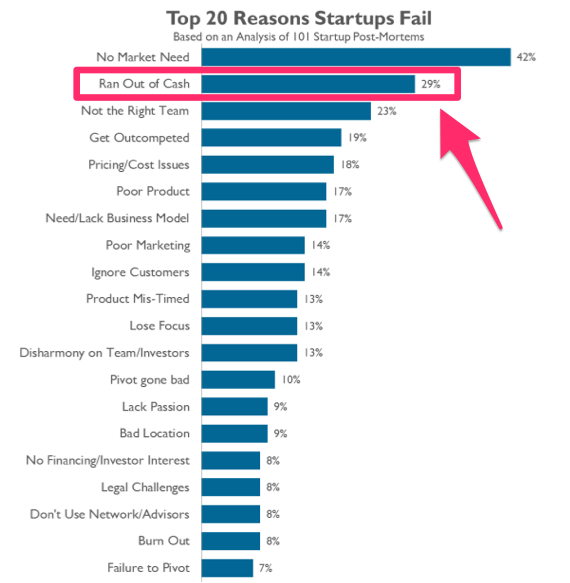
But running out of cash is one of the top reasons why startups fail.

failure

If you can focus on new ways to generate sales, you’ll always have a steady cash flow.

I understand that you have so many other areas of your company that require your attention. However, you need to have priorities.

You can’t let sales to a back seat to anything, or it’s going to be a problem for you in the future.

2. Forgetting about the customer

Your business will live and die by your customers.

All of your decisions need to be profitable.

These two statements don’t always add up. But you need to find a balance between both of them if you want to grow. Here’s what I mean.

On the one hand, a decision you make could reduce your operational costs and ultimately drive up your profit margins.

But if that cost reduction impacts the quality of your products and services, it’s not going to benefit your customers.

As a result, sales will start to drop, which is much worse than a plateau.

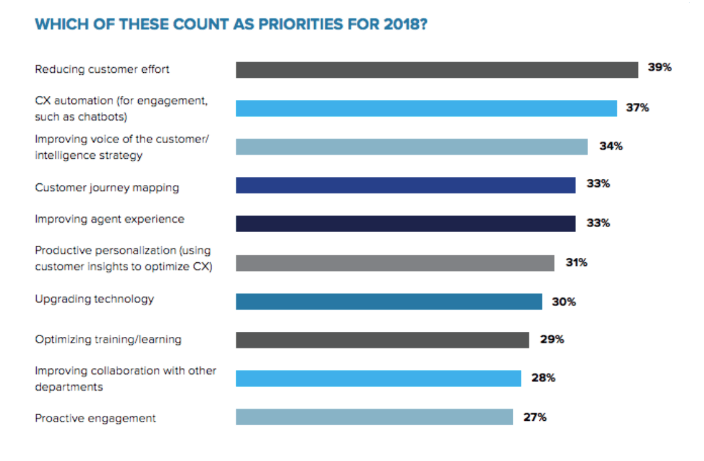
Let’s take a look at these priorities for businesses in 2018.

priorities

Do you see some commonality here?

Nearly everything on this list will help improve the customer experience. That’s what you need to prioritize.

Clearly, other businesses have recognized this and are acting accordingly.

So if you forget about your customers, it will be easy for them to just leave and go to one of your competitors instead.

If you put more emphasis on making your customers happy, the rest will take care of itself. Don’t cut corners just to turn a higher profit.

3. Ignoring data

Earlier I explained how some people focus on too many metrics that they forget about sales.

But another issue that I see all of the time is companies that just ignore these metrics completely.

I’m talking about things like:

  • website traffic
  • conversion rates
  • click-through rates
  • ROI

These are just a handful of the top metrics every marketing manager needs to track.

Without this data, how can you know if your campaigns are successful? How will you know what which decisions to make?

Another issue that I see is business owners who are clinging to the wrong data.

Here’s an example to show you what I mean.

Let’s say your business has website traffic that is increasing exponentially. You can’t just assume that it means your company is successful.

If your sales and conversions aren’t increasing at the same rate, you’re not actually growing, which should be a major concern for you.

That’s why you need to track your data and know how to analyze it properly as well.

4. Not analyzing your competitors

Your business doesn’t operate in a vacuum. There are outside factors that will have a direct impact on your success.

You need to keep an eye on your competitors.

Otherwise, they’ll steal your customers before you even realize what happened.

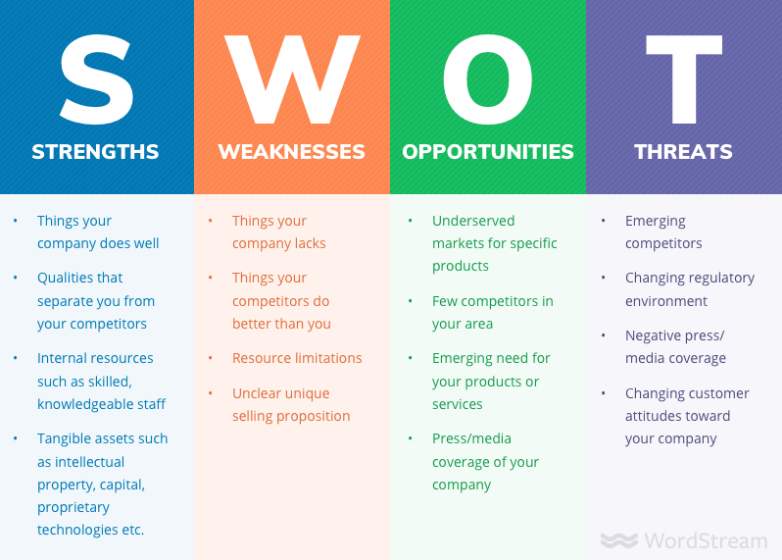
Compare yourself with them to see how you stack up. The easiest way to do this is with a SWOT analysis chart.

SWOT

It’s simple but very effective.

That’s because it forces you to see where your business stands on paper. Just saying things like “we’re really good at what we do” doesn’t give you any benefit.

When you put things in writing, any glaring mistakes or areas where you can improve will be more obvious.

You can also take advantage of helpful tools to monitor your competitors.

One of the first things you need to do is identify who you’re competing with. You’ll want to analyze competitors locally, regionally, and online as well.

Compare your prices to them. Look at their website.

Check out their advertisements and social media campaigns.

What’s working for them? What needs improvement?

Then, you can apply what’s working for your competition to your own business. Avoid their mistakes.

See what customers are saying about your competitors online. We’ll talk more about online reviews in greater detail shortly.

5. Avoiding new technology

Adapt or die.

This theory can be applied to nature, as well as business.

If you’re resistant to change, it’s going to be the downfall of your company. That’s why you need to educate yourself about new technology trends.

  • live chat
  • artificial intelligence
  • automation
  • machine learning
  • beacon technology

These are all things that can help your business grow.

I see so many business owners that are stuck in their old ways. But just because something worked for you back in 2005, it doesn’t mean that strategy will work in 2019.

To be successful in the future, you need to look beyond today, tomorrow, and next year.

You need to be prepared for technology advancements coming in 2022 or 2025.

Keep up with the latest trends. You don’t necessarily need to apply everything right away, but you have to start somewhere.

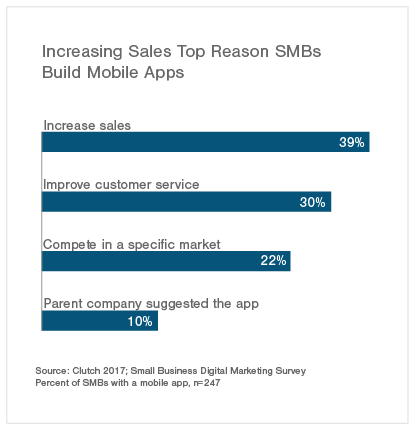
For example, you can start by building a mobile app for your business.

mobile app

Why haven’t you developed an app yet? Don’t let the costs associated with this venture scare you away.

22% of business owners say that mobile app development is too expensive.

An additional 23% don’t think they can run a business and maintain an app at the same time.

This type of mentality is what’s going to cause a plateau, and eventually a decline. Find ways to make this happen, especially if you’re in the retail business.

Mobile apps have triple the conversion rate compared to mobile web browsers.

Product views per user are 4.6x higher, and the add to cart rate is 2.5x higher.

Building a mobile app for your small business is just one example of implementing new technology, and it’s not even that new.

If you’re resistant to change, it’s going to stunt your business growth. So have an open mind moving forward, especially when it comes to technology advancements.

6. Ignoring customer reviews

I briefly mentioned this before when we talked about monitoring your competitors.

In addition to reading what people think about other companies, you need to see what customers are saying about your business online.

There are lots of different places you need to check, such as:

  • reviews on your website
  • third-party sites like Yelp or Google
  • social media comments

Respond to reviews.

Take notes about what customers are saying. Make the necessary changes based on this information.

Group common reviews together. If all of your customers are having the same problem, and you don’t make an adjustment, it’s basically just a slap in their face.

In addition to harming your relationships with existing customers, online reviews will have a direct impact on future sales as well.

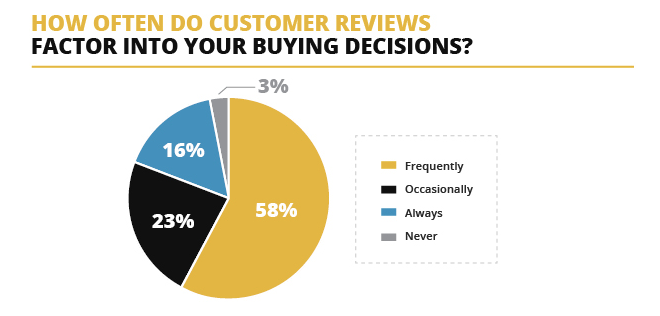
92% of people read a review before making a purchase online.

88% of consumers say they trust an online review as much as a recommendation from someone that they know. This impacts their buying decisions.

buying decision

Furthermore, 35% of people are less likely to buy if no online reviews are available.

This means that you need to take this strategy to the next level.

Not only do you need to read and monitor reviews, but you also need to encourage your customers to write reviews to improve your online reputation.

If you’re ignoring this, it’s a mistake that will be costly for your business.

7. Not accepting more payment methods

This relates back to what we talked about earlier in terms of forgetting about the customer.

I realize that it’s more expensive for you to accept certain forms of payment compared to other options. However, everyone has different preferences.

The days of just accepting credit and debit cards are over.

So if you’re still not taking every major credit card, it’s probably unlikely that you’re allowing customers to pay with digital payment methods.

But as I said before, you need to adapt to new trends and technology. Digital payments are becoming the way of the future.

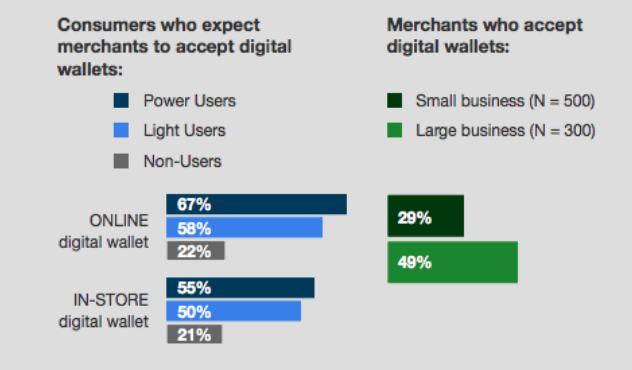
digital wallet

19% of consumers are using digital wallets.

About half of the people who use digital wallets expect merchants to accept those payment forms. But here’s something else that you need to keep in mind. More than one-fifth of users who don’t use digital wallets still expect businesses to accept digital payment methods.

Again, if you have integrated new technology into your business, this won’t be a problem.

The last thing you want is for a customer to decide they want to buy something, but change their mind because you don’t accept their preferred payment method.

Don’t expect them to just reach for another card. Instead, they’ll go find what they’re looking for from another business.

8. Never offering value

Why should people buy from your business?

It may sound like an odd question but think about it for a minute. You need to create a highly effective value proposition.

This will make it clear to everyone why they should buy from your business.

You need to understand the wants and needs of your customers.

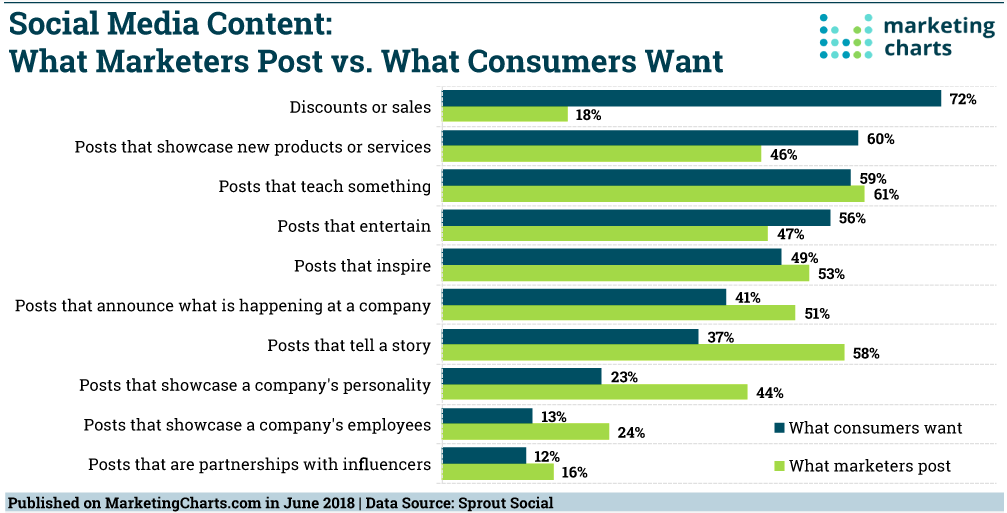
There’s a big difference between what consumers want and what marketers want.

value

As you can see from the graph, 72% of consumers want to see posts from brands on social media related to discounts and sales.

However, just 18% of marketers post those things.

There is obviously a major discrepancy here.

Even if you don’t want to offer discounts all of the time, you still need to come up with ways to add value to your brand. Otherwise, consumers won’t have a reason to buy from you, and sales will eventually decline.

Conclusion

Nobody is perfect. Every business makes mistakes.

You’re going to continue making mistakes in the future as well.

However, you reduce the chances of making these errors if you know what to look for before it happens.

Some of you may already be doing some of the things that I’ve covered on this list. But now you can identify those mistakes and make changes before they get out of hand.

If you can stay clear of the blunders that I’ve outlined above, it will help your business avoid a plateau or a decline.

What types of mistakes does your business need to fix in order to stimulate growth?


from Quick Sprout https://ift.tt/2S6n405
via IFTTT

Thursday, December 13, 2018

How to Buy a Domain Name

Your domain name is very important. It would be a mistake to gloss over the process of coming up with a name. If you take your project seriously, then you need to start off on the right foot with your name. After all, it’s going to be with you for the lifetime of whatever business or project you intend to use the domain for.

Many of the guides on how to buy a domain name or how to build a website tend to gloss over this process as well. It is often assumed that the best approach is to just register whatever domain name is available and call it a day. I think this is a big mistake.

There’s nothing wrong with registering a domain name that is available, as long as you’ve thought it through and are intentional about it. In fact, I would encourage that. The issue is that in many cases, people don’t even realize that there are other options. Getting your hands on the optimal name is more doable than you might think.

In this guide, I want to walk you through my process for buying a domain name, starting with how I go about coming up with a name in the first place.

Understand the Cost of a Domain Name

First and foremost, I suggest that you do put some budget behind your domain name — especially if it’s for your business. If your budget is tight, then you’ll be more limited in what you can do.

There are two options when it comes to getting your domain name

  1. Register a name that isn’t already currently registered.
  2. Acquire a name that is already registered from the person or company that owns it.

Regardless of which option you go with, you’ll still need to pay the annual registration fee of $7–$15/year on average.

The cost of acquiring a domain name will vary widely: You can easily spend 4–5 figures on a name. In some cases you can find a good one for hundreds of dollars. Some domain names aren’t for sale at all, while others have sold for millions of dollars.

Brainstorm Concepts and Ideas

Before you even think about buying a domain name, you’ll need to do some ground work.

Get creative, because it’s time to do some brainstorming.

Your domain name is going to be used for something. Maybe a business, or a campaign, or maybe just a blog. And you probably already have some ideas around what it’ll be called, so you’ve already started the process.

Create a Concept List

I like to call this a concept list. It’s the list before your final name list. It isn’t necessarily names, but for now, just concepts.

Take your project and write down of all the words, descriptors, phrases, ideas, mantras, etc. that come to mind. Come up with as many words as possible. Use a thesaurus to help.

I personally find a mind map useful for this process.

Create a List of Potential Names

Once you have a thorough concept list, you can develop a more refined list of potential names. Start by listing all the names that you like. Since you might not have an unlimited budget, make sure you dig deep here. You can’t be too picky yet, because that will end up limiting your options. Write everything down that you think might work.

Narrow Down The List According to Viability

You can narrow your list down quickly just by typing in the .com for each name that you like. Type it into your browser and see what is there.

  1. If there is an established website built on the domain name, cross that off your list. It is very unlikely to be a viable option.
  2. If nothing comes up at all, then keep it on your list. That could mean that the domain name isn’t registered yet, which is great!
  3. If a landing page with ads comes up, that means the domain name is parked. It is owned by someone already, but might be an acquisition target. Keep this on your list.
  4. If the domain name is for sale, then that is the best case scenario. That’s exactly what we are looking for. Keep it on your list, and take note of the listed price if there is a listed price.

I find that my best domain names are generally ones that are for sale (as opposed to unregistered). I recommend browsing through the following websites to get more ideas. You might get lucky and find something you like just by browsing. If you do, add those to your list as well.

BrandBucket — They put together more creative, brandable domain names and then sell them. I’ve found a lot of names here that I would not have thought of on my own.

BrandBucket domain name research screen

BuyDomains.com — They have a huge selection of domain names for sale. They have transparent pricing and offer a seamless experience. This is always my starting point, and preferred approach to acquiring a domain name.

BuyDomain.com domain purchase flow

Sedo.com — Probably the biggest selection of domain names and the most well known place to acquire a name.

Sedo domain purchase flow

BuyDomains.com and Uniregistry are the biggest players in selling domains. More times than not, if a domain name is for sale when I type it into my browser, it is one of those two companies that is behind the sale. I find them to be the most reasonable. HugeDomains.com is another one that I have bought from.

Once you have the narrowed down list. The next step is to dig even deeper to determine what your final options will be.

Choose Your Name

You’re ready to go through the process of choosing your domain name.

Some high level rules:

  • Don’t worry about SEO or keywords. That doesn’t matter.
  • Avoid hyphens.
  • Stick with a .com only. If you are in the UK, Australia, etc. then of course a .co.uk, .au, etc. is also good.
  • The shorter the better, generally speaking.

Quick checklist for your domain name options

  • Do you feel good about the name? Do you like it? Are you confident when you say it? Does it feel good when you write it down? When you read it?
  • Is it brandable? Is it unique, easy to remember and meaningful? Is it easy to read and spell?
  • Does it pass the google test? Google the name. Ideally there are not any other organizations that pop up. If there are, you at least want to make sure they are not in the same industry, or even in a closely related industry.
  • If it passes the Google test, you are probably good to go, but just in case, you also want to check for trademarks.

A Note on Social Handles

In a perfect world, you’d pick a domain name whose social handles are also available. This isn’t a perfect world. My take on this is that it’s hard enough to get a good domain name. Don’t make it even harder or nearly impossible by also adding this criteria. When it comes to picking up the social handles, you’ll have options. You can get creative, or even potentially acquire the handles from the current owners.

It’s a good idea to consider social handles when making your final decision, but don’t let that alone stop you from picking the right name.

The Starter Domain Approach

An approach that I am a fan of is to use the starter domain approach. The idea here, is that you can start with a domain name with the intention to move to another one down the road.

Let’s say you identify a domain name that you really like, but it is out of range for your budget. For example, when I was coming up with a name for my latest company, I really liked GoodLife.com. Someone else owns it, and isn’t necessarily looking to sell it. If I wanted to buy it, I would have to offer a lot of money — a lot more than I was ready to pay. If I wanted to take the starter domain approach, I could have gone with the name Good Life Media, and acquired GoodLifeMedia.com which is for sale for $24,500. (That price must have gone up, because it wasn’t that high when I was actually considering this as an option.)

Anyway, I could start with GoodLifeMedia.com and eventually try to acquire GoodLife.com. It would be very easy to rebrand from Good Life Media, to Good Life. Internally, we would just go by “Good Life.” The day that we eventually acquire GoodLife.com would be a huge milestone and would create a built-in company goal that we could go after as a team.

If you want a real life example, The Wirecutter just recently rebranded to WireCutter.

Considerations for the starter domain approach

  • Make sure it will translate cleanly. The two names have to be very closely related, and you could ideally even use the desired name everywhere outside of the actual domain name, including in your logo.
  • Remember that there is no guarantee your desired target domain name will be there when you are ready.
  • I recommend getting into discussions with the broker or domain owner of your desired name as soon as possible. Even if you know there isn’t any chance you can afford it today. They don’t need to know that. This is actually a huge advantage for you, because it is common that over time the owner will drop the price as they realize their high price isn’t going to happen.

Acquire And/Or Register Your Domain Name

At this point you should have a narrowed down list of viable options for your domain name. The next step is to own it.

Each of your options should fall into one of three categories.

  1. The domain name is available and unregistered.
  2. The domain name seems to be acquirable, but it is not clear.
  3. The domain name is clearly for sale.

What to Do If the Domain Name is Unregistered

In this case, all you need to do is go to NameCheap and register the domain name. You’ll find out for sure if that is an option or not once you type it into the search bar on NameCheap.

Namecheap domain not for sale
Our domain isn’t for sale…

Namecheap domain for sale
But www.mathsoeasy.com is for sale — for less than $1,500.

You’ll go through a straightforward process here. Don’t buy any of the add ons or worry about web hosting or any of that yet. You want to use NameCheap to simply register your domain name. That’s it. They are the best domain registrar, and I use them exclusively. I do not use them for anything else, because there are other companies that I use for the rest of my web needs.

After you finish registering the domain name, that’s it. You are officially the proud owner of your new domain name. All you have to do moving forward, is be sure to renew the domain name each year. If you fail to renew it, then someone else will be able to replace you as the owner.

What to Do If the Domain Name Seems Acquirable

If the domain name seems acquirable, but it isn’t clear — you have two options. Either you can try to figure out who owns the domain name yourself and reach out to them. Or, you can hire a broker to do it for you.

If you hire a domain broker, there isn’t much risk. Typically, the only way you will have to pay a fee is if you buy the domain name. The downside is that you do have to pay a fee if you buy the domain name.

Sedo is a good place to start if you want to hire a domain broker.

In the case of doing it yourself, you can start with a WHOIS search to try to figure out who owns the domain name. Googling the domain name and seeing if it is tied to any social media profiles or other websites is also a good approach.

More times than not, I will fail at finding out who owns the domain name myself. It is common for people to use privacy features that hide their contact information. Most domain registrars offer this for free, so people tend to do it by default.

The benefit of a domain broker is that they have a huge network. They almost always know who owns what, and if they don’t, they have ways of figuring it out. Back to my GoodLife.com example. There is no way I ever would have figured out who owns that domain name if I didn’t have a broker to figure it out for me. Of course, I still do not know who owns that domain name, but at least I have a broker who does.

Another benefit of a broker is that you do not have to deal with the awkwardness of negotiating price. You have a middle man who can be the bad guy for you.

What to Do If the Domain Name Is Clearly for Sale

Domain names that might be acquirable, as outlined above, can be challenging. I much prefer to focus on names that are clearly for sale. These are easy.

If the name is already for sale, then the process is straightforward. The only thing you really need to think about is negotiating price.

Negotiating Price

There is often opportunity to negotiate price. Depending on who you are dealing with, there could be some room to get the price down.

I don’t recommend pushing too hard or overthinking this. That might just lead to wasting time and potentially losing out on the name. However, there is no harm in giving it a shot and doing some level of negotiating.

After The Acquisition

Once you acquire the domain name, the next step is to transfer to your domain registrar. Again, I recommend NameCheap. You can see the process for transferring your domain name here. It also helps to understand how domains work.

Regardless of how you acquire your domain name, the final step is to see it sitting inside of your NameCheap account. That is when it’s official!


from Quick Sprout https://ift.tt/2QS0mv5
via IFTTT