Friday, May 29, 2020

The Best HR Software

Human resources software helps businesses of all sizes manage various aspects of HR processes. From employee onboarding to payroll, benefits, training, and more, HR software makes everything easier for your HR staff and employees alike.

Without HR software, organizations face a bottleneck in the HR department. The only way for employees to access information is by calling HR, sending an email, or physically visiting the HR office.

These scenarios aren’t realistic for the modern workforce, especially with so many people working remotely or in the field.

The best HR software provides employee self-service tools so people can access crucial information from anywhere.

When HR solutions were first released, it was typically licensed as on-premise software. But today, cloud-based technology has made it much easier for businesses to attain and use HR tools to streamline their processes.

Whether you’re a first-time buyer or looking to switch from your existing HR solution, you’ve come to the right place. I’ll help you find the best HR software for your business.

The Top 7 Best HR Software

After researching dozens of HR solutions on the market today, I’ve narrowed down the top seven that you should consider. Continue below to learn more about the features, benefits, prices, use cases, and potential drawbacks of each one on the list.

#1 – Zenefits — Best Overall Human Resources Software
• All-in-one HR solution
• Starting at $8 per month
• Free payroll for one year
• 14 day free trial
• Try Zenefits for free

Zenefits is our top overall recommendation for human resources software. It’s trusted by 11,000+ businesses and used by more than 400,000 employees.

As an all-in-one HR solution, Zenefits provides features for compensation packages, employee onboarding, PTO management and requests, employee management, and more.

Zenefits has built-in compliance features and safeguards in place to help you prevent accidental mistakes. The software automates the majority of compliance tasks and government filings as well.

With Zenefits, you’ll be able to increase employee productivity throughout your organization. Your staff can use Zenefits for things like self onboarding, choosing benefits, and signing documents.

Here’s a quick overview of the plans and pricing for Zenefits:

As you can see, these rates are very affordable. Depending on the size of your organization and the needs of your HR department, there’s a plan for everyone.

Payroll is not included in any of the base plans, but you can add it on for $6 per employee.

For a limited time, Zenefits is offering one free year of payroll to help small and midsize businesses during the COVID-19 pandemic. There are some restrictions; for example, you must sign up for an annual HR subscription plan.

Try Zenefits free for 14 days.

#2 – BambooHR — Best Human Resources Management System (HRMS)
• For small and medium businesses
• 1.56+ million active employees
• Great mobile app
• 7 day free trial
• Get started for free

For businesses seeking a complete HRMS solution, BambooHR will be a top choice for you to consider. This software is trusted by more than 17,000 companies and has 1.56+ million active employee users.

As a human resources management system, the primary focus of BambooHR is on the people within your business. The software specializes in hiring, onboarding, compensation, and company culture.

Designed for small and medium businesses, the solution makes it easy for business owners and HR departments to collect, maintain, and analyze data about their employees. This information will ultimately help the way you hire new talent and create a culture that empowers your team.

Some of the top features offered by BambooHR software include:

  • Employee records
  • Benefit tracking
  • Time off management
  • Company calendar
  • Onboarding and offboarding
  • Applicant tracking system (ATS)
  • Training
  • Company branding
  • Advanced HR reporting
  • Tailored workflows and approvals

BambooHR also has an exceptional mobile app that’s ideal for employees and HR administrators alike. You can purchase add-ons for things like performance management and time tracking.

Pricing for BambooHR is not available online. You’ll need to contact their sales team to get a quote.

Unfortunately, payroll isn’t available for this software. So you’ll need to run your payroll elsewhere. Check out our guide of the best online payroll services for some guidance in that department.

Try BambooHR free for seven days.

#3 – Namely — Best HR Software for Mid-Sized Companies
• Made for mid-sized businesses
• Easy to scale
• Built-in payroll processing
• Lots of integrations
• Request a free demo

Namely is a full-service HR solution for mid-sized organizations.

It’s trusted by 1,400+ businesses, so it’s not quite as popular as some of the other options on our list. But don’t let that number fool you. Namely’s HR solution has everything you need to manage a mid-sized HR department at scale.

With Namely, you’ll benefit from core features like:

  • Employee management
  • Onboarding
  • Talent management
  • Benefits administration
  • Payroll
  • HR compliance
  • Analytics
  • Recruiting
  • Time and attendance
  • Benchmarking

The software processes over $10 billion in payroll each year, so it’s great to have that feature built-in.

You’ll have access to live HR advisers, a learning management system, a living handbook, and OSHA logs to manage your HR compliance. Namely has enhanced services for things like benefits consulting as well.

The software is easy to use, and employees love it. Accessing pay stubs and requesting time off is just a few clicks away from the web portal or mobile app.

On average, HR departments save 11 hours per week by switching to Namely. Imagine how much more productive you could be with an extra 572 hours per year to spare.

Namely integrates with third-party tools for things like applicant tracking, e-sign, time and attendance systems, background checks, international payroll, and more. If you’re using already using a tool and can’t find it on the pre-built list of integrations, you can build your own through the secure Namely API.

Pricing for Namely HR is not available online. You’ll need to request a free demo and quote.

#4 – Gusto — Best HR Software For Small Business Payroll
• Trusted by 100k+ businesses
• Payroll and benefits
• Manage compliance
• Month-to-month pricing
• Get started today

Gusto is best known for its online payroll services. But the platform also has additional HR features, making it perfect for startups and small businesses.

More than 100,000 small businesses trust Gusto for payroll and HR.

The platform is super easy to use. Business owners who are managing payroll and HR on their own without a dedicated department can still navigate through Gusto with ease.

Gusto automatically calculates and files local, state, and federal taxes. It seamlessly integrates with tools like Quickbooks, Xero, Clover, TSheets, and more.

In addition to payroll, you can use Gusto to manage small group health insurance. There are more than 3,500 medical, dental, and vision plans available through Gusto’s licensed advisors. Other employee benefits options available on Gusto include 401(k) retirement, 529 savings, workers’ compensation, HSA, life and disability, commuter benefits, and more.

Use Gusto to manage compliance for things like HIPAA, COBA, Department of Labor, IRS, ACA, and ERISA.

Here’s a quick overview of Gusto pricing:

  • Core — $19 per month + $6 per person
  • Complete — $39 per month + $12 per person
  • Concierge — $149 per month + $12 per person

Gusto also has a free plan for businesses that haven’t hired W-2 employees. You can use Gusto to pay 1099 contractors for just $6 per month per person.

All Gusto pricing is month-to-month, so you can can cancel at any time without a long-term commitment.

#5 – SAP SuccessFactors — Best HCM Software Suite

• Ideal for SMEs
• All-in-one product suite
• HR analytics
• Workforce management tools
• Contact SAP to get started

SAP SuccessFactors specializes in HR software for HCM (human capital management). They put a unique twist on HCM and HRMS with the SAP SuccessFactors HXM suite.

If you’re not familiar with the acronym HXM, it’s probably because it isn’t an industry term. SAP coined the phrase “Human Experience Management” for this product suite.

This cloud-based human resources software is segmented into four different categories of products:

  • Employee experience management
  • Core HR and payroll
  • Talent Management
  • HR analytics and workforce management

As you can see, the product suite covers everything your HR department could possibly need.

The platform is robust and feature-rich, but it’s likely overkill for most small businesses. I’d recommend SAP SuccessFactors to larger organizations and SMEs. A small and mid-sized enterprise would benefit more from some of the advanced features offered in this product suite, especially in terms of analytics and workforce management.

Pricing for SAP SuccessFactors is not available online. You’ll need to contact the customer service team via phone, email, or live chat to get more information.

#6 – People HR — Best For Applicant Tracking and Recruitment

• Applicant tracking system
• Starts at $5 per month
• Secure top-level talent
• Essential HR features
• Start your free trial

The People HR software is best known for its applicant tracking and talent recruitment features. But it also has a wide range of human resources essentials that you can benefit from. This UK-based company provides HR services to companies throughout the world.

In terms of the HR essentials, People HR provides features for:

  • Automating repetitive HR tasks
  • Centralized employee information hub
  • Vacation planning and absence management
  • Timesheets and time recording
  • Expense reporting and approvals

Payroll is not built-in to People HR, but the software integrates with ADP, Sage Payroll, Ceridian, and Activpayroll.

The ATS (applicant tracking system) is the feature that really makes People HR shine. It allows you to easily attract, identify, and secure top-level talent. Publish open positions, screen for talent, manage your shortlist, and send an offer directly through the platform.

Here’s a quick overview of the plans and price points for People HR:

  • Team — $5 per employee per month
  • Professional — $6 per employee per month
  • Enterprise — $8 per employee per month
  • Elite — $10 per employee per month

As you can see, the rates are extremely affordable, even for smaller organizations. Although it’s worth noting that the recruitment and applicant tracking features aren’t available in the Team or Professional plans. You’ll need to upgrade to Enterprise or Elite to access those features.

Try it for free; no credit card required.

#7 – Sage Business Cloud People — Best For Multinational Organizations

• Made for mid-sized businesses
• Supports international employees
• Local and national compliance
• Easy to scale
• Book a free demo

Sage offers a wide range of products for businesses across all different shapes, sizes, and industries. From accounting tools to management and more, this is probably an organization that you’re familiar with.

With that said, Sage Business Cloud People is an ultra-specific HR solution. It’s designed for medium businesses with a global presence.

Managing HR when you have employees in different locations across the globe can be quite challenging. But Sage makes this easy by helping you create a single global policy for your entire organization while remaining compliant with all local and national regulations.

The platform is ideal for businesses with 200 to 5,000 employees. Small businesses should look elsewhere for HR needs.

Sage is robust enough to scale with your medium-sized company as it grows. It has everything you need to attract, maintain, and manage your workforce at a global level.

Compared to other HR services on the market today, the setup for Sage Business Cloud People is a bit complex. They advertise as offering “rapid implementation,” but if you read the fine print, it says you can go live in as little as 90 days.

Three months is a long time to get set up. So if your HR needs are time-sensitive, this platform probably isn’t for you.

Pricing for Sage Business Cloud People is not available online. Contact their sales team to book a free demo.

How to Find the Best HR Software For Your Business

With so many HR solutions on the market today, finding the best option for your business can feel like a daunting task.

Fortunately, I’ll explain what factors and elements you need to take into consideration as you’re evaluating prospective solutions. This is the methodology that we used to pick the winners on our list.

Business Size

The first way to narrow your options down is by the number of employees you have. Startups and small businesses with 20 employees won’t have the same needs as a company with 200 or 2,000 employees.

Startups and small businesses should look to solutions like Zenefits or Gusto. Namely and SAP SuccessFactors are better for medium businesses.

It’s important to make sure that your HR software can scale with you as your company grows.

HR Needs

What exactly do you need HR software for?

My needs might not be the same as yours. Not all software provides every single HR capability. So you need to identify the main reason why you’re seeking HR software.

For example, you won’t find payroll on the feature list for the majority of software on our list. In most cases, you’ll have to pay extra to get payroll on the few platforms that do offer it.

Other solutions address specific needs, like human capital management (HCM), applicant tracking systems (ATS), and human resources management system (HRMS). Some providers address ultra-specific needs, such as HR software for managing international employees.

Additional Features

In addition to your core needs, you should look to see what other additional features are offered by the software you’re evaluating.

Mobile apps and employee self-service tools are nice to have. Time tracking, time-off management, onboarding tools, and dozens of other features won’t necessarily fall into the “core HR” feature list. But they’re still great to have if you’re trying to optimize your HR department.

Just don’t let a long list of additional features distract from your primary HR needs.

Price

Most HR software is billed on a monthly basis per employee. These rates can start as low as $5 per employee per month.

Some platforms charge a base rate for your core plan, and then charge a per employee rate on top of it. Other software has different per employee rates based on the features available in the plan you select.

Not every HR solution has transparent pricing available online. In some cases, you’ll have to contact the sales team to request a quote and demo. Always test out the software with a free trial when its available before you commit to anything long term.

Conclusion

What’s the best HR software on the market today? Generally speaking, there is no “best for everyone” solution.

Zenefits is our top overall recommendation because it meets the needs of most businesses.

For those of you searching for a complete HRMS, try BambooHR. If your priority is small business payroll, choose Gusto. Mid-sized organizations should learn towards solutions like Namely. People HR is our top recommendation for applicant tracking and recruitment.

Check out SAP SuccessFactors for an HCM product suite. For mid-sized organizations with international employees, we recommend Sage Business Cloud People.

Regardless of your business size, industry, or HR needs, you can find what you’re looking for using this guide.


from Quick Sprout https://ift.tt/3gwg6hk
via IFTTT

Thursday, May 28, 2020

The Best Agile Project Management Tools

Agile project management has become increasingly popular over the last decade or so. While this project management methodology was initially created for software development teams, the principles can be applied to any large-scale project across any industry.

Traditional project management is rigid. It follows a linear path and offers little to no room for making changes.

Agile project management is much more flexible. The methodology makes it significantly easier to make changes to the product throughout the process.

With an agile operation, teams can manage projects by breaking the process up into multiple stages. There is constant collaboration and continuous improvement at each step as well. The final deliverable of an agile project might be different than the initial plan.

Any business or project team that handles fast-changing deliverables can benefit from an agile project management system. That’s why this methodology is so popular for technology and software projects.

Regardless of the type of projects you’re managing, you need to have an agile project management tool to implement this methodology properly. Use this guide to find the best project management software for your team.

The Top 7 Best Agile Project Management Tools

After researching dozens of agile project management tools on the market today, I narrowed down the list to seven that I can confidently recommend. Continue below to learn more about the features, benefits, use cases, prices, and potential drawbacks for each tool.

#1 – Jira Software — Best Overall Agile Project Management Tools

• Supports any agile framework
• Starts at $10 per month
• Add up to 5,000 users
• Data-driven reporting
• Try for free

Jira Software by Atlassian is our top overall recommendation for agile project management. Regardless of your team size, industry, or project type, Jira can accommodate your needs.

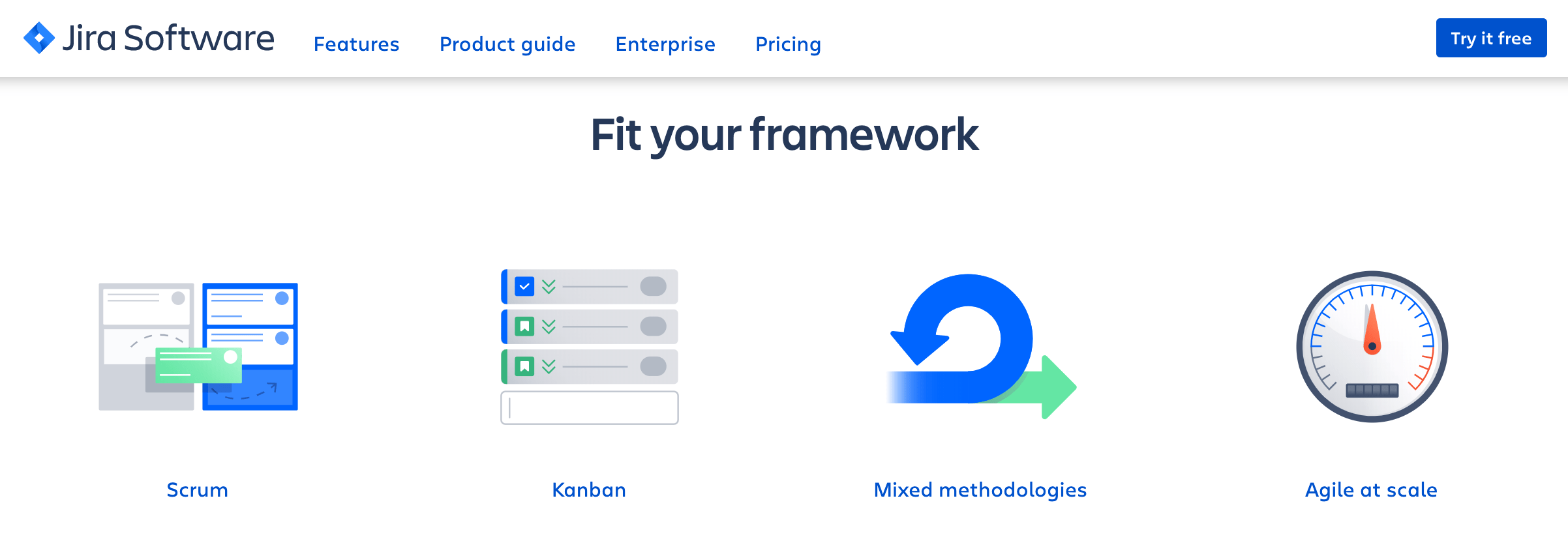
One of the reasons why we like Jira so much is its ability to fit any agile framework. This agile project management tool supports scrum, kanban, mixed methodologies, and agile at scale.

For those of you who use scrum, you’ll benefit from tools for sprint planning like story points, version management, backlog grooming, and a scrum board. Jira makes it easy to track your sprints with sprint permissions, custom issue types, workflows, and a release hub.

Jira Software also has tools to help prepare your team for daily scrums or stand ups. This makes these quick meetings more efficient for everyone.

Teams that prefer kanban will enjoy flexible workflows, swimlanes and columns, story cards, WIP limit configuration, and full visibility to everything on your kanban boards.

Whether you’re using scrum, kanban, or a mixed methodology (like scrumban or kanplan), Jira gives you insightful reports to help project managers and teams make data-driven decisions related to the project.

There is a bit of a learning curve for Jira Software. If you’re new to agile project management, this isn’t a tool that you’ll master in your first hour of use.

Pricing for Jira starts at $10 per month for up to 10 users. Plans for teams of 11+ start at $7 per month per user. Rates adjust based on your team size; the per-user prices decrease as more users get added to your plan. Whether you have a team of five or 5,000, Jira can accommodate your needs.

You can try Jira Software free forever with up to 10 users.

For those of you who want to deploy Jira on your own servers, there’s a self-managed option as well.

#2 – SprintGround— Best Agile Project Management Tool For Developers

• Free for up to 3 users
• Supports scrum and kanban
• Bug tracking
• 30 day free trial
• Get started for free

SprintGround is a popular project management tool for development teams. The software supports scrum and kanban, as well as a linear project management approach, known as the waterfall model.

With that said, the majority of you will likely lean towards the scrum and kanban methods, since the waterfall methodology isn’t agile.

Some of the top features of SprintGround include:

  • Real-time team collaboration
  • Development progress tracking
  • Task management
  • Bug tracking
  • Time tracking

SprintGround also makes it easy for your entire team to organize ideas, ask questions, make suggestions, and give feedback. It’s easy to track changes and view a quick summary of what happened since your last log-in.

The tool allows you to accurately plan releases and even has the ability for product owners to follow the development process.

Add files, share designs, upload mockups, and collaborate directly within the SprintGround platform. This agile project management tool makes it easy for you to determine how much time is left in the project and determine if you’re on schedule in real-time.

Overall, SprintGround helps improve team productivity. You’ll also benefit from critical decision support for short-term and long-term planning.

As a project manager for a software development project, SprintGround will give you a clear project overview for who is working on what. You’ll be able to monitor every task and decrease your incident response time.

SprintGround has a free forever plan for up to three users and two projects. Paid plans start at €24 per month for up to 8 users and €59 per month for up to 20 users. For teams of 21 or more, SprintGround costs €5 per month per user.

If your development team uses kanban, but you’ve outgrown Trello, SprintGround will be a top choice for you to consider.

The only downside is that the file storage is limited for all plans. Additional storage can be purchased for €1 per GB per month.

Try any SprintGround paid plan free for 30 days.

#3 – Pivotal Tracker — Best Agile Management Tool For Integrations

• Free for up to 3 users
• Paid plans start at $12.50
• 140+ integrations
• 30 day free trial
• Get started for free

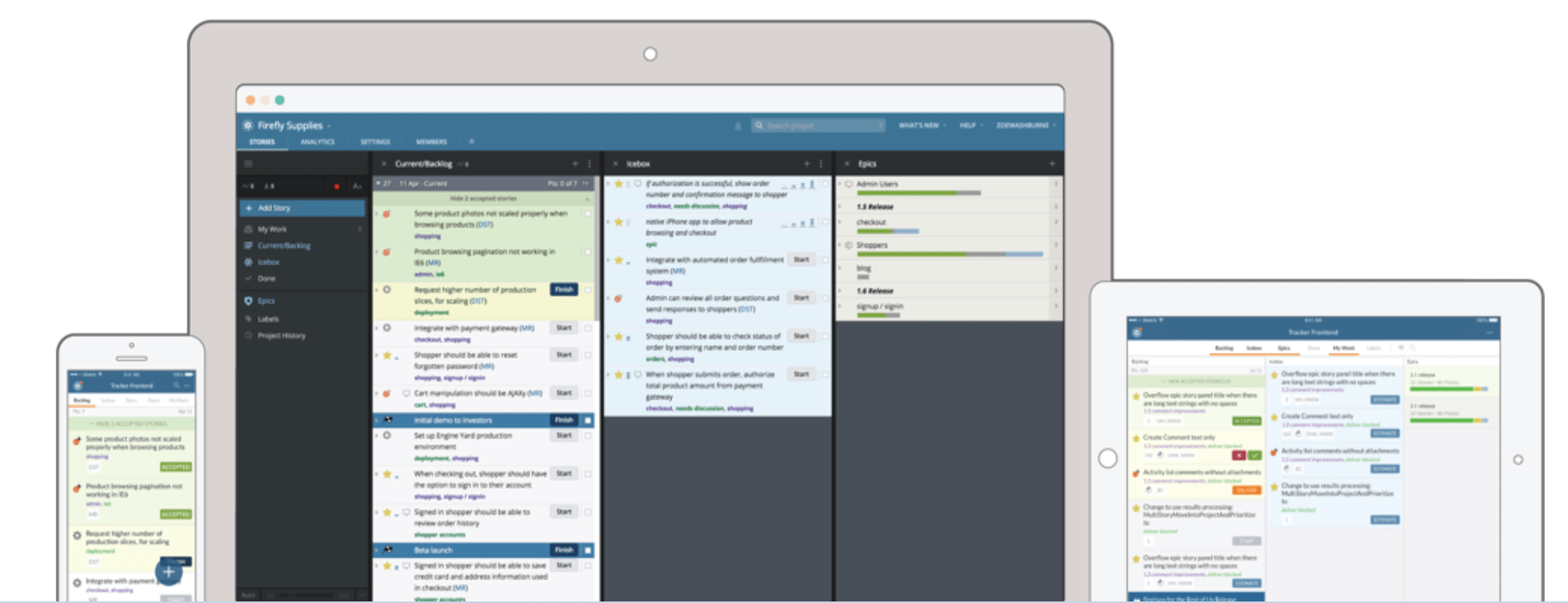
Pivotal Tracker is another agile project management solution designed for teams who build software. It has specific features for guided iteration, which allows you to break down your projects into manageable tasks and subprojects.

This tool gives you a clear overview of real-time work status for everyone on the team.

I’d recommend Pivotal Tracker to teams working on multiple projects simultaneously. It’s a great option for users on multiple teams as well.

Pivotal Tracker supports file sharing and a powerful search syntax to find what you need within complex projects. You can add labels to projects to make your workflow more visible.

The tool has a detailed breadcrumb trail of the project history so you can see how code changes were mapped out from day one to the final solution.

There is one area where Pivotal Tracker really stands out compared to other tools on the market today—integrations.

The platform seamlessly integrates with third-party apps like Slack, Zendesk, Zapier, GitHub, and more. You can browse the Pivotal Tracker Integrations Gallery to view more than 140+ apps to extend your agile project management functionality.

They have integrations for every category you can imagine. From analytics to issue tracking, roadmapping, API, customer support, testing, and more, Pivotal Tracker has it all.

The drawback of this tool is the fact that it relies on these third-party apps for full functionality. It’s not as feature-rich and robust out of the box, like other agile tools on our list.

Here’s a quick overview of the pricing for Pivotal Tracker:

  • Free — 3 collaborators and 2 projects
  • $12.50 per month — 5 collaborators and 5 projects
  • $29.17 per month — 10 collaborators and 10 projects
  • $62.50 per month — 15 collaborators and unlimited projects
  • $125 per month — 25 collaborators and unlimited projects
  • $250 per month — 50 collaborators and unlimited projects

All rates are based on an annual contract. For teams of 50 or more, you’ll need to contact Pivotal Tracker’s sales team for enterprise pricing.

Try any Pivotal Tracker plan free for 30 days. The trial comes with unlimited collaborators, unlimited projects, and unlimited storage.

#4 – CollabNet VersionOne — Best For Scalability

• Trusted by 50,000+ teams
• 70+ integrations
• Supports scrum, kanban, and SAFe
• 30 day free trial
• Start your free trial

CollabNet VersionOne is an enterprise-grade agile project management tool built for scaling teams across every department. It’s trusted by 50,000+ teams, making it one of the most popular agile project management solutions on the market today.

For those of you starting from scratch with agile and lean software development, VersionOne will be a top option for you to consider. It’s easy to scale your teams, project workplaces, portfolios, and locations throughout your entire organization.

VersionOne makes it easy for large organizations to collaborate and work together in real-time.

The VersionOne tool supports scrum, kanban, XP, SAFe, and hybrid development.

It integrates with other tools that you’re using, like Salesforce, Microsoft TFS, HP, GIT, Jira, CA Agile, and more. Overall, there are 70+ integrations for this project management tool.

VersionOne is an all-in-one agile ALM (application lifecycle management) platform. It comes with key features for things like:

  • Team collaboration
  • Portfolio and team kanban
  • Agile portfolio planning
  • Release and iteration tracking
  • Customer idea management
  • Executive dashboards
  • Test case management
  • Product roadmapping
  • Defect tracking
  • Agile metrics and analytics
  • Budget and allocation management

For smaller teams, the features of VersionOne will be a bit overwhelming. The price likely won’t be worth it for you either.

Like most enterprise solutions, pricing for VersionOne is not available online. You can try it free for 30 days or request a demo.

#5 – Targetprocess — Best Agile Tool For Enterprise Security

• Cloud and on-premise
• Visual project management
• 24/7/365 support and monitoring
• Industry leading security
• Request a free trial

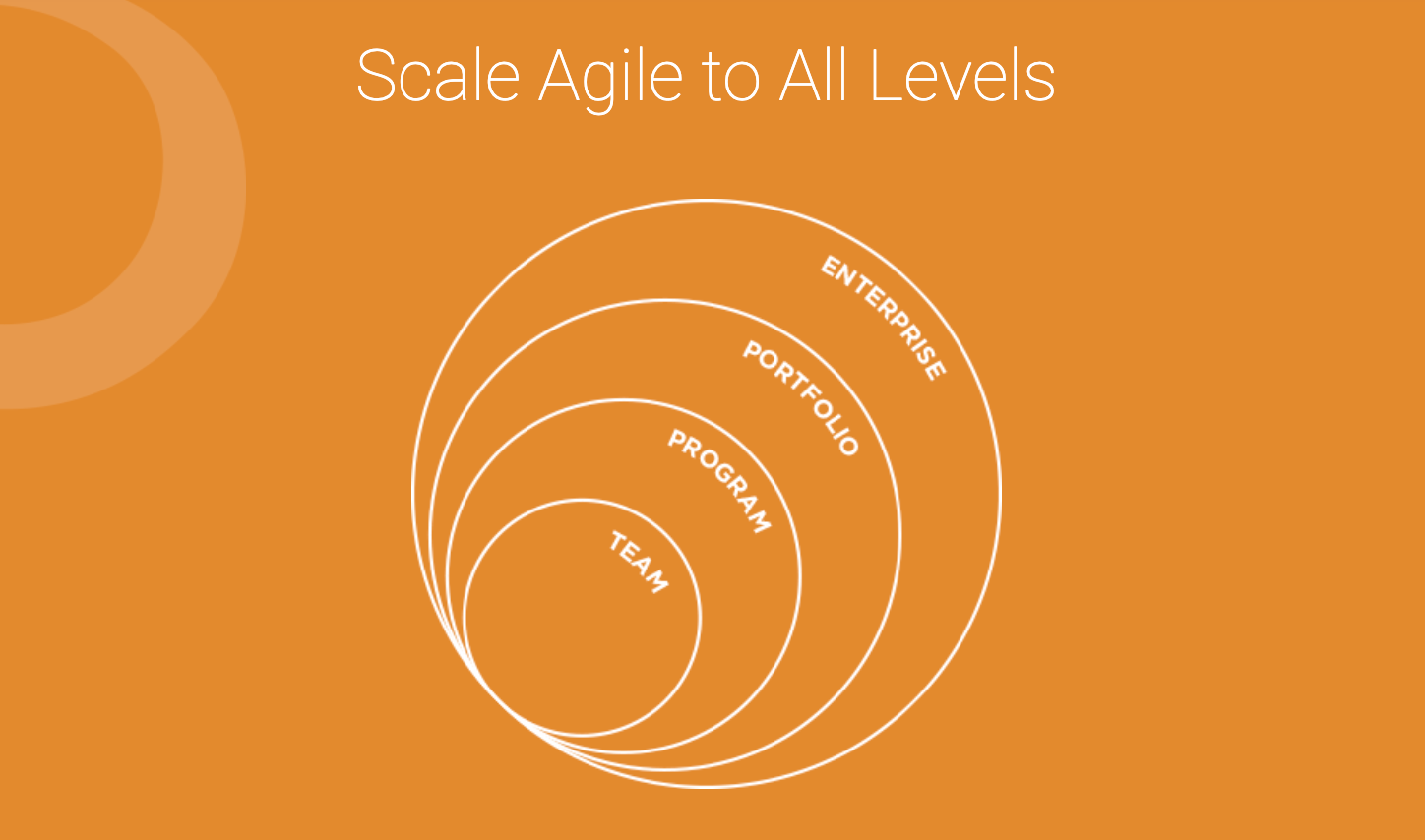
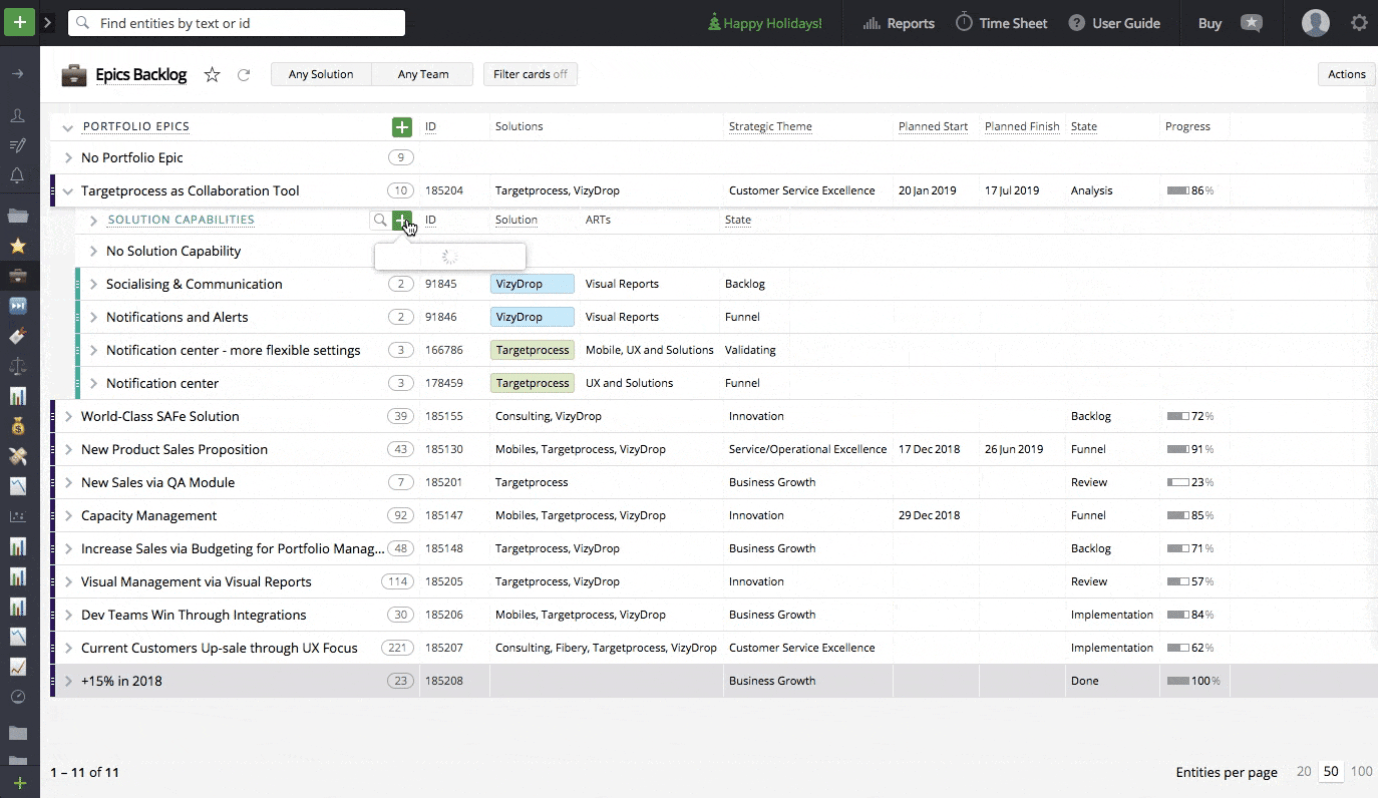
Similar to VersionOne, Targetprocess is another agile project management tool for enterprises. Targetprocess puts a stronger emphasis on visual portfolios and work management tools for agile organizations.

In fact, the tool is branded more as a visual platform than a project management solution.

With that said, it still has all of the tools and features you need for enterprise project management. Targetprocess supports kanban, portfolio dashboards, portfolio backlogs, roadmapping and milestones management, budgeting, process tracking, conflict resolution, workspaces, and workflow customization.

Overall, it’s a single source of truth for agile enterprises.

Targetprocess has an ideas intake solution for customers and stakeholders in projects. It has enterprise-grade security features as well.

While most organizations use Targetprocess as a cloud-based SaaS, on-premise hosting is available for enterprises that want a solution on their own servers.

The tool is compliant with GDPR and ISO27001. So if data privacy is a top priority for your organization, you can trust Targetprocess to take those needs seriously. They offer private cloud hosting packages for industries with strict regulations as well.

You’ll also benefit from one of the best customer support teams in the industry. Targetprocess has 24/7/365 monitoring and response.

The tool integrates with third-party apps like Salesforce, Zendesk, GitLab, Azure DevOps, and more.

Pricing for Targetprocess is not available online. Contact their sales team to request a live demo, free trial, or price quote.

#6 – ActiveCollab — Best Agile Tool For Time Tracking

• Starts at $7 per month
• Trusted by 50,000+ teams
• Built in time tracking
• 90 day free trial
• Get started for free

With so many agile project management tools on the market geared toward larger organizations and enterprises, it’s nice to see ActiveCollab accommodate the needs of smaller teams and small businesses.

For the last 10+ years, more than 50,000 teams have used ActiveCollab as a project management solution.

In addition to basic agile management tools, this platform puts a strong emphasis on time tracking software. It’s ideal for teams that charge by the hour for their work.

Starting at $7 per month per user, ActiveCollab is an affordable solution for any business or team. Save 15% with an annual contract.

Unfortunately, not every feature comes standard out of the box. To access the time tracking features, integrations, workload management tools, and more, you’ll need to pay an additional $4 per month per user. But it’s still relatively cheap compared to other options on the market.

You won’t have as much flexibility in terms of the agile methodology that you’re using either. The dashboards for task management are limited to just column views and timelines.

For a limited time, try ActiveCollab free for 90 days. This is significantly longer than the normal 14-day free trial period.

#7 – Monday.com — Best Simple Agile Project Management Tool

• Starts at $39 per month
• Trusted by 100,000+ teams
• Product launches and bug tracking
• 14 day free trial
• Get started for free

For teams looking for a simple agile project management solution, look no further than Monday.com. More than 100,00+ organizations across the globe trust this platform, including big names like GE, Adobe, Uber, Hulu, and Costco.

Teams with remote workers rely on Monday.com as a project management solution. It’s a centralized project management hub as well as team collaboration space.

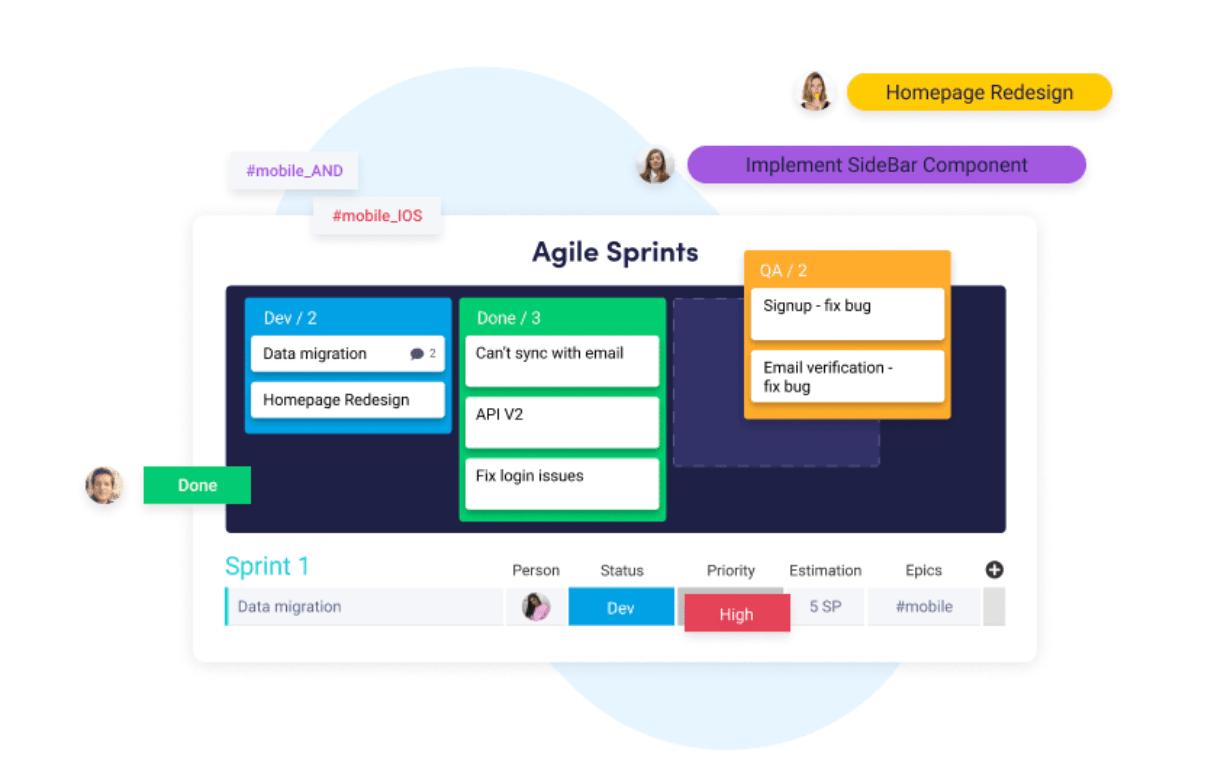
Monday.com is great for product launches, sprint planning, and bug tracking.

The solution is flexible enough to keep improving your project with real-time reporting, insights, and updates. But it’s easy enough for any of the non-technical users on your team.

If you’ve outgrown your basic project management software, you can upgrade to Monday.com and still benefit from a simple kanban view with other advanced features.

Pricing for Monday.com depends on the plan you select, the number of users on your team, and the length of your contract. Plans start at $39 for 5 users. Try it free for 14 days.

How to Find the Best Agile Project Management Tools For You

With so many agile project management tools to choose from, how can you determine which one is the best for your business?

This is the methodology that I used to pick the top options on the list above. I’ll explain what’s important about these factors in greater detail below. Generally speaking, there is no “best for everyone” solution. So you’ll have to weight these elements against your personal needs.

Agile Framework

Are you currently using an existing agile methodology to manage your team? Do you prefer one framework method over another? Not every agile project management tool supports each methodology.

For example, Jira Software supports scrum, kanban, and mixed methodologies. SprintGround supports scrum and kanban, while also offering support for the waterfall methodology (linear approach).

Some of the enterprise-grade solutions, like Targetprocess, have frameworks for LeSS (large scale scrum), DAD (disciplined agile delivery), scrum at scale, lean-agile, SAFe (scaled agile framework), and more.

Make sure you choose a tool that supports your preferred agile framework.

Team Size

Project managers overseeing five or six developers won’t need the same project management tool as an organization with hundreds or thousands of team members.

CollabNet VersionOne and Targetprocess are ideal for larger organizations and enterprises. Monday.com and ActiveCollab support smaller teams. Jira Software can accommodate teams of all shapes and sizes, up to 5,000 users.

Ease of Use

As I said before, agile project management tools are usually geared towards the tech industry. Web developers, app developers, and teams working on software releases use agile methodologies the most.

But with that said, some solutions are more technologically advanced than others.

You need to make sure that users on your team who aren’t technically inclined can still navigate through the platform. By requesting a demo and taking advantage of a free trial, you can test the ease of use before committing to a paid subscription.

Price

You don’t need to spend a fortune on an agile project management solution. We’ve seen rates starting as low as $7 per month.

When you’re pricing out a solution, just make sure to read the fine print. In some instances, lower rates require a minimum number of users or an annual contract.

For some enterprise solutions, you’ll have to request a custom quote for your team.

Conclusion

What’s the best agile project management tool on the market today? It depends on what you’re looking for.

Jira Software is our top overall recommendation, but it’s not for everyone.

For those of you who want as many different third-party integrations as possible, try Pivotal Tracker. Development teams should lean toward SprintGround. VersionOne and Targetprocess are better for larger organizations. Use ActiveCollab for the best built-in time tracking.

If simplicity is the most important feature to you, try Monday.com.

Regardless of what you’re looking for, you can find it on our list. I made sure to include something for everyone.


from Quick Sprout https://ift.tt/3c6YVPT
via IFTTT
The Best Water Delivery Services For Your Business

We all know it’s important to drink enough water. Dehydration can lead to headaches, lack of focus, and a loss of productivity. Not everyone likes the taste of tap water, so many businesses have high-quality water delivered.

If you’re looking to get fresh water delivered to your workplace on a regular basis, here’s a guide to help you choose the right water delivery service for your needs.

Compare Quotes From The Best Water Delivery Services

Get matched up with a water delivery service that fits your specific needs.

>> Compare Quotes

The 8 Best Water Delivery Services

The office water cooler serves several functions. Of course, water coolers also keep us adequately hydrated so we can deliver the best work performance possible. But it’s also a social area for many businesses—a place where employees gather and discuss movies, sports, and their weekend plans.

Whether your company is big or small, you want a water delivery service that delivers a fresh product that tastes good without costing a fortune.

Here are eight water delivery services to consider for your business.

1. Sparkletts

• Single serve and bulk water
• Water dispenser units
• Multiple brands & products
• In business since 1925
• Compare Quotes

Sparkletts delivers a lot more than just water. They also deliver a variety of other beverages like coffee and tea, breakroom supplies, and accessories like water dispensers.

In business since 1925, Sparkletts serves businesses located mostly in the Southwest, including a number of them parks and attractions in California. Its other service regions include Austin, Dallas-Fort Worth, Houston, San Antonio, Las Vegas, Los Angeles, Bakersfield, Phoenix, Mesa, San Diego, Tucson, and Santa Barbara.

Sparkletts delivers its own branded water in three- or five-gallon jugs. It also rents water dispenser units, coffee machines, and other equipment. The standard officer water dispenser is around $6 per billing cycle to rent.

If you prefer more variety, you can also sign up for delivery of other bottled water brands, sparkling water, and a large variety of coffee and tea. Of course, you’ll need breakroom supplies to go with them, and Sparkletts can deliver those, too. It delivers plates, napkins, coffee filters, creamer, sugar packets, and other supplies.

2. Absopure

• Individual servings or jugs
• Superior quality & taste
• Water filtration systems
• Delivers throughout the Midwest
• Compare Quotes

Absopure got its start in Detroit as an ice delivery company all the way back in 1908. The company is still based in Michigan and now delivers water and other breakroom supplies to companies throughout the Midwest.

Businesses can buy Absopure bottled water in individual servings, or they can select spring water dispensed from jugs in one gallon, 2.5 gallons, or five gallons. Absopure also sells purified drinking water, steam distilled water, and electrolyte water.

Absopure will also deliver and stock coffee, tea, or sparkling water. It also allows companies to rent the equipment they need to dispense hot and cold water.

If you prefer to use tap water, you can also purchase a water filtration system from Absopure. The company will even install it, so you can rest easy knowing it’s hooked up properly.

3. ReadyRefresh

• Jugs & bottled water options
• Multiple brands of water
• Variety of other products
• Several delivery options
• Compare Quotes

ReadyRefresh delivers a variety of products, including water, tea, sparkling water, Starbucks coffee, and supplies like water dispensers. ReadyRefresh customers can pick water from spring sources or municipal water systems. For example, the company sells Nestle Pure Life water, which is sourced from municipal systems and then put through a 12-step purification process.

The brands ReadyRefresh offers include Acqua Panna, Arrowhead, Deer Park, Ice Mountain, Nestle Pure Life, Ozarka, Perrier, Poland Spring, S.Pellegrino, and Zephyrhills.

If you choose jugs of water, you can pick from three- and five-gallon recycled jugs. When you’re done with them, ReadyRefresh will collect them and then sanitize them before reusing them.

ReadyRefresh also offers several different delivery options depending on your needs. You can get a one-time order or set up automatic delivery every week, every other week, once a month, or once a quarter.

4. FIJI

• Bottled at the source
• Great taste
• Single serve bottles
• 3, 6 and 12 month subscriptions
• Compare Quotes

You’ve probably seen individual FIJI bottles in gas stations and grocery stores, but the company also offers a subscription service for its popular artesian water.

However, FIJI is a little different from other water delivery services. Unlike most other water delivery companies, it doesn’t deliver water in gallon size jugs. Instead, its water is only available in single serve bottles. You can choose a bottle size ranging from 300 ML all the way up to 1.5 liters. It also offers bottles with a sports cap in its 700 ML size.

If you love the taste of true artesian water, though, FIJI might be worth considering. The water is bottled at the source in Fiji, where it filters to an aquifer after passing over volcanic rock.

FIJI offers its pre-paid subscription service in three-month, six-month and 12-month terms. You can cancel at any time, but you won’t receive a refund if you cancel in the middle of a pre-paid term.

5. Costco

• 3 & 5 gallon options
• Spring water or purified water
• One-year contract
• Discounts for gold star members
• Compare Quotes

Costco Water Delivery Services partners with local affiliates to deliver three- and five-gallon jugs of water to businesses around the country. Businesses can choose from spring water or purified water. You can also add on a water dispenser if you need it.

One potential downside is that you have to sign a one-year contract. For most businesses, however, this can be a benefit, since you only need to worry about bothering with the contract once a year.

The spring water is priced at around $7.50 per bottle while the purified water is cheaper at about $6.50 per bottle. If you need to add a bottom load water dispenser, the cost is about $3 per four-week billing cycle for Costco executive members and $5 per four-week billing period for Costco gold star members.

6. Diamond Springs

• 100% natural spring water
• Delivery every two or four weeks
• Offers other snacks & supplies
• Serves Virginia, North Carolina, & South Carolina
• Compare Quotes

Diamond Springs delivers 100 percent natural spring water, as well as coffee, breakroom supplies, and snacks. Its service area covers Virginia, North Carolina, and South Carolina.

Water is available in three- and five-gallon jugs, and you can add a water dispenser if you need one. There’s also an option to buy a water dispenser if you want it for the long haul and want to save on rental fees.

Diamond Springs offers delivery every two or four weeks, and they say they can accommodate additional requests within 24 hours if you need extras.

The company also offers a large variety of snack delivery, but this service is only available in Virginia. For smaller companies, you can order snacks by the case. Product options include potato chips, crackers, granola bars, candy, and microwavable cups of soup.

If you have a larger company, such as an office with 50 or more people, Diamond Springs can install a vending machine that dispenses snacks and cold beverages.

7. Culligan

• Large variety of delivery services
• Rent or buy equipment
• Bottle-free water systems
• Local Culligan representatives
• Compare Quotes

Culligan is one of the most recognizable brands in the water delivery service industry, probably due to its commercials that air nationwide.

The company offers a large variety of water delivery services in a range of bottle sizes and dispensing systems, with its bottled water delivery service starting at $9.95 per month. Businesses can choose to rent or buy water dispensing equipment, and you can even have Culligan install a reverse osmosis system.

If your business is environmentally friendly, you can choose from a bottle-free water dispensing system. With these units, there is no plastic bottle, which cuts down on waste.

One downside is that Culligan doesn’t let you choose a specific brand of water. When you purchase their jugs of water, it comes from Culligan’s filtered system. If you prefer a certain brand, it’s a good idea to taste Culligan’s water before you sign up.

Culligan’s sign up process is a bit different compared to other water delivery services. When you contact them, they will pair you with a local Culligan representative. This rep will come to your business and assess your area’s water quality to help you find the best Culligan system for your needs. While some people like this personal touch, others just want to order water online without taking time out of their schedule to meet with a company representation.

8. Mountain Glacier

• 3 or 5 gallon jugs
• Bottled water by the case
• Buy 5 cases get 1 free
• Serves Tennessee, Texas, & Indiana
• Compare Quotes

Mountain Glacier is a smaller water delivery service, but it offers flexible delivery options. The company services businesses in Tennessee, Texas, and Indiana. Companies can choose from three-gallon or five-gallon jugs, as well as water dispensers. Companies can also purchase cases of water, and Mountain Glacier offers a free case when you buy five cases.

Mountain Glacier delivers water once a month, but the company says it will arrange for more frequent delivery if a customer requires it. The company uses all recycled water jugs, making it more environmentally friendly than some other water delivery providers.

How to Choose the Best Water Delivery Service for You

There are a lot of factors to consider when it comes to choosing a water delivery service for your business. Here are six things to keep in mind before you sign on with a company.

Compare Quotes From The Best Water Delivery Services

Get matched up with a water delivery service that fits your specific needs.

>> Compare Quotes

1. Cost

Obviously, cost is going to be a major consideration. Some water delivery companies offer discounts if you sign up for automatic billing or put your contract on auto-renew terms.

You should also consider the company’s billing practices. Is your business prepared to sign a one-year contract for water? Or do you prefer taking things a little more conservatively and sticking to a monthly billing cycle? Make sure you understand the contract’s cancellation terms so you don’t get stuck paying for water long after you decide to end the service.

2. Equipment

Most companies need a way to dispense the water they purchase. Ask what kind of equipment and amenities the water delivery service offers. Many companies include coffee and tea delivery in their offerings, so you can take care of restocking your breakroom all at once.

If you need a water dispenser, look for a company that offers rentals and maintenance. This is the most hassle-free way to get water in your office. If the dispenser breaks or malfunctions, you can simply call up the company and get it serviced or replaced.

3. Water and Product Selection

While some people are happy with tap water, others prefer spring water or other beverages. If selection is important to you, look for a water delivery service that gives you a wide menu of options. For example, some companies source from natural springs, and companies like FIJI even offer water from remote parts of the world with their own aquifers.

You can also opt for jugs of water or a water filtration system the company installs. Keep in mind, however, that some employees won’t drink tap water, even if it has a filter attached. If you think your workers are more likely to drink from a water cooler, it’s probably best to stick with delivered water.

Also keep in mind that some water delivery services also offer coffee, tea, breakroom supplies, and snacks. If you want to bundle these services, it can be easier and less time-consuming to go with a water delivery service that can handle everything.

4. Bottle Sizes

The most common sizes you’ll see for water delivery are three-gallon and five-gallon jugs. Depending on the size of your company, these can last a month or longer.

However, some water delivery services offer a larger variety of sizes. Additionally, you can choose a service that delivers individual servings of water and other beverages.

Keep in mind, however, that individual bottles use a lot of plastic, and they can generate a great deal of waste in your office trash cans. If you don’t want plastic bottles piling up, you’re probably better off choosing the larger jugs.

5. Delivery Options

When you search for a water delivery service, ask about the frequency of the delivery options. While some companies can get by with water delivery once a quarter or every other month, some businesses will need water delivered once a month or maybe even weekly.

Delivery frequency can affect the price of the service, especially if your business needs a more frequent delivery schedule.

6. Subscription Options

Subscription options are usually closely tied to delivery options, as the price you’ll pay is often dictated by how often you need water delivered. On the other hand, you can often save money by signing up for a longer contract or bundling water delivery services with other things like breakroom supplies or coffee and tea delivery.

It’s definitely worth speaking with a company representative to see if you can negotiate a lower price. This is especially true if you have a large company that needs regular water delivery at multiple locations.

Ask a water delivery service if it will tailor a contract to fit your company’s needs. Many service providers are willing to make adjustments if it means securing business from a large company looking to purchase a large volume of products.

Conclusion

Keeping your employees hydrated can make them happier and more productive. A water delivery service is a good choice if you want to ensure a steady supply of great-tasting water for your workforce and your customers. Before you pick a supplier, make sure you review their offerings, contract terms, and delivery options.

Compare Quotes From The Best Water Delivery Services

Get matched up with a water delivery service that fits your specific needs.

>> Compare Quotes


from Quick Sprout https://ift.tt/33SBfMJ
via IFTTT
Best CRM Software

A good customer relationship management (CRM) software can take your business to the next level.

That’s because it focuses on the one thing that makes a great business: the customer.

Finding the right CRM platform for your business can be difficult if you don’t know what to look for. That’s what inspired me to create this guide.

What is CRM ?

CRM stands for “customer relationship management.” It’s a system that lets you manage all your organization’s interactions with your customers.

Typically, CRM refers to specific software that accomplishes this for you. A good CRM software improves sales log communication, lead management, and even helps with marketing campaigns.

At the end of the day, though, it’s there to improve your relationship with your customers. Doing so can help retain the ones you have while drawing new customers in.

Why you need CRM

Your customers are the most crucial lever for success. Plain and simple. CRM software gives everybody in your company an opportunity to improve the relationship with your customer through tools such as:

  • Sales reporting
  • Customer information
  • Segmentation
  • Lead reporting
  • Marketing analysis
  • Customer service

Historically, CRM software was only used by large businesses and enterprises. But today, CRM has evolved to fit the needs of all organizations, regardless of size or industry.

That means that you should invest in a CRM software—even if your company is small.

The 7 Best CRM Software Solutions of 2020

After researching and testing dozens of different CRM software, I’ve determined that these are the top seven options on the market today:

We’ll take a closer look at the features, benefits, and pricing of each software in the reviews below. Use this guide to help you find the best CRM software for your business.

Best CRM Software Reviews

HubSpot

• 100% Free CRM software
• Contact & task management
• Email tracking & scheduling
• Document sharing & live chat
• Get it for Free

HubSpot is another well-recognized name in the business world. Their blog is one of the best resources for content related to sales, marketing, and services.

HubSpot is unique because they offer free CRM software. They also have CRM for multiple roles within an organization, like:

  • CRM for sales leaders
  • CRM for salespeople
  • CRM for business owners
  • CRM for operations managers
  • CRM for customer service representatives
  • CRM for marketers

Some CRM providers offer a free trial or free plan with basic features. But HubSpot’s goes above and beyond what you’d normally get for free.

These are some of the top features for the free sales CRM:

  • Contact management
  • Deal management
  • Task management
  • Email tracking and notifications
  • Email templates and scheduling
  • Document sharing
  • Meeting scheduling
  • Email integration (Gmail and Outlook)
  • Live chat

As for the paid software, prices vary based on the type of CRM you’re looking for and the number of contacts you have.

The Marketing CRM, Sales CRM, and Service CRM all have plans starting at $50 per month. Enterprise plans for Service and Sales start at $1,200 per month, and the Marketing Enterprise begins at $3,200 per month.

For those of you who want CRM solutions for multiple departments and uses, you can buy a bundle from HubSpot as well. Growth Suites (include Sales, Marketing, Service) starts at $112.50 per month.

You can also create your own bundle based on the specific tools that you’re looking for.

Zoho CRM

• Plans start at $18/month
• Convert more leads
• Engage with customers
• Custom reporting dashboards
• Try it for Free

Zoho is a global leader in business SaaS. More than 50 million users across the world use their solutions. In fact, Zoho Books made our list of the best business accounting software, and Zoho Inventory is on our list of the best inventory management software.

Above all, Zoho CRM is arguably one of the best solution offered by this provider. It’s used by 150,000+ businesses in 180+ countries.

You can use Zoho CRM to convert leads, engage with customers, and grow your company’s revenue.

Big brands like Bose, Netflix, Amazon, Ducati, and Suzuki all use Zoho CRM for customer relationship management.

Here’s a brief overview of the plans and pricing for Zoho CRM:

Standard — $18 per user per month

  • Scoring rules
  • Email insights
  • Workflow conversion
  • Web forms
  • Unique and custom fields
  • Custom reporting and customized dashboards
  • Groups and tagging
  • 100,000 records

Professional — $30 per user per month

  • Real-time notifications
  • Process management
  • Email integration across multiple devices
  • Web-to-case forms
  • Inventory management
  • Google Ads integration
  • Validation rules
  • 2.5 million records

Enterprise — $45 per user per month

  • On-demand sales analytics
  • Pipeline view for emails
  • Customize your visual CRM record display
  • Built-in analytics
  • Multi-user portals
  • Custom buttons and modules
  • Mobile SDK and app
  • Territory management
  • 5 million records

All of the prices are for month-to-month plans. You can save 20% with an annual contract.

Zoho offers an Ultimate plan that’s only available yearly. It has features like advanced customization, enhanced storage, email sentiment, and automation suggestions. But you’ll need to contact the Zoho sales team for a custom quote.

Additionally, there’s a free version of Zoho CRM—although it’s extremely limited and only realistic for a small home-based business.

Salesforce

• Plans start at $25/month
• Productivity tools
• Advisory services
• Detailed analytics
• Compare Quotes

With more than 150,000 businesses using Salesforce CRM, this is another one of the most popular customer relationship management solutions on the market today.

Salesforce has an extensive suite of CRM products for you to choose from. They offer solutions based on business type, role, need, and industry. Examples include:

  • Small business
  • Service
  • Sales
  • Sales and service
  • Marketing
  • Commerce

Salesforce offers advisory services, success plans, productivity tools, integrations, and detailed analytics. It’s one of the most extensive CRM product offerings that you’ll find on the market today.

For the purpose of this review, I’m going to focus on the Sales CRM from Salesforce. In my opinion, this is the best one that they offer. Here’s an overview of the Sales plans:

Essentials — $25 per user per month

  • All-in-one sales and support
  • Account management
  • Lead management
  • Contact management
  • Opportunity management
  • Email integration
  • Salesforce mobile app

Professional — $75 per user per month

  • All Essentials features
  • Best for teams of all sizes
  • Lead registration
  • Lead scoring
  • Collaborative forecasting

Enterprise — $150 per user per month

  • Customizable CRM
  • All Professional features
  • Workflow automation
  • Approval automation

Unlimited — $300 per user per month

  • Best power and support of all plans
  • For large businesses
  • All Enterprise features
  • 24/7 support and configuration services

Even the Essentials and Professional plans will be more than enough for most businesses. You can try Salesforce for free with a 30-day trial.

Freshsales

• Plans start at $19/month
• Visual sales pipeline
• Lead and deal management
• SMS integration
• Compare Quotes

As the name implies, Freshsales is a CRM software that’s designed for sales teams.

It’s not quite as popular as some of the other solutions on our list. But Freshsales CRM is still used by more than 15,000 businesses. A couple of recognizable brands include Best Western and Dyson.

Freshsales will help your team find and manage the best sales leads. You’ll be able to have relevant conversations with prospects and improve your sales pipeline.

Let’s take a closer look at the prices and top features associated with each Freshsales subscription plan:

Blossom — $19 per month per user ($12 with annual contract)

  • Lead, account, contact, and deal management
  • Visual sales pipeline
  • Lead scoring
  • SMS integration
  • Access to marketplace apps
  • API access

Garden — $35 per month per user ($25 with annual contract)

  • 1,000 free contacts
  • 250 bulk emails per user per day
  • 5 sales sequences per user
  • 10 teams
  • 10 workflow automations
  • Lead assignments and territories
  • Advanced reports

Estate — $65 per month per user ($49 with annual contract)

  • Advanced CRM customization
  • Auto profile enrichment (with social media information)
  • Reporting dashboard
  • Event tracking
  • Multi-currency support
  • Sales goals

Forest — $79 per month (billed annually)

  • EEA data center
  • IP whitelisting
  • Audit logs
  • Dedicated account manager

You can try out any of these plans for free with a 21-day trial. Freshsales also has a free forever startup plan with basic features.

I like Freshsales because it’s affordable and perfect for a growing sales team. You can easily upgrade to a higher tier as your company grows.

Insightly

• Plans start at $29/month
• Send, track, & manage emails
• Workflow automation
• Customize dashboards
• Compare Quotes

More than 25,000 companies use Insightly for CRM software. This includes big names like Bosch, AT&T, and Bloomberg.

Insightly is a bit unique compared to some of the other options we’ve reviewed so far. In addition to sales and marketing, Insightly CRM puts a strong focus on project management. You’ll get all of these feature sets in a single solution.

Some of the benefits of Insightly CRM include:

  • Dataset management
  • Create and deploy custom apps
  • Customize dashboards for metric tracking
  • Lead routing
  • Workflow automation
  • Send, track, and manage emails
  • Relationship linking

Insightly has an exceptional mobile app that allows you to work from anywhere. You can scan business cards, update your tasks in real-time, and create new opportunities on-site at a client’s location.

Popular tools like G Suite, Gmail, QuickBooks, Google Drive, Mail Chimp, Slack, and Dropbox all integrate with Insightly.

All Insightly CRM plans are billed on an annual basis. Here’s a look at those rates:

  • Plus — $29 per user per month
  • Professional — $49 per user per month
  • Enterprise —  $99 per user per month

You can request a demo and try it out for free. Insightly has a free forever plan with basic features for two users.

Apptivo

• Plans start at $0/month
• Premium plans start at $10/mo
• Integrates with other tools
• Multiple apps in one
• Compare Quotes

Apptivo is another top choice for CRM software. It’s used by 200,000+ organizations in roughly 200 countries. The Apptivo CRM is unique because it combines multiple apps into a single solution.

In addition to CRM, Apptivo also offers:

  • Online invoicing
  • Web help desk
  • Project management
  • Expense reports
  • Field service tools
  • Email marketing
  • Procurement for supply chain management

So for those of you who are in the market for these additional services, you can manage everything in the same place with Apptivo CRM. This is much simpler than juggling multiple apps for different uses.

The CRM apps for Apptivo fall into the following categories:

  • Contracts
  • Sales planning
  • Territory management
  • Competitors
  • Work orders
  • Customers
  • Contacts
  • Opportunities
  • Cases
  • Leads

Apptivo integrates tools like Slack, Office 365, G Suite, and more.

Here’s a brief overview of the plans and prices for Apptivo CRM:

Starter — $0

  • Up to 3 users
  • 500 MB
  • Basic contact sharing
  • Standard reports
  • Standard support

Premium — $10 per month per user ($8 with annual contract)

  • 3 GB per user
  • 1,000 mass emails per user
  • 2,000 API calls
  • Standard support

Ultimate — $25 per month ($20 with annual contract)

  • 10 GB per user
  • 3,000 emails per user
  • 20,000 API calls
  • Priority support

Enterprise — Custom pricing

  • 5,000 emails per user
  • White labeling
  • Custom integrations
  • SLA support and dedicated account manager

You can save 20% if you sign up for yearly billing instead of month-to-month.

Apptivo is commonly used for businesses in real estate, travel and hospitality, retail, wholesale, manufacturing, utilities, and energy industries.

Pipedrive

• Plans start at $17/month
• Lead & deal management
• Communication tracking
• Deep insights and reports
• Compare Quotes

Pipedrive CRM is designed to simplify your sales process.

More than 90,000 businesses use Pipedrive CRM. It’s a straightforward platform that’s easy for anyone to figure out.

This CRM was created to generate more leads and sort your sales in a single location. It helps eliminate administrative tasks that are unproductive. It’s designed to drive more sales with less legwork on your end.

Some of the top features and benefits of Pipedrive CRM include:

  • Lead management
  • Deal management
  • Communication tracking
  • Automation
  • Deep insights and reports
  • Privacy and security for business data
  • Mobile app access
  • 150+ third-party integrations

More than $24 billion in sales have been closed using Pipedrive. On average, businesses increase their close rate by 28% after the first year using this CRM.

These are the plans and prices for Pipedrive CRM:

Essential — $17 per month per user ($12.50 with annual contract)

  • Custom pipelines
  • Custom fields
  • AI sales assistance
  • User and company goal setting
  • Custom dashboard

Advanced — $31 per month per user ($24.90 with annual contract)

  • Sales task automation
  • Email integration
  • Email templates and email automation
  • Products catalog

Professional — $59 per month per user ($49.50 with annual contract)

  • Call tracking
  • Click-to-call
  • Unlimited meeting scheduling
  • Batch emails
  • Team management
  • Multi-dashboard support
  • Revenue forecasts
  • Custom user and admin permissions

Essential — $99 per month per user (billed annually)

  • Minimum 10 users
  • Dedicated account manager
  • Phone support
  • Data import
  • Enhanced security
  • Additional user permissions for full control

Pipedrive also has a “Leadbooster” add-on for $39 per month ($32.50 with annual contract). This tool is billed per company, not per user. It’s designed to turn more web visitors into leads. Leadbooster is basically a chatbot. It engages with customers with instant responses and makes it easy for them to schedule a meeting.

Try Pipedrive CRM free with a 14-day trial.

How to Choose the CRM Software For Your Business

CRM software can be a complicated subject. With so many options to choose from, finding the best solution for your business might be overwhelming.

This is the methodology that we recommend here at Quick Sprout to help narrow your search. I’ll explain each element in greater detail so you can make a decision based on your needs.

Compare Quotes From The Best CRM Software

Get matched up with the CRM software that fits your specific needs.

>> Compare Quotes

Team Size

The size of your business and team will have a significant impact on the CRM you choose. Some solutions are better for small businesses, while other options specialize in enterprise software.

You can even find CRM tools for small teams of just one or two people.

Capabilities

Customer relationship management software is so diverse. It’s such a broad term, and it’s used across multiple departments and for various reasons.

Common CRM categories include:

  • Sales
  • Marketing
  • Project management

There are even other solutions for things like customer service. Some companies offer all CRM capabilities into a single platform. Others specialize in one category over another.

There are CRM solutions offered as an all-in-one solution. But other times, you’ll have to buy the software separately or bundle it into a single package.

Integrations

You should look for CRM software that integrates with popular tools that you’re already using. This will allow you and your team to manage everything from a single dashboard.

If you constantly have to bounce back and forth between multiple platforms to manage your leads and customers, it defeats the purpose of using CRM to streamline your process.

Price

As always, price will be a significant factor in which CRM you choose.

In most cases, pricing is based on the number of users you have. Depending on the platform, pricing can also be based on the number of contacts or storage you’ll need as well.

Make sure to find something in your price range. The pricing for CRM software ranges from $0 to $300+ per user.

Conclusion

What’s the best CRM software? The answer varies depending on your business type and what you’re looking for. Here’s a quick recap of the top seven options on our list:

From startups to enterprises, and sales to marketing and project management, I’m confident that you can find the best CRM software for your company on this list.

Compare Quotes From The Best CRM Software

Get matched up with the CRM software that fits your specific needs.

>> Compare Quotes


from Quick Sprout https://ift.tt/33Qe0Tn
via IFTTT